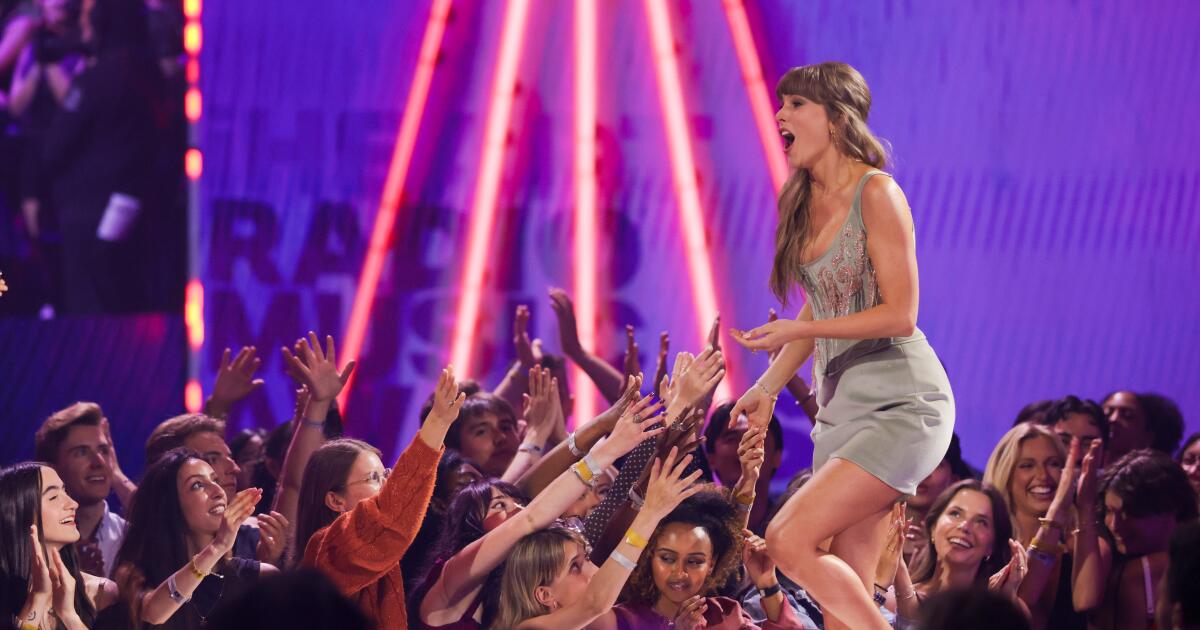
Taylor Swift is entering her trademark era.
Taylor Swift’s company recently filed for trademarks on three new items. Two are recordings of her saying, “Hey, it’s Taylor Swift” and “Hey, it’s Taylor.” The third is a famous image of the singer from her recent Eras tour – she’s pictured onstage, playing her pink guitar and wearing a sparkly outfit.
This effort to control her public image happens as more famous celebrities are asking for rules against AI-created content made without permission. Matthew McConaughey was among the first to use trademark laws to add extra security for himself.
I was surprised to learn that Matthew McConaughey trademarked a bunch of stuff recently! Apparently, back in January, he filed for eight trademarks covering things like pictures of himself – even just smiling! – and, get this, he even trademarked his famous “Alright, alright, alright” line from “Dazed and Confused.” It’s cool to see him protecting his image like that.
In a recent interview with the Wall Street Journal, the actor explained that they want complete control over how their voice and image are used, ensuring they always approve it beforehand. They and their team are working to establish clear rules about ownership and proper credit in the age of artificial intelligence, making consent and attribution standard practice.

Entertainment & Arts
Taylor Swift is facing a lawsuit claiming trademark infringement related to the phrase ‘Life of a Showgirl.’ She responded by releasing a previously unseen music video for her song ‘Elizabeth Taylor.’
Taylor Swift’s team recently filed trademarks to protect her voice, a new legal strategy aimed at preventing the unauthorized use of her voice by artificial intelligence. While her representatives haven’t commented on the specific reason, legal expert Josh Gerben notes this highlights a growing weakness in current intellectual property laws that AI could take advantage of. This approach, protecting a voice itself, hasn’t been proven in court yet.
Before artificial intelligence became widespread, musicians like Taylor Swift depended on copyright laws to stop people from illegally copying or sharing their music. They also used right to publicity laws to prevent anyone from using their image or voice for commercial purposes without permission. However, AI now allows users to alter voices and images, making it possible to create convincing fake performances where someone appears to sing or say almost anything.
As a huge McConaughey fan, I was reading about how he’s actually trademarked the unique quality of his voice – the way he delivers lines. Apparently, legal expert Gerben says that means if an AI creates a voice that sounds a lot like his, it could be seen as a legal problem – a violation of that trademark. It’s a pretty wild thought, honestly!
According to Gerben, securing trademark protection for their voice prevents AI platforms from creating new content using it. While every celebrity might eventually need to do this, the goal is to stop the unauthorized use of voices at the very beginning.
Variety first reported news of Swift’s trademark filing.

Hollywood Inc.
Last year, the U.S. music industry reached a record $11.5 billion in revenue. This growth was largely thanks to increased vinyl sales and the huge success of Taylor Swift’s newest album.
Taylor Swift, a hugely popular artist, has faced issues with AI being used to create content without her permission. She was previously featured as a virtual celebrity in Meta’s AI chatbot program, alongside other female celebrities, and these chatbots were reportedly used to generate inappropriate images. More recently, ahead of the 2024 election, Donald Trump shared fake AI-generated images of Swift appearing to support him – including one showing her dressed as Uncle Sam with a message encouraging people to vote for him.
As someone who follows these things closely, it’s clear to me that Taylor Swift’s team isn’t just filing these trademarks to cover their bases. Luke Arrigoni, from the tech company Loti AI – they specialize in protecting people’s likeness – explained it to me as building a whole system to safeguard her image for the future. It’s not a quick fix, it’s a long-term strategy.
According to Arrigoni, Taylor Swift is securing her trademarks to control how AI might replicate her voice in the future. If a company wants to use an AI voice that sounds like hers – say, in 2027 – they’ll need her permission or risk legal trouble. This is a way for her to profit from her digital identity, and Arrigoni believes the entire entertainment industry should follow suit to protect artists in the age of AI.
Read More
- Last Furry: Survival redeem codes and how to use them (April 2026)
- Honor of Kings April 2026 Free Skins Event: How to Get Legend and Rare Skins for Free
- Gold Rate Forecast
- Clash of Clans: All the Ranked Mode changes coming this April 2026 explained
- Gear Defenders redeem codes and how to use them (April 2026)
- COD Mobile Season 4 2026 – Eternal Prison brings Rebirth Island, Mythic DP27, and Godzilla x Kong collaboration
- The Mummy 2026 Ending Explained: What Really Happened To Katie
- Brawl Stars April 2026 Brawl Talk: Three New Brawlers, Adidas Collab, Game Modes, Bling Rework, Skins, Buffies, and more
- Laura Henshaw issues blunt clap back after she is slammed for breastfeeding newborn son on camera
- Silver Rate Forecast
2026-04-28 13:31