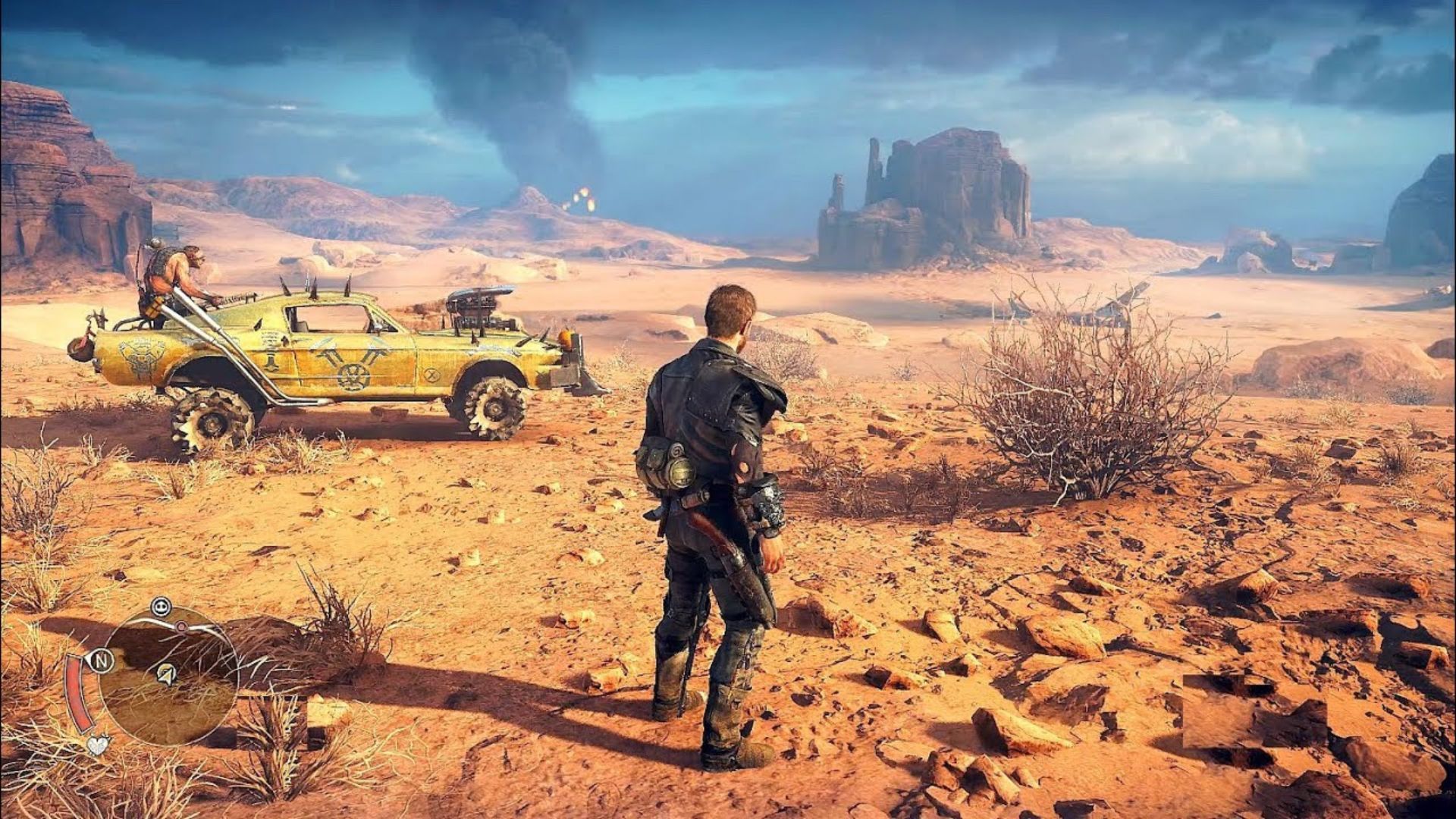
Companies like Take-Two and Bethesda have created some of gaming’s most popular franchises, including Grand Theft Auto, The Elder Scrolls, Red Dead Redemption, and The Legend of Zelda. However, for every massive hit game that everyone talks about, there’s another equally great open-world game that unfortunately didn’t get the attention it deserved.
Games like Dying Light, Mad Max, Gravity Rush 2, and Sunset Overdrive all brought something new to the open-world genre, but unfortunately didn’t get the recognition they deserved. Some were released at the wrong time, while others suffered from being limited to certain platforms or were created by studios that later shut down.
The Saboteur Let Players Liberate Nazi-Occupied Paris in Black and White
Released in 2009, The Saboteur takes place in a visually striking Paris under Nazi occupation. The game is played almost entirely in black and white, challenging players to scale buildings, destroy enemy structures, and fight a lone rebellion throughout the city. What makes the game truly special is how it uses color. As players liberate each district, it bursts into full color, visually representing their progress. This innovative use of color wasn’t just aesthetically pleasing; it was one of the most memorable artistic achievements in open-world game design, making the transformation from monochrome to color incredibly rewarding to witness.
Pandemic Studios intended to make a sequel to The Saboteur, but the project was jeopardized when EA decided to close the studio. Morgan Jaffit, the creative director brought in to lead the sequel, immediately sensed the studio was in trouble. EA officially shut down Pandemic on November 17, 2009, resulting in the layoff of 228 employees. The Saboteur was released just three weeks later, a completed game launched by a studio that no longer existed, and there was no one left to continue developing it.
Mafia II Is a Linear Game Wearing an Open-World Coat and That’s What Makes It Work
Mafia II, released in 2010, features a large, open-world city you can explore by car, but the game itself follows a very direct, story-driven path with almost no optional activities. The developers intentionally created this contrast – a linear experience within an open world. The city of Empire Bay, inspired by American cities from the 1940s and 50s, isn’t meant to be a free-for-all sandbox. Instead, it’s designed as a backdrop for Vito Scaletta’s compelling Mafia story, which feels more like a classic crime film directed by Martin Scorsese than a typical Grand Theft Auto expansion.
I remember when Mafia II first came out, some people complained it didn’t have enough to do in its open world. They wanted tons of side activities, but honestly, I never felt that was missing. Empire Bay itself was the star for me – the way the snow fell on those streets, the classic cars, and the amazing jazz music just pulled you right into the era. Plus, the driving felt weighty and realistic, and the gunfights were brutal, not some Hollywood action movie. The story wasn’t afraid to show the real consequences of your choices either. It proved to me that an open world doesn’t need to be a giant playground to be special – sometimes, the world itself is what matters, and it’s enough just to exist in it.
Dragon’s Dogma: Dark Arisen Took Shadow of the Colossus’s Best Idea and Built an Open World Around It
I remember when I first played Shadow of the Colossus – it was easily one of the most exciting things I’d ever experienced in gaming. But it was also really unique; a beautiful, simple game with only sixteen massive bosses, a vast, empty world, and not much else between those fights. Then, Capcom’s Dragon’s Dogma came along in 2012, and it felt like they asked the perfect question: what if we took that amazing boss-climbing mechanic and built a huge, full-fledged open-world RPG around it?
Hideaki Itsuno, the director famous for Devil May Cry, created a game with a unique feature: players could climb onto and ride mythical creatures like griffins, cyclopes, and chimeras as they moved and fought. Once the ride ended, players would return to a vast fantasy world to continue their adventure, collecting items and gaining experience.
Another unique feature was the Pawn system. Players could create AI companions that learned from their fighting style and could be shared with other players online. This meant your Pawn could return from someone else’s game with new information about enemies and quests – a clever way to integrate multiplayer into a single-player experience. While Dragon’s Dogma received generally positive reviews, it didn’t gain much traction due to the huge popularity of Skyrim and inconsistent marketing from Capcom. The 2013 re-release, Dark Arisen, added a large post-game dungeon and became the preferred version of the game. Over the next ten years, a dedicated fanbase developed, ultimately leading to a sequel in 2024.
Sunset Overdrive Was Insomniac’s Best Game Before Spider-Man
Insomniac Games created Sunset Overdrive in 2014 as a playful rebellion against the many dark and overly serious open-world games available at the time. The game takes place in Sunset City, which has been overrun by monsters created by a mutated energy drink. It features a unique movement system that turns the entire city into a dynamic playground for grinding, wall-running, and zip-lining. Players were actively encouraged to stay in motion, combining acrobatic moves with constant gunfire for non-stop action. The weapons were just as over-the-top, including a bowling ball launcher, a gun firing explosive teddy bears, and an acid-spraying sprinkler.
The main issue was the timing and promotion of the game. Sunset Overdrive came out as an exclusive title for the Xbox One when the console wasn’t selling well, and Microsoft didn’t do much to advertise it. Interestingly, the game’s developer, Insomniac, kept the rights to the game, and it eventually became available on PC in 2018. However, by then, the initial excitement had faded. Players who found Sunset Overdrive after playing Spider-Man often discovered a game that was even more creative, playful, and encouraged experimentation and chaos than its more popular counterpart.
Dying Light Made Nightfall the Most Terrifying Mechanic in Open-World Gaming
In Techland’s 2015 game, Dying Light, the open world changed dramatically depending on the time of day. During the day, players explored the city of Harran using fast-paced, first-person parkour. They could smoothly run, jump, and climb over obstacles – a style of movement more reminiscent of Mirror’s Edge than typical zombie games.
During the day, the game offered a rewarding cycle of exploration, gathering resources, building weapons, and completing objectives while securing areas. But once night fell, dangerous creatures called Volatiles appeared. These fast, strong, and light-sensitive predators hunted players through the city. What felt like fluid and powerful movement during the day turned into a frantic rush for cover when darkness came.
The changing day and night wasn’t just a visual feature; it dramatically altered how players explored the game world. At night, you earned double experience, encouraging risky play, but the danger was very real. Being spotted by a Volatile enemy started a terrifying chase. Despite selling over 30 million copies, Dying Light came out alongside major titles like The Witcher 3 and Batman: Arkham Knight and didn’t get as much initial attention. Techland continued to support the game for years with free updates, and thankfully, enough people bought it to make Dying Light 2 possible.
Mad Max Nailed the Fury of the Films But Launched the Same Week as Metal Gear Solid V
Avalanche Studios’ Mad Max (2015) is a surprisingly excellent game based on a popular movie series. It perfectly recreates the gritty, post-apocalyptic world created by George Miller. The car combat is intense, you can customize your vehicles extensively, and Max’s car, the Magnum Opus, feels like a significant part of the experience. The game focuses on high-speed vehicle battles, enhanced by dynamic weather events that change the environment. While on-foot combat is reminiscent of the Arkham games, Mad Max truly shines when you’re behind the wheel.
When Mad Max came out on September 1, 2015, it unfortunately launched on the same day as Metal Gear Solid V: The Phantom Pain, a hugely popular game that everyone was excited about. This timing was a disaster for Mad Max. Metal Gear dominated all the news and attention, and while Mad Max received okay reviews, it was considered average – a judgment that was somewhat deserved, as the parts of the game where you weren’t in a vehicle felt slow.
Despite its flaws, the game truly excelled in its car combat and depiction of a desolate wasteland. Those who played it later often felt it captured the spirit of Mad Max more effectively than many officially licensed games manage to do with their source material. Perhaps George Miller was right all along…
Gravity Rush 2 Let Players Fly Through a Floating City Before Sony Killed its Studio
Keiichiro Toyama, known for creating the Silent Hill series, developed a game centered around a girl with the power to control gravity. The first Gravity Rush game launched on the PS Vita in 2012, and the 2017 sequel, Gravity Rush 2, brought the idea to the PS4, evolving it into a large, open-world action game with beautiful, anime-style graphics.
The main character, Kat, doesn’t walk, climb, or drive – she simply falls in any direction the player picks. This ‘falling’ movement wasn’t graceful flight, but more like a chaotic tumble, which was surprisingly disorienting and really enjoyable to watch. It transformed getting around into a dynamic system, making the entire city feel accessible from any viewpoint.
The city of Jirga Para Lhao, featured in the game, was designed based on the team’s experiences traveling in Latin America and Asia. Its buildings visually represented a large gap between rich and poor, with wealthier areas literally floating above less affluent ones. The art style blended influences from Japanese manga and the work of French comic artist Jean Giraud. Unfortunately, the game launched very close to other popular titles like Resident Evil 7 and Yakuza 0, which hurt its sales. Sony closed Japan Studio in 2021, and the game’s creator, Toyama, started a new studio called Bokeh Game Studio. Currently, Sony owns the rights to the game, but there are no plans to make a sequel.
Read More
- Last Furry: Survival redeem codes and how to use them (April 2026)
- Gear Defenders redeem codes and how to use them (April 2026)
- Honor of Kings April 2026 Free Skins Event: How to Get Legend and Rare Skins for Free
- Clash Royale Season 83 May 2026 Update and Balance Changes
- Gold Rate Forecast
- Brawl Stars April 2026 Brawl Talk: Three New Brawlers, Adidas Collab, Game Modes, Bling Rework, Skins, Buffies, and more
- Brawl Stars Starr Patrol Skins: All Cosmetics & How to Unlock Them
- Silver Rate Forecast
- Laura Henshaw issues blunt clap back after she is slammed for breastfeeding newborn son on camera
- Total Football free codes and how to redeem them (March 2026)
2026-05-02 20:41