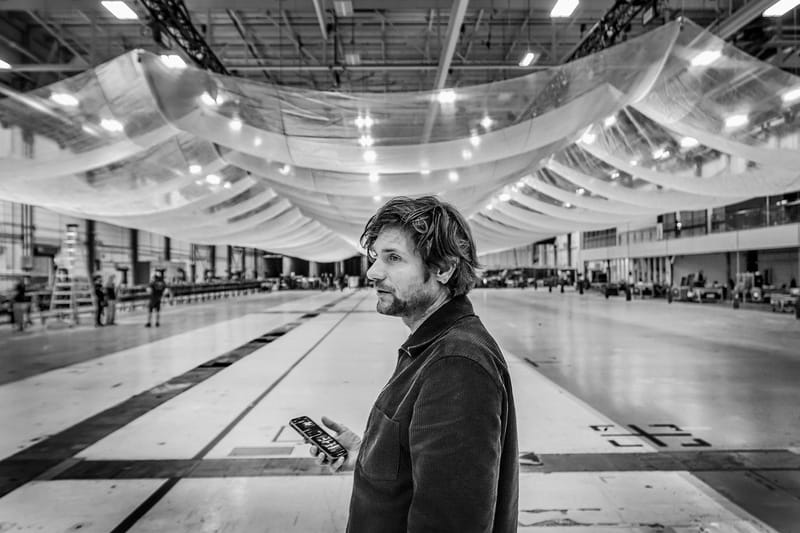
In this episode of Through the Lens, we get a unique perspective on the work of artist Boris Acket – told through the eyes of his father, Rob Acket.
For the last three years, Acket’s father has been filming what goes on in the studio, showing the many hours of testing and the technical problems that are part of Acket’s creative process. This feels like things have come full circle. Acket spent his childhood accompanying his father, a sound technician and designer, to different filming locations. Now, the roles are reversed: his father is the one recording Acket’s complicated installations, viewing his work with a loving, fatherly eye.
Acket’s recent work with the Fred again.. USB002 tour perfectly showcases this approach. The project involved reimagining his piece “Einder” – a massive, cloud-like structure – for live audiences in ten cities. Instead of being a fixed exhibit, this version was designed to move and change with each performance. The team spent a year refining the technology needed to make the 1,3000-square-foot fabric structure respond to its surroundings, including temperature, humidity, and the energy of the crowd, and had to adjust it for twenty different locations.
Acket’s art really comes alive during the process of creation. He’s fascinated by the fragile, experimental stage of a project, whether he’s working with large pieces of fabric or creating artificial weather inside a building. For Acket, the finished artwork isn’t the most important thing – it’s the constant refinement and adjustments along the way that truly matter.
We talked to Boris about his temporary workspace, his thoughts on the challenges of minimalism, and how he feels about people primarily seeing his art through photos on their phones.


Some creations might quickly capture someone’s attention and stay with them for a long time, while others, even if they exist for years, can be easily overlooked.
Could you tell me about how you first developed as an artist? I understand you began with graphic design and then transitioned into photography – is that right?
When you were eleven and first starting to create music, do you remember a particular time when you realized you wanted to incorporate the environment around you into your work, rather than just focusing on the sounds themselves?
My interest in music grew over time. When I was 11, just creating sound was incredibly satisfying because it naturally felt like it had depth and space. Even using simple music software, I was already arranging elements like mood, energy, and rhythm to create an emotional experience. I was essentially building a whole world with just sound, and I didn’t feel like anything was missing – maybe just a desire to improve and explore further.
As I got more into clubs and nightlife, I realized what drew me in wasn’t just the music. It was the whole atmosphere – the haze in the air, the way the lights looked on people’s faces as the night went on, the feeling of being packed together, and the shared excitement. I started to see that the music was just one part of a much bigger experience.
That moment marked a significant change in my approach. I started exploring not just the emotional impact of sound, but also how it interacts with the space around it and the people within it, and even how it feels physically. I went from simply creating sound to being captivated by the environment that shapes and alters it. I realized the space itself could function like an instrument, and elements like light, air, materials, rhythm, and architecture could all be used as building blocks in my work. I didn’t see it as leaving music behind; rather, sound and music became part of a broader artistic practice.
How does constantly moving your studio between storage and testing locations change your perspective on how lasting your artwork is?
I’ve stopped focusing so much on things being permanent and started appreciating being present in the moment. Our studio is constantly changing – it’s not tied to one location. It shifts between storage, workshops, testing areas, fabrication sites, exhibition spaces, and temporary technical setups. The artwork rarely develops in a single, consistent place. Instead, it comes to life through movement, temporary arrangements, adjustments, and adapting to whatever situation we’re in. Interestingly, the studio itself mirrors the work – it’s always evolving, adapting, and in a state of becoming.
I’ve shifted my focus from how long something lasts physically to the impact it has on people’s minds. While the materials and physical presence of a work are still important, what truly matters now is whether it creates a lasting impression – a memory or a feeling. Something can be experienced briefly but stay with someone for years, while something that exists for a long time might barely be noticed. Having a constantly changing studio has made me more aware of how fleeting moments can create powerful, lasting internal experiences.
This process also ensures the work stays grounded and authentic. By constantly shifting between creation and evaluation, we avoid becoming overly attached to ideas too soon. The pieces need to withstand real-world challenges – the wear and tear of moving them, potential failures, unexpected changes, the elements, and all the practical limitations that surprisingly reveal a lot about the work. I appreciate that aspect. It stops the work from becoming disconnected from reality, forcing it to exist not just as an idea, but in a tangible, logistical way, which I believe gives it strength and a sense of humility.


I don’t see the chaos as a temporary or hidden part of the process; it is the core of the work. It demonstrates that the piece develops and grows organically over time.
It’s been pretty surreal having my dad follow me around for the last two years, watching me work on this! Honestly, it’s a little vulnerable letting him see everything – the good, the bad, and the totally frustrating parts. But we both feel it’s really important to show all of that in the book. I think people often only see the finished product, the success, but they don’t realize how much work goes into getting there, and how messy that process can be. Showing the failures and experiments – all the stuff that didn’t work – feels really honest and important. It’s about showing the real journey, not just the destination.
It’s been three years working on this, and that makes it especially significant to me. Over time, it’s evolved from simply documenting something to becoming a lasting connection. What I find most moving is seeing a connection across generations. As a child, I often accompanied my father to his job as a sound technician and designer, helping out on shoots and during performances. I experienced his work through observation, admiration, and the daily routines of his craft. Now, that relationship has flipped. He’s the one following me, documenting my work and my process with his camera. It’s a beautiful thing – his work is now focused on mine, and my work is being seen through his unique perspective.
I also don’t want the book to feature only perfect, final results. The process of experimentation is crucial because that’s when the work is still evolving, fragile, and finding its shape. Much of our creative work comes from trial and error – misinterpreting materials, tweaking processes, pushing boundaries, simplifying things, and learning through persistence. Removing these imperfections removes the very essence of the work, leaving only a finished product without showing how it came to be.
This book is a collaboration with writer and philosopher Victoria Trumbull and the design studio, Studio Airport, and their contributions feel perfectly suited to the project. Victoria brings a deep understanding of time, memory, and how fleeting the present moment is, while Studio Airport has a unique and thoughtful visual style that can handle complex ideas without feeling overwhelming. What I find exciting is that the book brings together different ways of experiencing time: my father’s photography captures long, observational moments, Victoria’s writing explores memory and repetition, and Studio Airport’s design provides a framework to hold all of these elements. I don’t see the imperfections or ‘messiness’ as something hidden; it’s actually the core of the work, demonstrating how it evolved and grew over time.
Your documentary focuses on three main ideas: how long something lasts, how much it grows or spreads, and the idea that things can be both endless and self-contradictory. If you had to describe these not as concepts, but as feelings, what would they be?
If I were to describe these concepts as feelings, I’d say Duration feels like longing, Amplification feels like openness, and the Infinite Paradox feels like a gentle, unsettling feeling.
To me, the experience of time isn’t just about the present moment; it’s always colored by memories of the past and hopes for the future. Even when we’re fully immersed in something happening now, it’s tinged with what came before and what might come next. This creates a gentle, slightly wistful feeling – not sadness, but a sense of being connected to all moments in time, like layers overlapping and shifting. It feels expansive and a little fragile.
Amplification isn’t about simply making things bigger or louder; it’s about becoming more aware. It’s like removing mental filters, allowing you to notice subtle details and experience things more fully. Small changes can feel significant, and things you usually ignore become important. This expanded awareness feels similar to openness and a fresh, childlike receptivity. The work of acoustic ecologist Gordon Hempton, particularly his focus on listening and silence, really sparked my interest in this idea.
The Infinite Paradox creates a subtle discomfort because it holds an unanswered question I’m not sure I want to address. It’s ironic – we often use technology to reconnect with things it initially pulled us away from. We create simulations to help us remember real experiences, like using microphones to rediscover how to truly listen, or building artificial systems to feel more present. There’s a certain beauty in this, but also a nagging feeling of discomfort. It’s not simply hopeful or critical; it’s a complex balance that feels like a quiet, persistent unease.


Even a small movement can feel powerful when the energy is high, because it momentarily alters the rhythm and feel of the space.
Your art often feels like it creates self-contained worlds or systems that almost seem to have a life of their own. What sparked your interest in creating these kinds of structured environments, and what do you find appealing about them?
My background in graphic design runs deep – it’s actually in my family, as my mother is also a designer. Growing up surrounded by design principles like grids, typography, and layout really shaped how I think. Graphic design isn’t just about creating visuals; it’s about building the underlying logic and systems that make those visuals work. This has strongly influenced me to focus less on individual elements and more on the structures that can create a variety of results.
Growing up, my father worked as a sound technician, so I was often around recording equipment and all the technical aspects of audio. These mixing desks are incredibly organized – lots of different signals and connections happening at once, but within a very logical structure. I believe that early exposure influenced my current approach to work. To me, a mixing desk is like an instrument that controls space and sound, and I see my installations as similar – but instead of audio, they manipulate light, air, movement, sound, and even people.
When working on large-scale, energetic projects like the Fred again.. tour, how do you maintain the clarity and recognition of your personal design style?
I tend to simplify things, even on large, complex projects. My first impulse is to reduce elements until a single, powerful idea takes center stage. I don’t believe that bigger automatically means more detail. Often, the opposite is true. With so many elements already at play – the logistics, the emotions, the expectations – the risk isn’t a lack of content, but having too much. It’s easy for the work to become overly ornate or feel forced, so I always strive to avoid that.
For a project like my work with Fred, my main goal was to create an installation that wasn’t just a backdrop. I wanted it to feel like a living, breathing system – using simple elements like fabric, air, gravity, temperature, light, and movement. That simplicity is what defines my style, not a recognizable visual trademark, but a deliberate focus on honesty in materials and motion. I aim for viewers to easily understand what they’re experiencing, while also allowing themselves to get lost in the moment.
I often find people mistake minimalism for simplicity, but I don’t see them as the same. Even a small, minimal action can feel powerful when things are already energetic, adding a different rhythm to the situation and changing the overall feeling of a space. That’s why I make sure my work retains its own quiet strength, even when surrounded by noise, speed, or intensity.


“The best work can be shit on a phone, the best image can be shit in real life.”
It’s kinda weird, honestly. I put a ton of physical effort into making my art – sculpting, building, really doing things with my hands. But most people just see it as a picture or a video on their phone. It’s cool that more people get to see it, but it feels a little disconnected knowing they’re not experiencing the real thing, you know? It’s like watching a movie about a concert versus actually being there. I’m still figuring out how I feel about that shift.
There’s a bit of a paradox, but I’ve come to terms with it as just part of how my art exists today. My installations are very much about the physical experience – their size, how they feel to touch, the air around you, how your body moves within them, taking your time, the temperature, and being with others. They require you to be fully present. However, I also know many people primarily, or even only, see my work through photos and videos on their phones. So, I can’t dismiss the digital experience as less important; it’s now a key part of how my work is shared and experienced by the public.
I find it interesting how working primarily with digital formats actually highlights a core tension in my art. I use methods that involve a separation from direct experience to try and create a sense of immediacy. While a phone screen definitely simplifies and shrinks my work – reducing its size, depth, and length to a small image or clip – it can also act as an invitation. It can spark interest in a more immersive, physical experience that isn’t meant to be instantly understood. Surprisingly, footage that feels the most authentic and ‘real’ still stands out, even when viewed on a small screen. Ultimately, people are drawn to the raw, physical qualities of the work, rather than something overly polished or pre-packaged.
There’s a risk the artwork could become just a visual display. However, it also has the potential to reach a wider audience through images, which could then inspire a more meaningful connection with the actual piece later on.
I sometimes struggle with how quickly things move on phones. My work often focuses on what develops over time – with repeated viewing, or simply through sustained attention. It’s rarely about the initial impact, but rather the subtle changes in how you see things. The current challenge, though, is to create art that can exist alongside this fast pace without being dictated by it.
The best work can be shit on a phone, the best image can be shit in real life.
When working on large, fast-paced projects like the Fred again.. tour, how do you maintain a consistent, recognizable visual style?
I tend to simplify things, even on large, complex projects. My first impulse is to pare everything down to a single, strong idea. I don’t believe that just because something is big, it needs to be complicated. Often, the opposite is true. With so many elements already at play – the logistics, the emotions, the expectations – the real risk isn’t a lack of detail, but having too much. It’s easy for the work to become overly ornate or feel forced, so I always strive for clarity and restraint.
For a project like my work with Fred, I wanted the installation to be more than just a backdrop. It needed to feel like a living, breathing system – relying on simple elements like fabric, air, gravity, heat, light, and movement. That simplicity is what defines my style. It’s not about a recognizable look, but about using materials and motion in a straightforward and genuine way. My goal is for viewers to easily understand what they’re seeing, while still feeling immersed in the experience.
I often find people mistake minimalism for simplicity, but I don’t see them as the same. Even a small, minimal action can be powerful in a lively environment, adding a different rhythm to the experience. It can actually shift the energy of a space. That’s why I make sure my work maintains its own distinct presence, even when surrounded by noise, speed, or intensity – it needs to feel natural and self-contained.


“The space speaks first, and I try to listen to it rather than impose something onto it.”
Because you work in different locations, do you have a particular item or tool that helps you feel settled and turns any place into your creative space?
Constantly moving between different environments teaches you to be incredibly adaptable. You learn to make do with what you have, rather than waiting for ideal circumstances. Because of this, I believe a studio isn’t defined by a specific place or object. It’s more about a way of thinking and the people involved. A studio comes alive when discussions begin, when ideas are explored, and when things are created or challenged. Ultimately, a studio is less about a physical location and more about the connections between people.
I deeply value the network of people who support my work. Individuals like Luiza Guidi, a fantastic creative producer and collaborator, Anne Verhallen, who expertly represents and promotes my projects, and Joris van Welsen, who handles the studio’s business operations, allow me to focus and work with peace of mind. Knowing they reliably manage production, logistics, representation, and finances frees up my mental energy to concentrate on the creative work and long-term development of our projects.
The studio isn’t really a location, but rather a mindset or approach we all share. We also want to thank Sarah Schulten, who’s a key member of our team.
When creating a story, how do you choose between a large, sweeping scale and a smaller, more personal approach, and how does that decision affect what the story ultimately becomes?
I don’t usually begin with a preconceived idea of how large or small a piece should be. More often, the environment itself guides the process. Things like the building’s structure, ceiling height, sound quality, temperature, and how people interact with the space often inspire the artwork, rather than the other way around. I prefer to let the space dictate what it’s best suited for – to discover its unique characteristics – and then create something that enhances them, rather than trying to force an idea into it.
We’re currently working on an art installation in a massive market hall in Amsterdam with a ceiling height of about 28 meters. This height is the defining feature of the space, so we’re focusing on creating something that responds to it – a horizontal or close-up piece wouldn’t make sense. The hall’s impressive verticality, size, and open air are central to the project. Essentially, the building isn’t just a space to put the art; it’s an active partner in the creative process.
Large spaces often shift the focus from individual experience to a shared feeling and atmosphere. They can change how a room feels and make people conscious of being part of a group, all experiencing the same thing together. This is what makes scale compelling – not as something visually impressive, but as a way to build a sense of community.
Smaller, more personal artworks offer a different experience. They encourage close attention, nuance, and a direct connection between the viewer and the work itself – whether it’s a change in light or a specific sound. These pieces can be delicate and refined, subtly shifting how we see things rather than dramatically changing a space. I focus on understanding the existing environment and responding to it, rather than forcing my own ideas onto it.

I want people to sense that these systems feel dynamic and evolving, not rigid or fixed. Their ability to surprise us is what makes them feel truly alive.
Aside from your own projects, what interesting art have you seen recently? Also, what kind of music are you listening to while you work?
I’ve always admired artists from the Dutch creative scene. Their work strikes a great balance between experimentation and directness. Artists like Rosa Menkman, Children of the Light, Geoffrey Lillemon, Heleen Blanken, Zoro Feigl, Pelle Schilling, Lumus Instruments, Philip Vermeulen, Nikki Hock, Tina Farifteh, and Zalan Szackacks all approach their art in unique ways, but they’re united by a clear and focused use of technology, how we perceive things, imagery, and space. They often combine strong ideas with a very tangible, immediate visual impact. This combination is especially inspiring to me, as they explore light, systems, media, and perception using technology that feels both modern and deeply human.
I’ve also been revisiting the work of artists like Rebecca Horn, Loie Fuller, and Hans Haacke, and I’m struck by how much their early explorations of movement, systems, and performance resonate with my own. They were grappling with similar ideas about unseen forces and immersive environments long before today’s technology existed. It’s fascinating to see that many of the questions we’re asking now aren’t new – just the methods have evolved. I appreciate the idea of building on a continuing artistic dialogue, using different materials and technologies to express enduring themes. Working with curator Sanneke Huisman at the Stedelijk Museum Schiedam really helped me understand this concept.
Surprisingly, the studio is often quiet. We’re constantly surrounded by the sounds of equipment – motors, fans, fabric, and the systems themselves – so silence becomes a valuable thing. It’s not an empty silence, though; it’s filled with subtle sounds and focused energy. While music occasionally plays, the real ‘soundtrack’ is usually the work we’re doing.
Because the documentary is still being made, what are you hoping for when it’s released, and what’s the most important message you want viewers to get from seeing how you created it?
Honestly, more than any specific point, I hope people walk away with a feeling – a sense of why we even create things like this. It’s interesting because a lot of the tech I work with actually highlights just how much of our lives happens through layers of technology these days. It makes you think!
The studio isn’t focused on resolving that contradiction; instead, we’re exploring it. We want to create immersive experiences where people can perceive time, space, memory, and presence in new ways. Ultimately, what ties all our work together isn’t the technology itself, but the shared moments of self-awareness – of perception, memory, and emotion – that people experience together within the same space.
I often feel my work explores what it means to be human – how we each have unique experiences, yet share them all as one. Perhaps that’s what I’m really aiming for with my studio: creating spaces where people can recognize that feeling of being simultaneously alone and connected.
Read more at TopMob
Read More
- Last Furry: Survival redeem codes and how to use them (April 2026)
- Gold Rate Forecast
- Brawl Stars April 2026 Brawl Talk: Three New Brawlers, Adidas Collab, Game Modes, Bling Rework, Skins, Buffies, and more
- Clash of Clans: All the Ranked Mode changes coming this April 2026 explained
- COD Mobile Season 4 2026 – Eternal Prison brings Rebirth Island, Mythic DP27, and Godzilla x Kong collaboration
- Gear Defenders redeem codes and how to use them (April 2026)
- Honor of Kings April 2026 Free Skins Event: How to Get Legend and Rare Skins for Free
- The Mummy 2026 Ending Explained: What Really Happened To Katie
- Brent Oil Forecast
- Razer’s Newest Hammerhead V3 HyperSpeed Wireless Earbuds Elevate Gaming
2026-04-27 16:58