CoinDesk Indices

What to know, or rather, what to ponder in the twilight of digital dreams:
You find yourself here, dear reader, perusing the pages of Crypto for Advisors, CoinDesk’s weekly missive that unravels the enigma of digital assets for the financially astute. Subscribe, if you dare, to receive it every Thursday, like clockwork.
In this installment, Josh Olszewicz, the oracle of Canary Capital, introduces the Sui blockchain-a name as sweet as a summer breeze, yet as complex as a Russian novel. He muses on its potential to reshape Web3 adoption and optimize the mundane for consumer applications.
Special alert, or a whisper in the wind: Are you bound for Consensus Miami? Do not miss the clandestine Wealth Management Day on May 6. A side event, tailored for advisors, awaits. Attendance is complimentary, but only for the anointed-a CRD number is your ticket to this exclusive gathering.
Proceed, if you will, into the labyrinth of words.
Deconstructing the Sui: A Tale of Layers and Ledger
The Sui network, pronounced with a lilt like “swee,” emerges from the ether as a Layer-1 blockchain of peculiar distinction. In this cycle of markets, it stands apart, blending novel architecture with a philosophy that courts the consumer. A Layer-1, the bedrock of a network, where transactions are etched, validated, and sealed. Yet, Sui is no ordinary stone in the mosaic of high-throughput chains. Its approach to execution, data ownership, and tokenomics is a dance of divergence, one that may prove pivotal for adoption and the whims of investors.
Born in 2023, under the aegis of Mysten Labs, Sui is a delegated proof-of-stake (DPoS) Layer-1, crafted with the Move programming language. Its heart beats with an object-based data model, a marvel that allows transactions to unfold in parallel, not in sequence. This design, a symphony of efficiency, promises high throughput and low latency, scalability unshackled from rollups, and native support for applications as intricate as they are asset-centric.
In the realm of Sui, not all transactions are created equal. Owned objects stride forward independently, while shared objects seek the embrace of consensus. This selective execution, a ballet of efficiency, reduces bottlenecks and elevates performance at scale.
Sui’s design is a courtship of the consumer, a bridge between the usability of Web2 and the ownership of Web3. With zero-knowledge logins and passkeys, it whispers of a future where friction is but a memory. The implication is clear: if Web3’s destiny lies in applications, not speculation, then Sui’s architecture may be its silent benefactor.
Beyond its base layer, Sui unfolds into a tapestry of infrastructure. An execution layer for smart contracts, decentralized storage via Walrus, programmable encryption through Seal, and confidential compute with Nautilus-each thread woven to support hybrid on- and off-chain applications. Together, they form a full-stack Web3 sanctuary, a refuge from centralized providers.
On the altar of consensus, Sui offers a dual-layer sacrifice. Narwhal ensures data availability, while Bullshark ordains transaction finality. This design, a marriage of throughput and security, is Sui’s silent strength.
The SUI token, a fixed constellation of 10 billion, knows no inflation. Its release is gradual, a long-term vesting schedule that tempers sell pressure. Staking rewards flow from a pre-allocated supply, a testament to Sui’s deliberate design.
Sui’s growth is a narrative of steady ascent. Transactional activity hums, active addresses multiply, and Total Value Locked (TVL) swells with the tide of DeFi and stablecoins. Yet, like all tales, there are valleys-TVL peaked at $2 billion in October 2025, only to retreat to $600 million, a mirror to the broader market’s ebb.
The ecosystem flourishes with DeFi platforms, stablecoin integrations, and incentive programs. Scallop lends and yields, Run Legends rewards the fleet of foot, and FanTV mimics the social scrolls of TikTok. Each a thread in Sui’s growing tapestry.
To assess Sui is to gaze into a “network P/S ratio,” a metric of market cap and fees. Yet, fees are fickle, accruing only to validators and stakers, swayed by incentives and subsidies. Valuation, thus, must be read in the context of adoption, transaction trends, and ecosystem expansion.
Sui’s reach extends to traditional finance, with SUI-linked investment products and exchange-traded vehicles. A sign of institutional curiosity, a mirror to crypto’s evolution-access, yield, and regulation unlocking new paths for capital.
Sui, a Layer-1 of distinction, offers parallelized execution, an object-based architecture, and a non-inflationary token model. Its ecosystem, a blend of consumer and DeFi applications, grows. For investors, the question lingers: Can Sui’s design foster sustained adoption and economic activity? If so, it may yet be a cornerstone of Web3’s next chapter.
Generations of the Internet
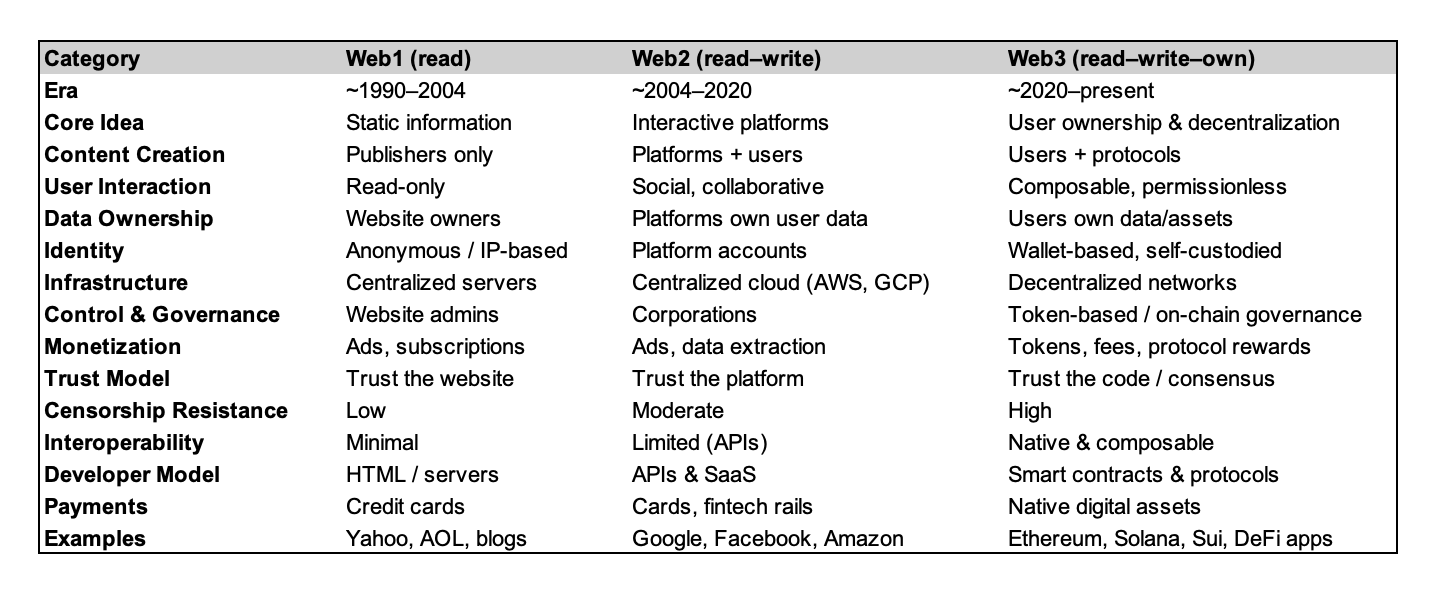
Web1: Information online | Web2: Platforms and social interaction | Web3: Ownership, composability, and programmable value
For further enlightenment and a chance to mingle with the digitally enlightened, Canary Capital joins hands with 3iQ, Digital Ascension Group, and Bitnomial for an exclusive event on May 4 in Miami. Learn more, if your curiosity permits.
– Josh Olszewicz, portfolio manager, Canary Capital
Read More
- Total Football free codes and how to redeem them (March 2026)
- Farming Simulator 26 arrives May 19, 2026 with immersive farming and new challenges on mobile and Switch
- First Look at Bad Bunny’s Exclusive Zara x Benito Antonio Collection
- Last Furry: Survival redeem codes and how to use them (April 2026)
- Clash of Clans May 2026: List of Weekly Events, Challenges, and Rewards
- Honor of Kings April 2026 Free Skins Event: How to Get Legend and Rare Skins for Free
- PUBG Mobile x Harley-Davidson Partnership to introduce new Motor Cruise event with rewards and Skins
- ALLfiring Companion Tier List
- Honor of Kings x Attack on Titan Collab Skins: All Skins, Price, and Availability
- Clash of Clans “Clash vs Skeleton” Event for May 2026: Details, How to Progress, Rewards and more
2026-04-30 18:09