Republican members of the Senate Banking Committee are defending the CLARITY Act before it goes up for review on May 14th. They disagree with concerns that the bill would harm existing securities laws, create ways to bypass regulations, or overlook risks related to illegal financial activity. Instead, they claim the legislation will clearly define which agencies are responsible for overseeing digital asset markets, require companies to be more transparent, and strengthen protections against fraud.
Key Takeaways:
- Senate Republicans rejected claims that the CLARITY Act would weaken investor protections.
- The bill would clarify SEC and CFTC authority while adding disclosure and anti-evasion rules.
- Republicans said the proposal addresses sanctions, money laundering, DeFi risks and foreign illicit finance concerns.
Republicans Answer Claims on Securities Law and Illicit Finance
Senate Banking Committee Republicans defended the CLARITY Act ahead of a scheduled May 14 markup after criticism focused on investor protections, regulatory gaps, illicit finance, decentralized finance ( DeFi), and software developer liability. Their response followed publication of the bill text on May 11 and framed the measure as an alternative to fragmented oversight.
In a statement released on May 12th, legislators responded to concerns that their plan would reduce the strength of existing securities laws. They clarified that securities involving digital assets would still be regulated by the Securities and Exchange Commission (SEC), and companies dealing with these assets would have to meet certain requirements – including disclosing information, limiting resales, and following rules to prevent loopholes. The statement also highlighted that determining which agency, the SEC or the Commodity Futures Trading Commission (CFTC), has authority over these assets is a key part of the discussion.
As a researcher focused on technology’s impact on society, I believe it’s crucial that everyone in the US – regardless of the tools or platforms being used – has the right to understand how things work, be treated equitably, and have someone to answer to when things go wrong. It’s about basic principles of fairness and openness, no matter the tech involved.
Another key argument against the bill focused on illegal financial activity. Republicans claimed it would subject cryptocurrency businesses – like brokers, dealers, and exchanges – to rules designed to prevent money laundering. These rules include monitoring for suspicious transactions, verifying customer identities, and complying with financial sanctions. They also highlighted that the bill would give the Treasury Department more power to oversee potentially risky cryptocurrency transactions from other countries, particularly those linked to money laundering.
Bill Adds Consumer Rules and Enforcement Standards
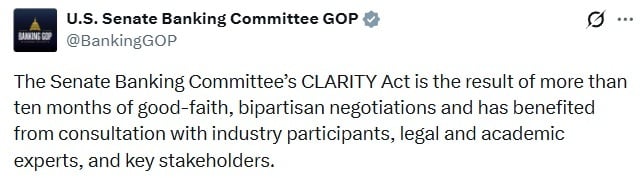
Republican members of the committee explained that the bill was the result of over ten months of collaboration between people from different backgrounds – including regulators, law enforcement, university researchers, and industry professionals. They highlighted this collaborative process to address concerns that the bill favored industry needs over the public good.
The plan also includes safeguards for consumers. It would mandate clear information about the risks of digital assets, require companies to be upfront about their practices, and establish ways to report fraud. Financial regulators would work together to improve public understanding of these assets, and existing rules against fraud and restrictions on reselling would stay in effect. Republicans on the Senate Banking Committee stated:
“The CLARITY Act replaces uncertainty with clear rules of the road.”
The final part of the response addressed kiosks, DeFi, and software development. Digital asset kiosks would face registration and compliance standards, including warnings, fraud controls, holding periods, and withdrawal limits. Centralized intermediaries interacting with DeFi protocols would face risk-management rules, while developers who do not control customer funds would receive protections.
Read More
- Gold Rate Forecast
- Total Football free codes and how to redeem them (March 2026)
- Netflix’s Best Stranger Things Replacement Officially Takes America By Storm
- 6 Animated Movie Trilogies Where Every Entry Is Near-Perfect
- Maggie Smith’s sons “deeply touched” by huge honour to the late “national treasure”
- The Division Resurgence Best Weapon Guide: Tier List, Gear Breakdown, and Farming Guide
- Clash of Clans “Clash vs Skeleton” Event for May 2026: Details, How to Progress, Rewards and more
- These Cartoon Reboots Totally Missed the Point of the Originals (& Went Downhill Fast)
- Zenless Zone Zero version 2.8 ‘New: Eridan Sunset’ update will release on May 6, 2026
- Arghavan Khosravi Brings Diasporic Narratives to ‘What Remains’
2026-05-12 19:57