Crypto investment firm Capriole Investments is waving its metaphorical handkerchief and sounding the alarm on elevated inflation, warning that every historical instance of inflation reaching these rather spicy current levels has been followed by an average market crash of 30% over the next one to 24 months. It’s the sort of news that makes you want to cancel your subscription to the Financial Times and take up gardening instead, if only you could remember how to tell a weed from a petunia.
- Every time inflation has hit these current heady heights, the market has promptly keeled over by an average of 30% shortly thereafter, as if it’s just remembered it left the gas on.
- The 2000 dot-com crash, which erased 47% of market value, and the 2008 financial crisis, which took a whopping 55% off the top, represent the worst-case range in Capriole’s historical dataset, enough to make even the most hardened stockbroker reach for his pocket handkerchief and a very large brandy.
- The U.S. CPI hit 3.8% recently, its highest since May 2023, sustaining pressure on the Fed and risk assets that is about as welcome as a visit from Aunt Agatha, who has a habit of bringing up your youthful indiscretions at every possible opportunity.
Historical Data Paints a Picture So Bleak You’ll Want to Hide the Charts Under the Sofa
Capriole Investments highlighted a pattern that has held across decades of market data, as reliable as Aunt Dahlia’s tendency to turn up unannounced with a crate of vintage claret and a request for a loan to cover the bills for her latest hare-brained scheme: when inflation climbs as high as it has today, the broad market has declined by an average of 30% over the following one to 24 months. It’s enough to make you want to tuck your investment portfolio under the mattress and pretend the whole stock market business is just a very unpleasant dream you had after eating too much pickled herring at the club dinner.
Two of the most severe crashes on record occurred within this exact inflation regime, namely the dot-com collapse that erased 47% of market value between 2000 and 2002, and the 2008 financial crisis that took markets down by 55%. One rather hates to say “I told you so” to the chaps who were busy buying shares in pet rock startups back then, but well, one did rather tell them so, didn’t one?
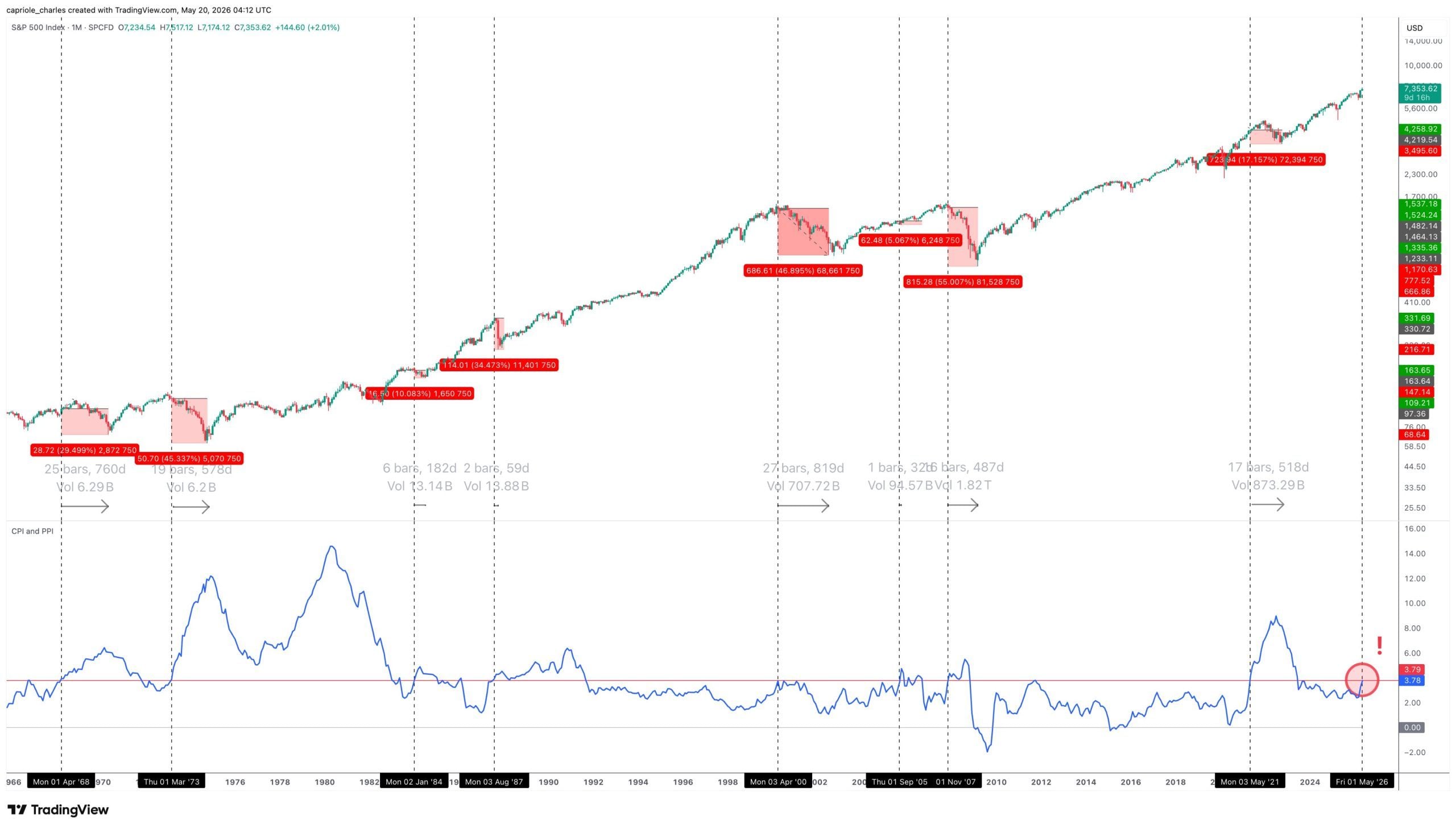
The U.S. Consumer Price Index (that’s the government’s fancy way of counting how much more expensive everything is these days, from a loaf of bread to a pair of trousers to a night out at the opera where you have to listen to some tenors warbling on about nothing) rose 0.6% on a seasonally adjusted basis in April 2026, pushing the annual inflation rate to 3.8%, its highest reading since May 2023. Producer price inflation has also run hotter than a summer kitchen in the Cotswolds, adding to the Federal Reserve’s difficulty in signaling rate cuts, which is making the poor dears’ job about as easy as trying to herd cats at a village fete.
With the 30-year Treasury yield having briefly touched 5.19% yesterday (enough to make anyone with a mortgage break out in a cold sweat) and equity markets sitting near all-time highs like they haven’t got a care in the world, Capriole’s argument is essentially that the market is mispricing risk about as badly as Bertie Wooster misprices the cost of a night out at the Drones Club. It’s all very well for the optimists to crow about record highs, but the tea leaves (or in this case, the inflation data) are pointing very firmly towards a spot of bother on the horizon.
Bitcoin Faces the Very Real Risk of Being Dragged Down With the Rest of the Rabble If the Stock Market Goes Pear-Shaped
For bitcoin and the broader crypto market, the implications are about as welcome as a visit from Aunt Agatha, who has a habit of bringing up your youthful indiscretions at every possible opportunity. Bitcoin has spent significant portions of 2026 under pressure, falling below $80,000 multiple times amid inflation concerns and spot ETF outflows, and touching a cycle low near $60,000 in February, which is enough to make anyone who bought at the top feel as silly as a chap who shows up to a hunt ball in a pair of flip-flops.
Capriole’s analysis does not target a specific crypto price level but instead focuses on the macro environment that surrounds it. However, if traditional markets experience the kind of average drawdown the historical data implies, risk assets, including bitcoin and altcoins would be unlikely to escape the fallout. It’s the sort of thing that makes you want to keep your savings in a jar under the floorboards, if you ask me.
The caveat in Capriole’s framework is the width of the outcome distribution, because while the 30% average captures the central tendency, the actual range is about as wide as the difference between Bertie Wooster’s IQ and a garden slug’s. On the rare occasions when inflation has been sustained above these levels rather than reverting quickly, markets have gone on to experience the most severe crashes in the dataset. It’s the difference between a spot of bother and a full-blown catastrophe, and one would rather not have to find out which one we’re in for.
The critical variable is not whether a crash occurs in this environment but how long inflation persists, and whether the Fed moves to cut rates before growth cracks so visibly you could see it from space. If they move fast enough, we might all get off with nothing worse than a nasty fright and a slightly smaller investment portfolio. If not, well, we’d all better start practicing our very best “I say, old chap, isn’t this a bit sticky?” faces for the inevitable cocktail party conversations about our ruined savings.
This macro backdrop sits alongside a more optimistic read from some crypto-specific analysts. K33 Research, which Bitcoin.com News reported on recently, has argued that bitcoin’s February low near $60,000 may already represent the bear market’s maximum drawdown, with slow consolidation between $60,000 and $75,000 the more likely near-term path. Of course, given how often the markets have a habit of doing the exact opposite of what everyone expects, it might be wise to keep a stiff upper lip and a well-stocked drinks cabinet handy, just in case.
2026-05-20 21:29