The amount of Bitcoin being sent to cryptocurrency exchanges has fallen to its lowest point in over six years, which some analysts believe could signal the start of a price increase. Recent data shows a significant decrease in Bitcoin moving onto these platforms, suggesting that people are holding onto their coins rather than selling them, despite ongoing uncertainty in the crypto market.
Exchange Inflows Collapse To Multi-Year Lows
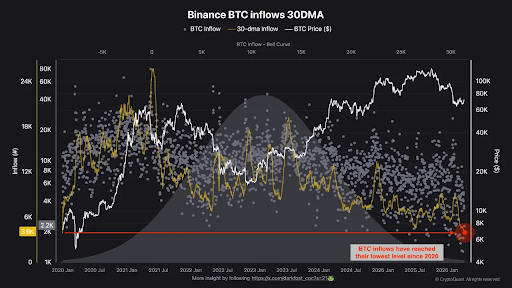
I’ve been looking at some data from CryptoQuant, specifically from an analyst called Darkfost, and it’s pretty interesting. Apparently, the amount of Bitcoin going *into* Binance is way down – we’re talking levels we haven’t seen since 2020. Right now, the 30-day average of BTC deposits to Binance is only around 3,998. That’s a big change, and it’s happening whether the market’s been going up, down, or sideways, which makes it even more noticeable.
When investors get worried, they tend to sell their Bitcoin. They quickly transfer it to cryptocurrency exchanges, making it easier to sell. We saw this happen in July 2023, with an average of 19,000 BTC flowing into Binance each day, and also during the peak of the bull market in May 2021, when daily inflows exceeded 25,000 BTC.
Looking at the amount of Bitcoin entering Binance over the past 30 days, a clear pattern emerges. The data shows a peak in July 2021, followed by a significant drop. Currently, inflows are around 3,900 BTC, representing the lowest level seen in the timeframe analyzed.
Typically, Binance receives an average of 11,000 Bitcoin. Current inflows are significantly lower than usual – about one-third of what’s normally seen, suggesting the market is currently slower than average.
Institutions Are Filling The Gap
Just because people aren’t selling doesn’t mean they don’t care. According to Darkfost, it suggests they’re holding onto their investments – a tactic that naturally lowers immediate selling, and one that’s continued even with recent market uncertainty.
As an analyst, I’ve been tracking Bitcoin’s recent performance, and it’s been quite a ride. We saw a peak of around $126,080 in October 2025, but that was followed by a significant correction, dropping the price down to $60,000 by February 2026. While we’ve recently seen a recovery to around $75,000, it’s been slow and hasn’t been consistent. Interestingly, despite these price swings, the amount of Bitcoin flowing into Binance has been consistently lower than usual for several months now.
Another factor impacting trading volume is the increasing popularity of spot Bitcoin ETFs. More and more Bitcoin is being bought and sold through these ETFs, which means less activity is showing up on traditional exchanges like Binance, making it harder for analysts to track overall Bitcoin movement.
Bitcoin ETFs in the US have seen strong investment over the past two days. On April 14th, these ETFs took in a total of $411.5 million, with BlackRock’s ETF accounting for $214 million of that amount. The positive trend continued on April 15th with another $186 million flowing into these ETFs. This increased demand, combined with fewer Bitcoins being sent to exchanges, is easing selling pressure.

2026-04-16 18:29