Michael Saylor recently shared a new chart about Bitcoin as his company, Strategy, currently owns 843,775 BTC and has $3.225 billion in cash. They also have permission to sell up to $23.53 billion worth of stock to get more money, leading people to wonder if they will start buying Bitcoin again.
Key Takeaways
- Michael Saylor posted Strategy’s bitcoin acquisition chart with the message, “We’re gonna need another color.”
- Strategy holds 843,775 BTC purchased for $63.69 billion, according to its latest regulatory filing.
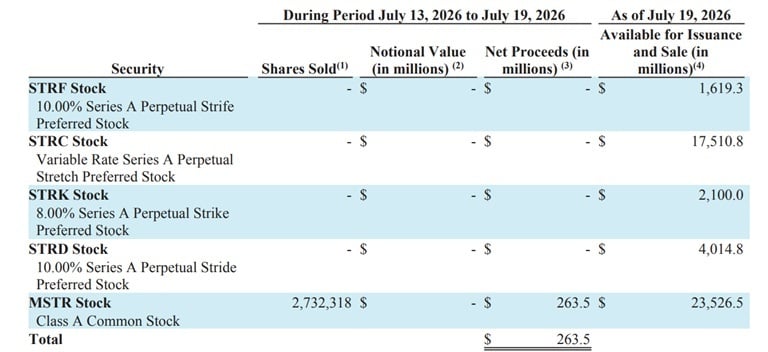
- The company raised $263.5 million without buying bitcoin and can still sell up to $23.53 billion of additional stock under its existing authorizations.
Saylor Shares Strategy’s Crowded Bitcoin Chart
Strategy Inc. (Nasdaq: MSTR) Executive Chairman Michael Saylor renewed speculation on Sunday, July 26, by sharing the company’s bitcoin acquisition chart alongside the remark, “We’re gonna need another color.” The X post included a graphic filled with orange markers representing Strategy’s purchases since 2020.
Strategy currently holds 843,775 Bitcoin, purchased over 113 transactions. These holdings are currently worth around $54.36 billion, with an average purchase price of $75,653 per Bitcoin. However, the value of these holdings has decreased by an estimated $9.47 billion since the purchases were made.
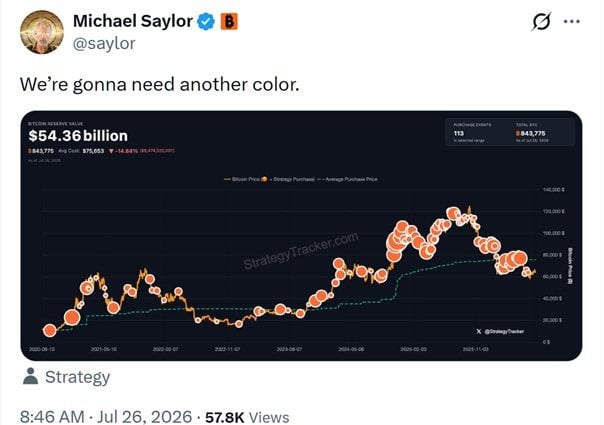
Saylor often shares charts before official financial reports are released, leading some investors to speculate these posts hint at upcoming Bitcoin purchases. However, these posts aren’t confirmations, and recently Saylor shared a chart after his company actually sold $263.5 million worth of stock instead of buying more BTC.
Strategy Builds $3.225 Billion Cash Buffer With $23.53 Billion in Stock Capacity
During the July 13-19 reporting period, Strategy sold 2,732,318 MSTR shares for $263.5 million in net proceeds but did not purchase bitcoin. The proceeds increased Strategy’s U.S. dollar reserve to $3.225 billion, illustrating that the company does not automatically deploy newly raised capital into BTC and may instead strengthen its cash position.
The company still has authorization to sell up to $23.53 billion of additional common stock under its existing at-the-market offerings, according to a July 20 regulatory filing with the U.S. Securities and Exchange Commission (SEC).
This $23.53 billion figure indicates how much more stock the company *could* issue, not money it has already collected. The company can gradually sell shares and use that money to buy Bitcoin, build up its cash holdings, or cover other expenses – all without needing to announce a new stock offering.
Strategy previously said its cash reserve provided more than 20 months of dividend coverage after reaching $3 billion. The increase to $3.225 billion extended coverage to approximately 1.8 years. The company also estimated that the market value of its bitcoin holdings represented 31 years of preferred-stock dividend coverage. Holding more cash gives Strategy greater flexibility over the timing of future bitcoin purchases by providing a larger buffer for near-term dividend and interest obligations.
Saylor Sees Bitcoin as Global Digital Capital
Saylor has consistently described BTC as a long-term capital asset rather than a short-term trade. In his bitcoin forecast through 2036, he argued that BTC could become a global digital capital asset used for reserves, collateral, and financial products.
He has also called corporate bitcoin adoption “necessary, inevitable, and welcome,” saying corporations provide the scale and continuity needed to expand BTC’s role in global finance.
This perspective indicates that Strategy’s recent halt in buying isn’t due to a shift in their overall bitcoin plans, but rather how they are deciding to use their funds. The key question now is whether they will utilize the remaining funds from stock sales to make another purchase, or if they will prioritize increasing their cash holdings.
2026-07-26 17:58