Ah, the wondrous world of tokenized assets! It seems the financial wizards have been busy turning lead into gold-or rather, U.S. Treasurys into digital tokens-and lo, the market hath swelled to a whopping $34 billion! By the beard of Om, that’s a tenfold leap since mid-2024, faster than a troll learning to count to three.
Key Takeaways (or as we like to call them, the Clacks messages of the financial realm):
- Tokenized assets have hit $34 billion, thanks to Treasurys, commodities, and credit-because who needs physical gold when you can have it on a blockchain?
- Institutions are piling in like dwarves at a gold rush, thanks to clearer stablecoin rules and blockchain systems that actually work (most of the time).
- Diversification is the name of the game, and compliant tokenized products are the new shiny toys everyone wants.
Treasurys: The New Black (or Should We Say, Blockchain?)
The tokenized asset market hath surpassed $34 billion, led by those trusty U.S. Treasurys and institutions finally getting their heads around blockchain. According to rwa.xyz, the value of these digital trinkets hit $34.01 billion, up from a mere $3 billion in mid-2024. A16z proclaimed this on X (formerly known as Twitter, or as we call it, the Great Chatterbox in the Sky).
Treasury-linked products now sit pretty at $16 billion, commodities are nudging $6 billion, and asset-backed credit has cracked $3 billion. Even tokenized equities, private equity, and real estate are joining the party. And let’s not forget the 815,297 asset holders and 256.95 million stablecoin holders-that’s more people than you’d find in Ankh-Morpork on a busy market day.
A16z said it best:
“The tokenized asset market crossed $30 billion last month and has stayed there. Roughly the size of an elite university endowment. As recently as mid-2024, it was below $3 billion. 10x in under two years. Magic? No, just blockchain.”
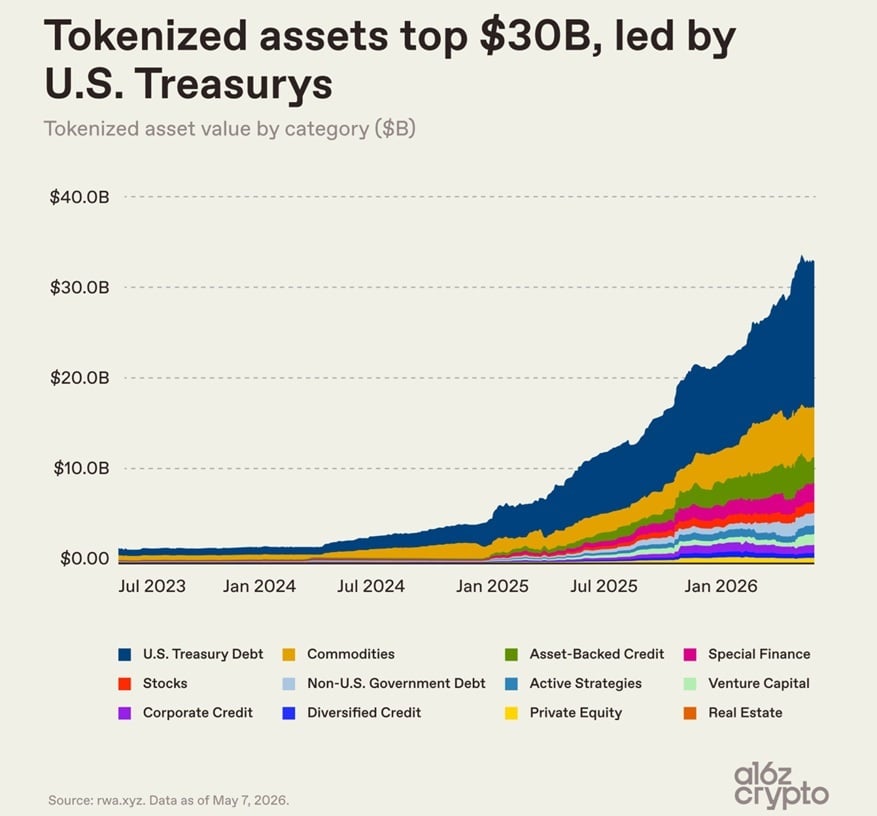
Institutions are jumping on the bandwagon like it’s the last coach to Genua. Thanks to the GENIUS Act (yes, that’s its real name-no one said politicians were creative), stablecoin rules are clearer, and blockchain systems are moving from “let’s test this” to “let’s make money with this.”
The GENIUS Act became law in July 2025, giving stablecoins a federal framework. Asset-backed credit hit $1 billion in just 185 days-faster than a wizard can say “Pratchett.” Specialty finance took under two years, while venture capital tokenization dawdled for seven years. Some things just take time, eh?
GENIUS Act: When Politicians Actually Get Something Right
The GENIUS Act hath spurred institutional blockchain deployments, and not just because it sounds clever. Regulated stablecoin frameworks mean issuers must keep liquid reserves, and what’s more liquid than U.S. Treasurys? Analysts say this has boosted Treasury demand, and Bank of America reckons stablecoin growth could lead to even more Treasury bill purchases. It’s like a self-perpetuating money-go-round!
Financial firms are launching tokenized Treasury products left and right, using blockchain for instant transfers and programmable asset servicing. The Federal Reserve Bank of Richmond reminded everyone that tokenized deposits are not the same as stablecoins, and the GENIUS Act lets banks issue tokenized deposits. So, no confusion there (hopefully).
A16z summed it up:
“What changed: the GENIUS Act, mature institutional onchain infrastructure, and a wave of financial institutions moving from pilots to production – all at roughly the same time. Coincidence? We think not.”
The market’s also diversified beyond Treasurys and commodities. In early 2024, those two were the whole show, but now they’re just two-thirds of it. Tokenized gold still rules the commodity sector, with Tether Gold (XAUt) and Pax Gold (PAXG) leading the charge. Tokenized oil, agricultural assets, and compute-linked products are still finding their feet, but give them time-they’ll get there.
2026-05-24 06:57