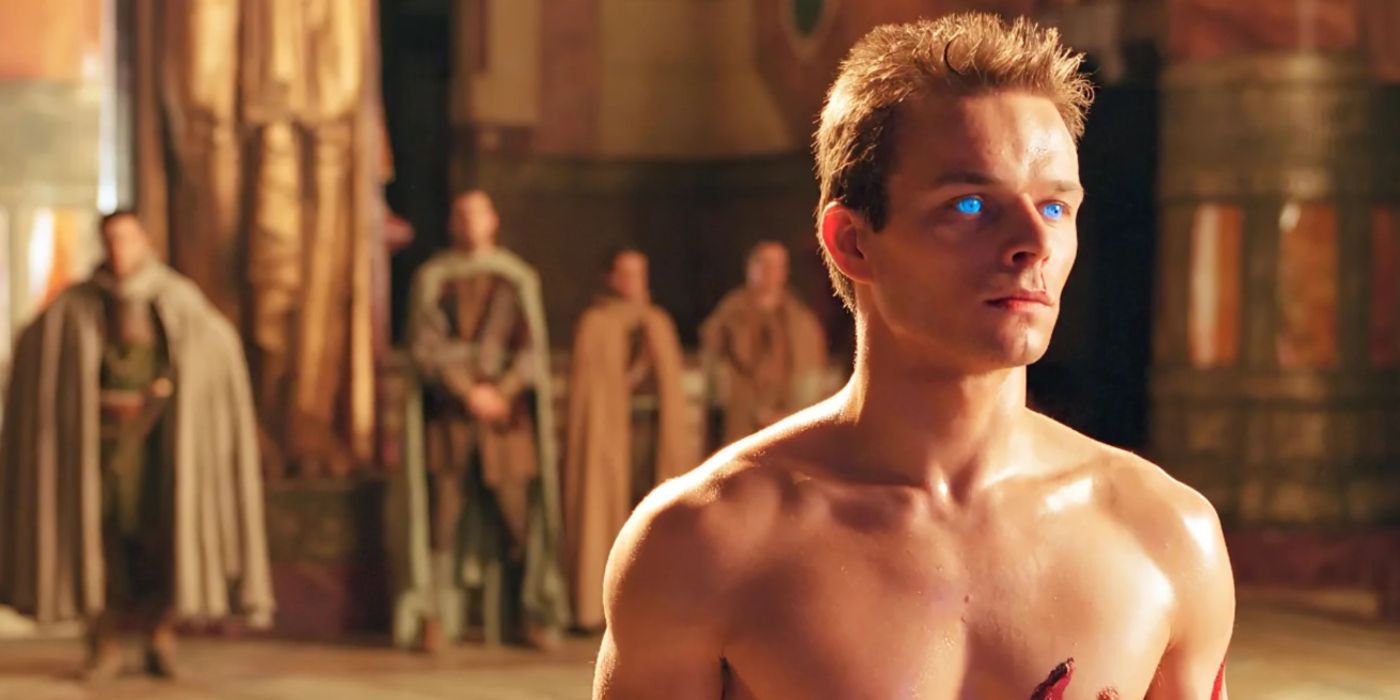
Denis Villeneuve’s films have made the Dune series a huge box office success, something the previous movie version failed to do. Villeneuve’s approach of dividing Frank Herbert’s first novel into two films allows for a fairly faithful adaptation, though not without some changes. While it’s a more successful adaptation than David Lynch’s Dune, another version actually stays even closer to the original story.
The 2000 Syfy miniseries adaptation of Frank Herbert’s Dune is surprisingly strong, and in some ways, an improvement over previous attempts. Because it had more time, the miniseries was able to delve into characters and ideas that the films largely ignored. The same holds true for its sequel, which could potentially be as good as or better than the upcoming adaptation of Dune Messiah.
Syfy’s Dune Miniseries Is a Faithful Adaptation of the Book
This miniseries, which originally aired on Syfy in 2000, is based on the well-known science fiction novel. Though the book was also adapted into films by David Lynch and Denis Villeneuve, many consider this version the most faithful adaptation. Its longer format allowed it to fully capture the scope and detail of the original story.
While the recent Dune movies are quite long, the original miniseries actually takes even more time to tell the story. The first book in the series is covered by two films, and those films dedicate roughly the same amount of time to the story as the miniseries did.
To reach the final length, the filmmakers expanded on certain parts of the story – even adding completely new plot points – while minimizing others. A prime example of this is the relationship between the characters, which Villeneuve altered significantly.
The recent adaptation of Frank Herbert’s Dune developed the romance between Paul and Chani more fully, mirroring the novel’s approach. It avoided the quick pacing of previous versions while also preventing their relationship from becoming as hostile as it is in the films directed by Villeneuve. The adaptation also showed the birth of their child, the first incarnation of Leto Atreides II, who tragically dies during the climactic battle with the Harkonnens.
Ian McNeice consistently delivered a compelling performance of the character, arguably the most impactful in any adaptation. He portrayed the character’s cruel and pleasure-seeking nature with a raw emotional intensity that felt more real than Stellan Skarsgård’s subtler take, yet avoided the over-the-top exaggeration seen in Kenneth McMillan’s performance.
Frank Herbert’s Dune included the , who haven’t appeared in Denis Villeneuve’s films yet. These characters and ideas helped make the world feel richer and more detailed, showing aspects that the movies only hinted at. This extra depth was a key part of what made the original book so successful, particularly in how it developed certain characters.
Liet-Kynes and Lady Jessica Had Expanded Roles in the Dune Miniseries
The character Liet-Kynes wasn’t portrayed effectively in the Dune films, and his crucial role was never explained. He was a well-known planetologist among the Fremen people of Arrakis, respected in both their hidden sietches and villages. He successfully integrated himself into their culture, and his death was a significant loss for them.
Chani was the one most deeply affected by this loss, as she was actually Liet Kynes’ daughter. This connection between Kynes and Chani appears only in the original novel, Dune, which highlights the strong love Chani felt for her father even after he died.
Okay, let’s talk about Chani in David Lynch’s Dune. The movie mentions she’s Liet’s daughter, but if you haven’t read the books, you’ll be totally lost as to who Liet is – he’s only called Dr. Kynes in the film. Now, in the new Dune movies, they’ve cleverly reimagined Liet as a female character, but so far, there’s been no indication that she’s still Chani’s parent. Honestly, the original miniseries gave Liet-Kynes a much bigger role and a lot more screen time, which made his death really hit hard. It feels like that crucial connection is missing here.
While some characters didn’t appear in the live-action versions, the Syfy miniseries generally gave the main characters and supporting cast more depth and development.
In Frank Herbert’s Dune, Lady Jessica’s importance is apparent even before the story’s central conflicts begin. Once on Arrakis, she quickly notices and dislikes some local customs, and immediately starts treating the native servants with greater kindness and respect. This action foreshadows her future role as a Sayyadina among the Fremen, demonstrating her subtle use of power, which is both shaped by and diverges from the pragmatic teachings of the Bene Gesserit.
The new miniseries is a more faithful adaptation of the source material. The previous films by Villeneuve significantly changed Alia’s storyline, showing her only briefly in a quick glimpse of the future, portrayed by Anya Taylor-Joy as an adult.
It’s a shame the movie’s timeline means we don’t really get to see her as the villain we know from the book. They haven’t even established her backstory yet! Thankfully, the new miniseries does a much better job of staying true to the source material, and it reminds me a lot of the original from 1984 in how it portrays her.
I always felt like Alia in the newer Dune movie just… fit better. In the older version directed by Lynch, she seemed really rushed, and honestly, it kind of mirrored how chaotic the second half of that film felt. It made her character come across a little silly, though I understand a lot of that was due to how difficult the production process was.
The miniseries included a new character who eventually marries Paul in a marriage arranged for political reasons. Director John Harrison added her to emphasize her greater role in future installments of the franchise, a welcome change from her minor appearance in the 1984 film.
In the miniseries, her role felt more like voiceover than a significant on-screen presence, and her connection to Paul and her importance within the Corrino family were minimized. The adaptation also added a key dinner scene not found in the films. While the story developed her character further from the middle onward, the original Dune films still offer the best portrayal of her overall.
Frank Herbert’s Children of Dune May Still Eclipse the Next Dune Movie
Fans are eagerly awaiting the upcoming final film in the Dune series, which will cover the events of the second novel. The movie will conclude the story of Paul Atreides and Zendaya’s character, Chani, though it’s likely to be a bittersweet ending, mirroring the tragic climax of the book. While the film will draw from the source material, it’s expected to include changes, similar to how Dune: Part Two (released in 2024) adapted the first novel.
A major challenge for the next Dune movie is determining how much of the source material needs to be adapted. While the first Dune novel was considered difficult to film, the sequel is even less suited for the big screen. It contains less action and visual spectacle than the first book, meaning director Denis Villeneuve will likely need to add new content to recapture the magic. The Dune miniseries previously faced this same issue and successfully resolved it with its second installment.
Syfy’s Children of Dune miniseries combined the storylines of the second and third books in Frank Herbert’s Dune series, Dune Messiah and Children of Dune. The first half of the miniseries focuses primarily on Dune Messiah, and any weaknesses in that book’s plot were effectively addressed by the adaptation.
Fans are eagerly watching to see how the upcoming Dune Messiah movie will adapt the novel, particularly because the previous Syfy miniseries stayed true to the book’s plot. The challenge comes down to the differences between film and television – movies generally can’t tell stories as complex and lengthy as those seen on TV. Some even believe this limitation has contributed to recent declines in movie ticket sales.
Ultimately, television seems like the ideal format for this story because of its complex background and rich mythology. That’s why Syfy’s adaptations capture the essence of the story more effectively than any other attempt.
Found an error? Send it so it can be corrected.
Read More
- Gold Rate Forecast
- These Cartoon Reboots Totally Missed the Point of the Originals (& Went Downhill Fast)
- Netflix’s Best Stranger Things Replacement Officially Takes America By Storm
- 6 Animated Movie Trilogies Where Every Entry Is Near-Perfect
- Top 5 Best New Mobile Games to play in May 2026
- Total Football free codes and how to redeem them (March 2026)
- STARBUCKS STAND by BEAMS Channels Kenyan Coffee Heritage Into Its Latest Spring/Summer Wardrobe
- Maggie Smith’s sons “deeply touched” by huge honour to the late “national treasure”
- Clash Royale May 2026 Update to bring Collection Levels, Mastery rework, and progression overhaul
- Clash Royale Season 83 May 2026 Update and Balance Changes
2026-04-17 03:39