As a researcher tracking investment performance, I’ve been looking at Strategy Inc. (Nasdaq: MSTR) and their adoption of bitcoin. Since August 2020, when they started holding bitcoin as their main reserve asset, their stock has actually outperformed bitcoin itself, as well as major tech companies – often called the ‘Magnificent Seven’ – and the broader S&P 500, with an annualized return of 42%.
Key Takeaways
- Strategy says MSTR posted a 42% annualized return since adopting bitcoin reserves on Aug. 10, 2020.
- The firm’s 843,775 BTC treasury, bought for $63.69 billion, sat about 17.9% underwater.
- Saylor unveiled Net BTC and BTC Hurdle ARR metrics on July 24 to reframe the bet for shareholders.
A Long-Term Bet, Restated
Strategy Executive Chairman Michael Saylor’s company touted its multiyear stock performance this week, telling followers that MSTR has delivered a 42% annualized return since the software firm pivoted to a bitcoin-based treasury strategy on Aug. 10, 2020. The figure beats bitcoin (BTC), the so-called Magnificent Seven group of large-cap technology stocks, and the S&P 500 index over the same stretch.
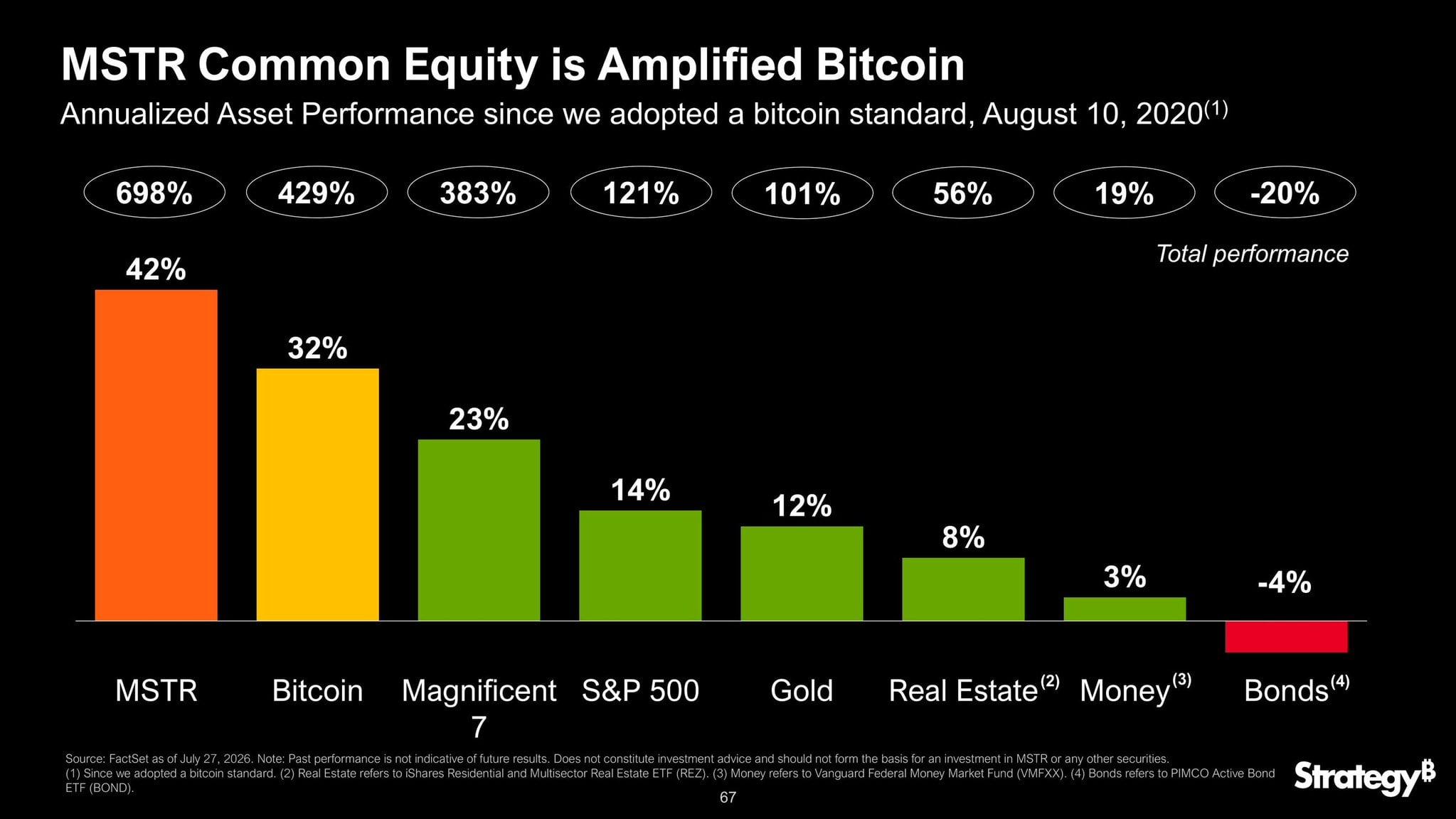
Saylor often points to MicroStrategy’s stock performance, claiming that transforming the company into a major holder of Bitcoin has yielded better returns than almost any other investment option for public investors. He’s been sharing a similar chart illustrating this point since 2025, updating the potential returns to reflect changes in both MicroStrategy’s stock price and the price of Bitcoin.
The market’s unpredictable nature was clear in 2026. Despite continuing to buy Bitcoin, Strategy’s stock price dropped significantly, prompting Saylor to find new methods for justifying this approach to investors.
New Metrics for a Complicated Balance Sheet
On July 24, Strategy unveiled a new reporting framework built around Net BTC Per Share, BTC Hurdle ARR and BTC Floor ARR, three metrics designed to show investors what the company’s bitcoin holdings are actually worth once debt and preferred-stock obligations are subtracted out.
Net BTC Per Share is similar to calculating a company’s book value per share, except it’s measured in bitcoin instead of dollars. BTC Hurdle ARR is the amount of bitcoin the Strategy needs to earn each year to cover its expenses, and BTC Floor ARR is the minimum annual bitcoin return required to maintain a healthy debt level, reflected in its BTC Rating of 1.0x.
Saylor explained that the changes are necessary because Strategy’s finances have become much more complicated. This is due to the company adding different types of preferred stock on top of its initial investment in Bitcoin.
The Treasury’s Other Side of the Ledger
The new framework arrives as Strategy’s underlying bitcoin position sits well below its purchase price. As of July 29, the company holds 843,775 BTC acquired for an aggregate of $63.69 billion at an average price of $75,476 per coin. The numbers leave Strategy with an estimated $11.4 billion paper loss, or about 17.9% below its cost basis.
This difference explains how MicroStrategy (MSTR) claims to have an annualized return of 42%. Because its stock acts as a way to amplify the price of Bitcoin—rather than simply holding Bitcoin directly—the stock can show significant gains over several years, even when the company’s actual Bitcoin holdings are temporarily worth less in dollars.
As an analyst, I’ve been looking at Early Strategy’s bitcoin holdings. Their initial purchases in 2020 and 2021, when prices were much lower, continue to significantly boost their overall returns. However, more recent buys at higher prices are gradually increasing the average cost of their bitcoin holdings.
Strategy has continued adding to its bitcoin holdings through 2026 despite the drawdown, with the company recently moving to add $525 million to its dollar reserve (primarily in an effort to shore up dividend coverage on its preferred shares).
2026-07-29 12:28