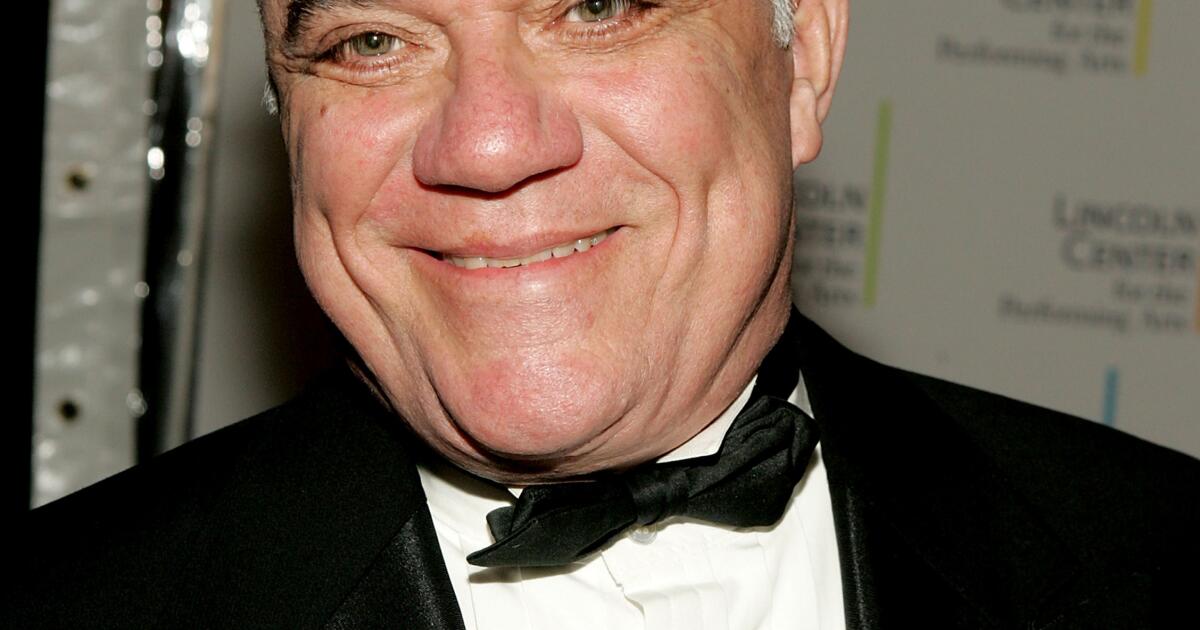
Rex Reed, a well-known movie critic and interviewer famous for his sharp wit and often harsh reviews, passed away on Tuesday at the age of 87.
Journalist William Reed passed away at his home in Manhattan after a brief illness, according to his friend William Kapfer and publicist Sean Katz. He died peacefully in his sleep, confirmed Merin Curotto, his editor at the New York Observer.
Reed consistently criticized successful actors and directors, especially those who had recently gained recognition. He seemed to target those enjoying new praise the most.
In a 2003 interview with Patrick Goldstein, Reed explained that he stopped enjoying modern films in the 1940s. He preferred classic musicals by Vincente Minnelli and crime thrillers directed by Michael Curtiz, and jokingly suggested he’d had enough if Jennifer Lopez was considered the modern equivalent of Rita Hayworth.
Goldstein observed that this writer, known for their sharp and critical profiles, has maintained a consistently honest and uncompromising style, even as tastes in criticism have changed over the years.
In a 2018 interview with the New York Times, Reed explained that while he dislikes as many films as he enjoys, he believes there’s a glut of average movies. He focuses on making work that encourages people to think more deeply, and finds it challenging to get audiences interested in quality films.

Obituaries
Ted Turner, the media mogul who created CNN and revolutionized cable television, has died.
Ronnie Reed was born on October 2, 1938, in Fort Worth, Texas. As an only child, he developed a love for movies at a young age, even sharing his reviews with his mother’s friends. He later studied journalism at Louisiana State University, where he wrote columns for both the university newspaper, the Daily Reveille, and the Baton Rouge Morning Observer.
I had the incredible opportunity to interview so many actors and filmmakers who came down South to shoot movies – and there were a lot of them, especially with all the location shooting happening in the plantation homes of Mississippi and Louisiana. I still remember when Angela Lansbury, Paul Newman, Lee Remick, Joanne Woodward, and even Orson Welles came to Baton Rouge to film ‘The Long, Hot Summer.’ I actually got to meet them all! I was particularly lucky to become good friends with Angela Lansbury; she was a truly wonderful person.
After graduating from college, Reed moved to New York City and took on various temporary jobs. He didn’t manage to get a traditional entry-level position at The New York Times, but he did get one of his first published pieces in the newspaper. This happened after he boldly attended the Venice Film Festival in 1965, where he cleverly convinced people he was a legitimate journalist and interviewed film legends like Buster Keaton and Jean-Paul Belmondo, the star of “Breathless.”
He finished writing the interview with Keaton and submitted it to the New York Times without knowing if they’d accept it. This interview turned out to be Keaton’s final one. He also sent a piece about Belmondo to the New York Herald Tribune, a newspaper that no longer exists.
In 2003, Reed told the Los Angeles Times that he became a local sensation in New York after having two stories published in the same Sunday newspaper.
These interviews formed the basis of his 1968 book, “Do You Sleep in the Nude?,” which he claimed was inspired by a question he’d once asked Ava Gardner.

Music
Nedra Talley Ross, the final surviving member of the Ronettes, a popular girl group from the 1960s, has passed away at age 80. The group, which was signed by Phil Spector, is remembered for classic songs like ‘Be My Baby.’
Over the next several years, Reed contributed articles to various magazines like Vogue, Esquire, GQ, and Women’s Wear Daily. In 1987, he joined the New York Observer when it first launched as a weekly print publication.
In 2024, Reed explained to his editor at the Observer that he took what he considered a basic form of journalism – celebrity interviews – and transformed it into something more meaningful. He believed he improved the quality of these interviews during his time at the Times, Esquire, and New York Magazine. He also noted that, coming from a poor background with no connections, building a successful journalism career in New York was a significant accomplishment.
He didn’t excuse bad behavior from celebrities. Early in his career, when Barbra Streisand arrived 3½ hours late for an interview, he vividly described her entrance: she dramatically plopped down, legs spread, and began eating a green banana, saying she only had 20 minutes. He also famously struggled to interview Warren Beatty before the release of “Bonnie and Clyde” in 1967, later writing that interviewing Beatty was like asking someone with hemophilia for a pint of blood.
In a 2013 review of the movie “Identity Thief” for the New York Observer, a publication he’d been with since its 1987 launch, he famously described actress Melissa McCarthy with harsh terms, calling her loud, overwhelmingly large, unsettling, and comparing her to a hippopotamus.
Reed criticized comedian Melissa McCarthy, calling her act a shallow spectacle built on being deliberately outrageous and overweight. He also expressed sympathy for actor Jason Bateman, wondering how someone with so much talent and appeal ended up in so many bad projects.

Entertainment & Arts
Valerie Perrine, a former Las Vegas showgirl and Academy Award nominee, has passed away at the age of 82. She was widely recognized for her roles as the wife of comedian Lenny Bruce and as Lex Luthor’s girlfriend.
Reed frequently challenged prevailing opinions, openly criticizing acclaimed films for what he considered serious weaknesses. He knew he often went against the crowd, as he famously did with “The Shape of Water” in late 2017. He wrote that he strongly disagreed with many of his fellow critics – even those he admired – about the film, and was surprised by how much praise it had received. He felt critics had excessively lauded it.
I remember being so thrilled when, just a few months after it came out, this film absolutely swept the Oscars, winning four awards – including Best Director and, amazingly, Best Picture! It was a huge moment for everyone involved, and a well-deserved win, in my opinion.
According to Reed, ‘The Shape of Water’ is a confusing and silly mess. While he considers it less nonsensical than the critically acclaimed film ‘Get Out,’ he believes it stubbornly attempts to be meaningful despite its flaws.
I was absolutely appalled when I heard what Jack Clayton said about Marlee Matlin winning her Oscar. To suggest her incredible performance in ‘Children of a Lesser God’ was just a ‘pity vote’ is just…wrong. It minimized her talent and dedication, and the idea that she didn’t deserve it because there weren’t many roles for deaf actors at the time is incredibly frustrating. She earned that Oscar, and it was a huge moment for representation, not some kind of charitable gesture.
Years after the incident, Marlee Matlin still remembered what Reed had said. In a 2021 interview with The Times’ Glenn Whipp, she recalled his offensive language, stating, “He clearly didn’t understand what being genuine meant.”
Movies
Movie critic Rex Reed just left a screening and looked utterly miserable, as if he’d endured a painful dental appointment.
Reed occasionally acted, appearing in a small role in the 1978 film “Superman” and in a few other movies during the 70s and 80s. He also hosted the show “At the Movies” alongside Bill Harris, and was a panelist on the comedic television show, “The Gong Show.”
He was openly gay but declared himself free of relationships, “except friends.”
In a 2018 interview with the New York Times, he admitted that love hadn’t always come easily to him. He also suggested that some people might be put off by those who express strong beliefs.
Reed lived in a two-bedroom, two-bathroom apartment at the Dakota in Manhattan from 1969 until he passed away. He purchased the apartment for $30,000.
Reed’s last piece for the Observer, published last December, honored Arthur L. Carter, the newspaper’s founder.
I always felt Carter truly valued writers as people, more than just what we thought about editing. He was committed to good work, and incredibly supportive of mine. He never once dismissed an idea I had, and always let me know when he especially liked something I wrote. It might sound small, but that kind of encouragement means everything to a writer, and it’s rare to find an editor who consistently offers it. He made sure his praise felt as impactful as any critique. As someone who’s been with The New York Observer since the very beginning, I can honestly say I never received a negative reaction to anything I wrote for him. Considering I sometimes tackled controversial topics, that level of consistent support was truly remarkable and something I’ll always appreciate.
It was a self-centered burst of kindness that ran counter to much of what Reed was known for.
Earlier this year, the writer told his editor at The Observer that he hopes people will remember him as someone who genuinely tried to improve things, or at least appreciated good work when he saw it. He emphasized that he doesn’t want to be seen as a grumpy or negative person, saying that’s not his true personality, according to the Associated Press.
Read More
- Total Football free codes and how to redeem them (March 2026)
- Clash of Clans May 2026: List of Weekly Events, Challenges, and Rewards
- Farming Simulator 26 arrives May 19, 2026 with immersive farming and new challenges on mobile and Switch
- Last Furry: Survival redeem codes and how to use them (April 2026)
- Gold Rate Forecast
- Honor of Kings x Attack on Titan Collab Skins: All Skins, Price, and Availability
- NTE: Neverness to Everness Original Game Soundtracks: Your Ultimate Playlist Guide
- Pixel Brave: Idle RPG redeem codes and how to use them (May 2026)
- Top 5 Best New Mobile Games to play in May 2026
- Brent Oil Forecast
2026-05-12 23:32