Key Takeaways
- The increase suggests that more Bitcoin is being retained rather than returned to the liquid market.
- Bitcoin still needs to reclaim key Fib level before the current rebound gains stronger confirmation.
- Weakness in major technology stocks could eventually redirect some capital toward BTC, but no clear rotation is visible yet.
Data from Bitbo shows that a record 16.83 million Bitcoin have been held for the long term. This means these coins haven’t been moved in at least 155 days.
At the time of this report, Bitcoin was trading around $65,400, a slight increase of about 1% for the day. This follows a recent attempt to break past $67,270, which was unsuccessful. That price level, based on Fibonacci retracement analysis, seems to be acting as a barrier to further price increases.
While the existing number of Bitcoin holders creates a limited supply, it doesn’t necessarily mean there’s been an increase in people wanting to buy it.
What the 16.83 Million BTC Record Shows
The number of coins held long-term goes up when people don’t move their crypto for at least five months. These coins are typically seen as less likely to be sold during normal ups and downs in the market.
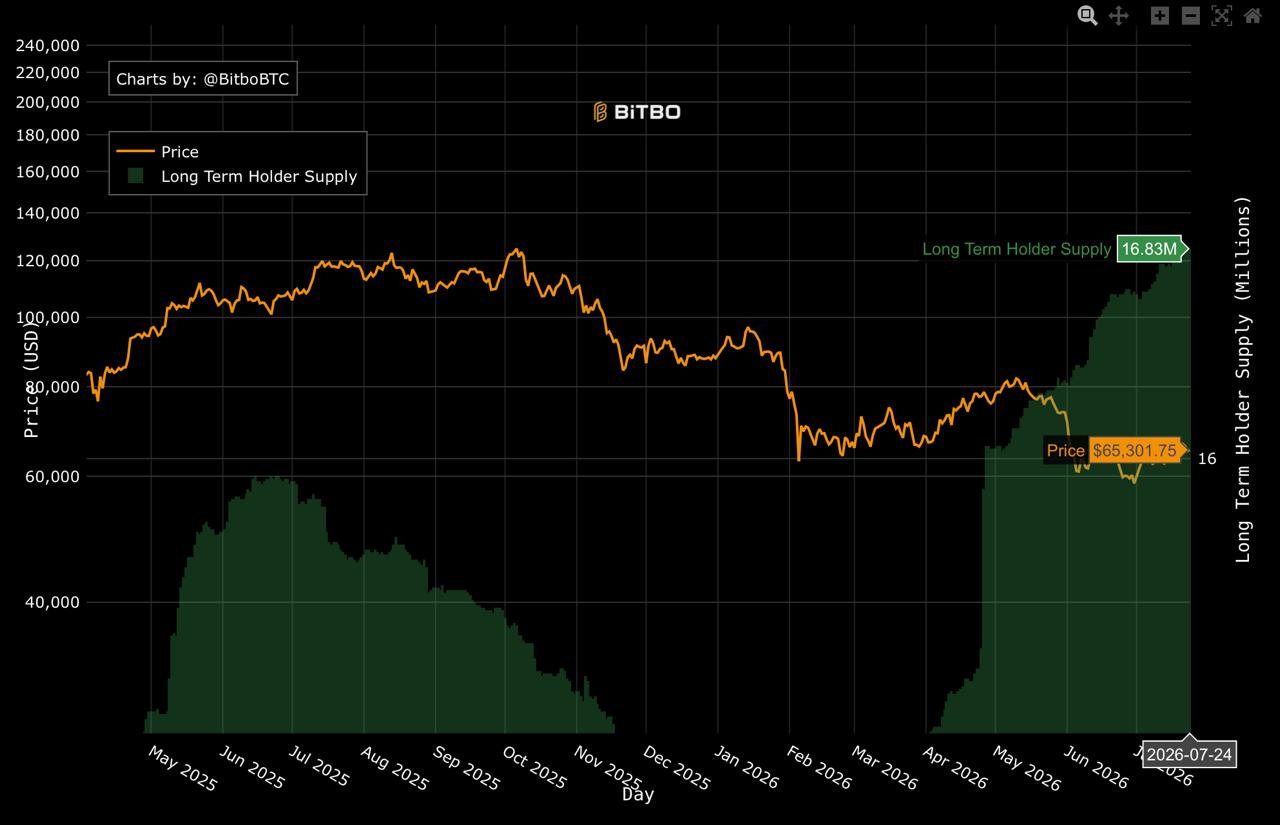
Recent data indicates more people are holding onto their Bitcoin instead of trading it often. This decrease in selling could limit the Bitcoin available on exchanges for immediate purchase, impacting both traders and those looking for quick buys.
It’s important to understand this increase doesn’t necessarily mean people are buying a lot of new cryptocurrency. Some coins are simply being reclassified because they’ve been held for over 155 days without any activity.
This measurement actually shows how well people hold onto their Bitcoin, rather than how much new Bitcoin is being bought. Despite recent price swings, hitting a record high suggests that most owners haven’t felt pressured to sell.
If demand increases in the future, this situation could become even more significant. With fewer coins being offered for sale, any new money entering the market might cause a bigger jump in price compared to when there are plenty of coins readily available.
Bitcoin Still Needs to Recover $67,270
The supply signal is constructive, but the daily price structure remains unfinished.
Recently, Bitcoin attempted to rise past $67,270 – a key technical level identified using Fibonacci retracement analysis – but fell short. This price point is now acting as an initial hurdle for any further upward movement and stands between the current recovery and several important moving averages.
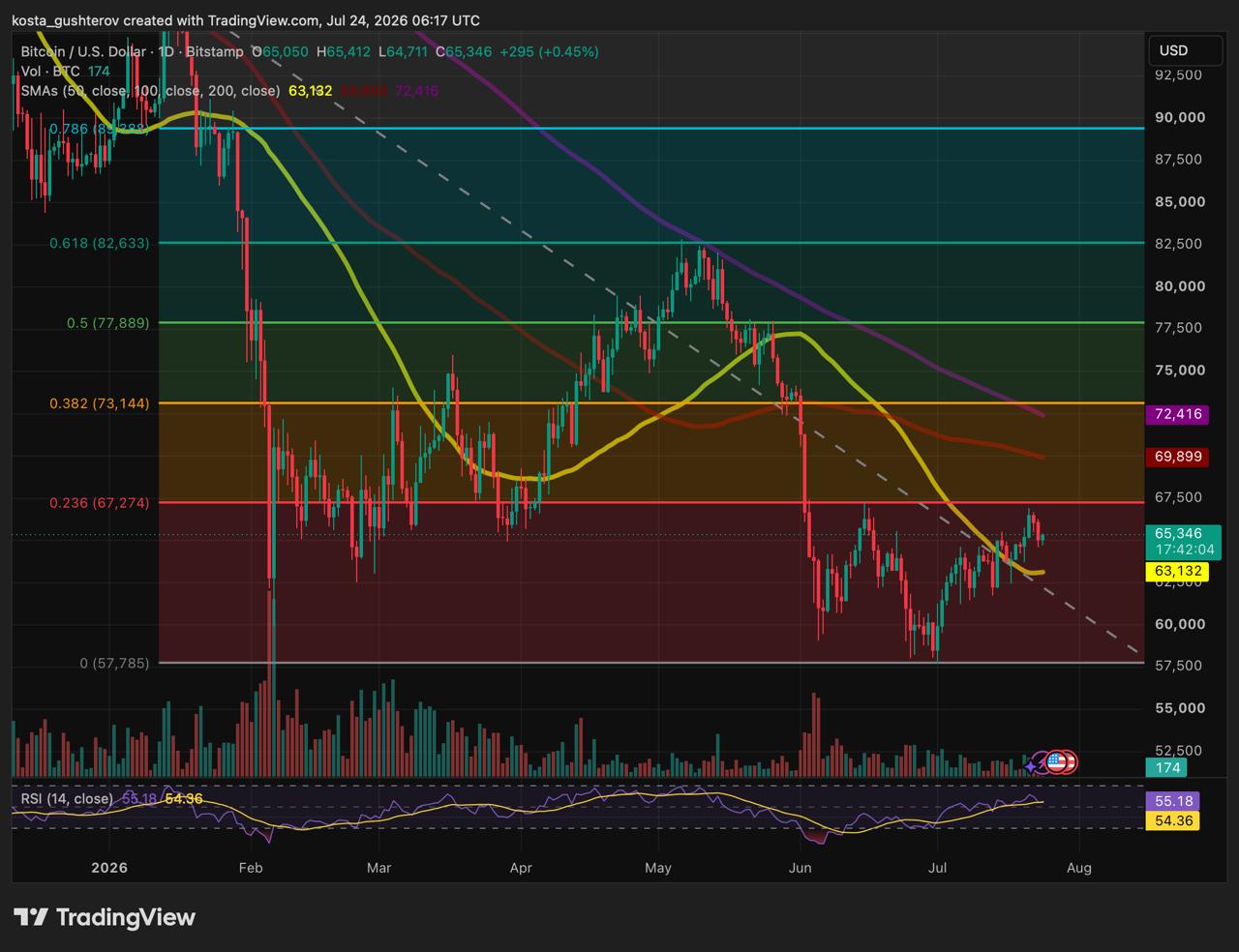
If Bitcoin rises back to $67,270 and firmly stays above that price point after a brief dip, traders will likely start looking towards around $69,900 – an important moving average indicating the trend.
This upcoming test will be challenging. Because the 100-day average continues to decrease, it might encourage people who want to sell after the recent price drop. While breaking above this average wouldn’t signal a complete turnaround, it would suggest Bitcoin is gaining more than just temporary momentum.
The Relative Strength Index (RSI) is around 55, which indicates that upward momentum is increasing, though it’s not yet at an overbought level. This suggests there’s potential for further price increases, but a sustained move above $67,270 is needed to confirm this trend based on current momentum.
If Bitcoin’s price starts to fall, it will likely find initial support around $64,600. If it drops further, the 50-day moving average, currently around $63,100, could act as the next support level.
| Bitcoin Level | Why It Matters |
|---|---|
| $67,270 | The 0.236 Fibonacci retracement and immediate resistance blocking the rebound. |
| Approximately $69,900 | The falling 100-day moving average and the next major test after a confirmed breakout. |
| $64,600 | The first nearby support if Bitcoin loses its current momentum. |
| Approximately $63,100 | The 50-day moving average and a deeper test of the improving short-term structure. |
Tech Weakness Raises a Future Rotation Question
Yahoo Finance reports that the “Magnificent Seven” stocks experienced their biggest single-day drop since April 2025 – a decline triggered by tariffs at that time. This selloff erased nearly $800 billion from the total value of these companies.
Although Bitcoin’s price increased during the same period, this doesn’t necessarily mean investors are shifting funds out of AI and large technology stocks and into Bitcoin.
A single day of trading isn’t enough to confirm a market shift. Bitcoin and tech stocks could continue to fall in tandem if investors generally decide to sell off risky investments.
If major tech companies continue to struggle, some investors might start looking for other options that are performing better. Bitcoin could be a likely choice, especially if it holds steady and breaks through the $67,270 price point.
To confirm a true shift in trend, we’d need to see this price movement continue over multiple days. More compelling proof than just a single day of gains would include increased Bitcoin trading activity, consistent money flowing into the market, and the price breaking through key resistance levels.
Tariffs, War and Oil Prices Keep Risk Elevated
The possibility of future inflows must also be weighed against a difficult macroeconomic backdrop.
New tariffs from the Trump administration are creating worries about trade, how much things cost for businesses, and potential price increases for consumers. On top of that, tensions with Iran and higher oil prices are putting further strain on the economy by making energy and shipping more expensive.
If people expect inflation to stay high, interest rates and bond yields could remain elevated, making investments that rely on readily available money less attractive. In this situation, investors might sell Bitcoin along with stocks, rather than viewing it as a safe haven when they move money out of tech companies.
Some believe that worries about things like trade, currency fluctuations, and regular financial markets could actually increase interest in Bitcoin, as it operates independently of traditional banking.
Both positive and negative results are still likely. While tariffs and global uncertainty don’t guarantee more people will buy Bitcoin, they can strengthen the idea of Bitcoin as a different type of investment. However, these factors could also make investors more cautious about taking risks.
The Supply Is Tightening Before Demand Is Confirmed
What Would Change the Setup
The next important indication will likely come from price changes, not just supply numbers. If the price stays above $67,270, it suggests increasing demand is meeting the limited supply. However, if the price continues to fall back down, Bitcoin could drop to even lower support levels.
Current economic conditions make it harder to be certain about future trends. While declining tech stocks might lead investors to explore other options, factors like tariffs, higher oil prices, and global political instability could also decrease interest in investments generally.
Bitcoin is now facing its next challenge with a limited supply, but without a clear reason for potential growth. If buyers can consistently purchase the remaining Bitcoin despite price resistance, it could signal positive momentum.
This article is for informational purposes only and shouldn’t be considered financial, investment, or trading advice. Coindoo.com doesn’t recommend any particular investment or cryptocurrency. Before making any investment decisions, be sure to do your own research and talk to a qualified financial advisor.
2026-07-24 09:56