I’ve been following a recent discussion on X where a community member, Just Hopmans, directly asked the Polygon Foundation about their responsibility to $POL token holders. The core of his concern is that while the Polygon network itself seems to be doing well operationally, the price of the $POL token isn’t reflecting that success – and he’s rightly asking for an explanation.
Polygon Labs, the company behind the Polygon blockchain, is transitioning to focus on payments, but many token holders feel they won’t directly benefit from this change. This disagreement, highlighted on July 19, 2026, shows a common challenge in the crypto world: balancing a company’s business goals with the economic principles of decentralization.
Marc has made it clear that Polygon Labs aims to be a successful company focused on blockchain-powered payments.
However, for those who hold $POL tokens, the situation is different. They don’t own any part of Polygon Labs or have rights to its earnings. The value of their investment relies solely on the $POL token itself and how the Polygon network operates.
— Just Hopmans (@HopmansJust) July 19, 2026
According to Hopmans, Polygon Labs CEO Marc Boiron has made it clear that the company is aiming to become profitable by focusing on stablecoin payments and legally compliant money transfers.
Labs is actively working to increase revenue, demonstrated by recent acquisitions like Coinme and Sequence. The company plans to become profitable by 2027 and is restructuring its teams with several layoff rounds to improve efficiency.
However, things are different for those who hold $POL tokens. These tokens don’t represent ownership in Polygon Labs or a share of its future earnings. Instead, their value increases based on how much the network is used, the fees generated, and funds held in the Community Treasury, which receives 1% of all $POL tokens created each year.
On January 9, 2026, POL was trading at about $0.156 when the Foundation announced it would be more open about how it managed its funds. However, by July 19th, the price had fallen to around $0.081 – a drop of approximately 48% – despite the network seeing record levels of transactions and stablecoin usage.
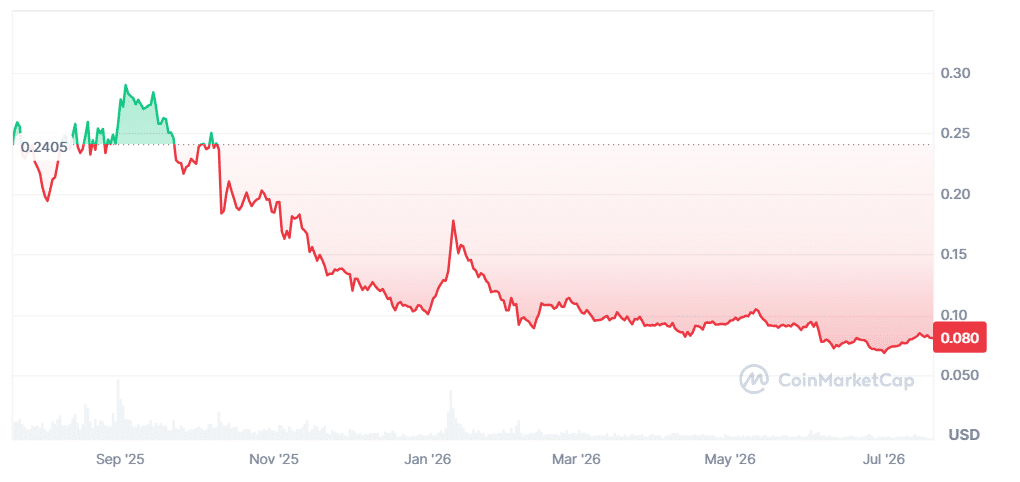
Holders’ Concerns Over Transparency and Sustainability
The main concern involves how the Foundation will report its progress. In January, leaders announced that the Foundation would decide on financial plans, while Labs would carry them out, and they would publish reports twice a year to show how well they’re meeting their objectives.
According to Hopmans, as of mid-July, the first half of 2026 report wasn’t out yet, and there was no publicly accessible plan for 2026 – including its budget or specific goals.
This is important because when the price of tokens goes down, it reduces the actual value of the tokens distributed to those who build and maintain the network – including those working on infrastructure, security, and overall development. Since these builders and projects depend on these funds, consistently increasing the token supply without seeing clear benefits could harm the network’s future strength.
Hopmans questioned whether the Foundation is continuing to work towards a long-term, stable future for Polygon and its token, $POL, that isn’t dependent on any one company. The post stated that while $POL holders can’t expect guaranteed profits, they deserve transparent communication, fulfillment of promises, and a clear understanding of how improvements benefit the token’s overall economic health.
These issues highlight common problems within the layer-2 and scaling technology space. Many projects are shifting from being community-led to being funded by venture capital, which can create conflicts when the price of their tokens doesn’t match actual activity on the blockchain. Polygon, for example, has become very popular for payments, with over $3 billion in stablecoins on its network and a leading share of certain USDC transactions. However, token owners feel that the financial gains are mostly going to the company behind Polygon (Polygon Labs) and aren’t being shared with the wider token-holding community as intended.
Foundation Emphasizes Fundamentals and Long-Term Vision
On July 20th, Sandeep Nailwal quickly defended Polygon (POL) against criticism about its price. He explained that looking at POL’s performance alone isn’t helpful – when compared to similar projects like ARB, OP, STRK, and SCR, it has performed just as well, or even better, despite recent struggles in the wider Ethereum network.
Looking at POL’s price in isolation can be misleading. When compared to other similar projects like ARB, OP, STRK, and SCR within the Polygon ecosystem, POL is competitively priced, and often performs as well or better. The recent price fluctuations are more related to broader trends within the Ethereum network as a whole.
— Sandeep | CEO, Polygon Foundation (※,※) (@sandeepnailwal) July 20, 2026
Nailwal called for a realistic look at the core data, including how many transactions are happening, how much money those transactions generate in fees, yearly income for token holders, network stability, and overall system capacity – all of which he noted have been increasing rapidly.
Revenue for the chain grew about tenfold since 2025 thanks to a surge in payment activity. Nailwal emphasized that neither he nor Boiron have direct control over the token’s price; their focus is on long-term protocol and ecosystem health. He explained that a profitable Labs operation would decrease the need to fund technology and growth with money from the POL treasury, allowing more resources to be dedicated to improving the core network.
The CEO stressed the importance of long-term planning. Having worked on Polygon for years, he and his team are making choices that prioritize the project’s success over the next ten years, rather than focusing on quick, temporary gains. He noted it’s challenging to communicate this to everyday investors who are concerned with immediate price fluctuations, compared to developers who are building the underlying infrastructure.
Evidence from various sources confirms aspects of both arguments. Data shows that Polygon handles a large volume of payments efficiently and at low cost, making it popular for stablecoin transactions. Recent activities by Meta – including paying creators in USDC on Polygon and collaborating with established financial institutions – demonstrate its growing use in the real world. Despite this, the price is still affected by factors like token releases, new coin creation, and overall market trends.
This recent development shows Polygon is growing up. By shifting its focus to a payment system that makes money – using secure and compliant tools for moving funds – Polygon Labs aims to connect with traditional financial institutions. While company leaders believe this will ultimately help the blockchain network by boosting usage and reducing spending of their reserves, the lack of clear updates has left some investors feeling excluded from the changes.
Polygon is currently working with two different organizational structures, which might lead to more discussion about how decisions are made. Improving transparency around how funds are used, setting clear goals, and demonstrating how token holders benefit could help resolve disagreements within the community. The release of a long-awaited report detailing plans for 2026 – especially if it includes specific, achievable targets – will likely be key to regaining trust as the year progresses.
This episode highlights how cryptocurrency is changing: businesses are becoming more established, but those who own tokens want a stronger voice and share in the success. Polygon specifically faces the difficulty of staying flexible as a company while also remaining accountable to its community. It will be interesting to see if improvements to their core technology lead to long-term growth for their token, or if they need to make bigger changes to ensure everyone benefits.
2026-07-20 11:35