In the grand court of crypto, Nic Carter, the founding partner at Castle Island Ventures, has donned his wizard’s hat (complete with a metaphorical pointy top) to present three fantastical paths for Bitcoin. Yes, dear reader, as we march tirelessly toward the post-quantum cryptography era-like a troupe of well-rehearsed penguins on ice-we find that we must grapple with the ghostly specter of Satoshi’s coins. The options? Well, they’re as follows: freeze those vulnerable old coins faster than you can say “quantum catastrophe,” let them loll about untouched like forgotten socks in a dryer, or embark on a rather legalistic “salvage” mission that avoids confiscation by protocol-level decree, which is about as comforting as a wet blanket in a snowstorm.
This debate is not merely an academic exercise in futility; oh no, it matters greatly! In Carter’s rather intriguing framing, there’s a veritable treasure trove of approximately 1.7 million BTC lurking in old pay-to-pubkey outputs. These coins could very well be exposed if Bitcoin decides to throw caution to the wind, deprecating elliptic curve signatures just as a cryptographically relevant quantum computer decides to pop in for tea.
The Third Option In Bitcoin’s Satoshi Coin Battle
In a post on X, which is where all the serious thinkers now gather (just imagine a digital pub where everyone is shouting their opinions), Carter mused that the Overton window-whatever that is-around quantum risk has shifted quicker than a squirrel on espresso. What was once a quaint concern relegated to the realm of conspiracy theorists is now a hot topic, discussed fervently as an engineering and governance conundrum for Bitcoin itself. “The thing about the PQ transition,” he quipped, “is that it’s impossible for a Bitcoiner to strut around claiming this protocol is cutting-edge if it turns out Bitcoin’s a laggard in the tech race.” Betting the network’s future on the hope that technology will take a nice long nap? Reckless and downright embarrassing, if you ask him!
From there, our intrepid Carter laid out the upgrade path he anticipates. After a soft fork-because nothing says “progress” like a gentle nudging-Bitcoin would likely meander through an awkward phase where users can either sign with the existing ECC-based schemes or try their luck with the shiny new post-quantum signatures. In due time, he suggested, legacy signatures like ECDSA and Schnorr would be tossed aside like yesterday’s newspapers. But here’s where things get sticky: what do we do about coins that refuse to migrate? Ah, that’s the rub.
Carter framed the ensuing dispute as a clash of titans (or at least folks in polo shirts). On one side are the institutions, custodians, exchanges, and fiduciaries who would see a freeze of non-migrated coins as the only sane option. Their thinking? They can’t possibly tolerate the risk of dormant holdings-yes, including those enigmatic Satoshi coins-being recovered by some dastardly quantum-capable entity and then dumped into the market like bad produce at a discount grocery store.
On the flip side, we have the hardcore Bitcoiners and ideological purists, those delightful souls who view any freeze as a fundamental breach of the system’s monetary and political principles. Carter articulately captured their sentiment: “Satoshi set 21 million as the monetary parameter, and no living being possesses the authority to capriciously modify that to 19.x million. Bitcoin doesn’t indulge in selective ‘irregular state changes’ like Ethereum did after the DAO incident; even after 850k BTC were lost to Mt. Gox, nothing was done at the protocol layer to recover the funds.” Talk about sticking to your guns!
Carter is convinced that the freeze camp holds more sway than many Bitcoiners care to admit, largely because the very structure of the market has transformed since those raucous blocksize wars of 2015-2017. Today’s Bitcoin is swathed in corporate entities, ETF issuers, custodians, and large asset managers, giving these “economic nodes” far more clout than they had a decade ago. And lo and behold, some influential technical figures have already climbed aboard the freeze-the-vulnerable-coins train if a genuine threat materializes.
Yet, Carter’s ideal outcome isn’t a freeze or laissez-faire chaos. Oh no, his “secret third thing” is a legal salvage framework. Under this whimsical scenario, a US quantum leader-think Google, IBM, or some other powerful wizard of the tech realm-would build the first cryptographically relevant quantum computer and, under the watchful eye of the court, recover those vulnerable coins into trust-like structures, instead of guzzling ownership outright.
“Here’s how it would unfold,” Carter explained. “A US firm, whether it’s Google, or IBM, or another quantum heavyweight, acquires a CRQC first and contracts with the US government to legally recover the 1.7 million p2pk coins. They don’t claim ownership; instead, they become a neutral receiver or court-authorized custodian, charged with securing and returning the assets to their rightful owners where possible, or otherwise holding them in trust pending judicial disposition.” Sounds almost noble, doesn’t it?
In Carter’s grand hierarchy, lawful salvage takes the crown as the best solution, a freeze comes in second, and the laissez-faire approach is languishing in the basement. “If Bitcoin really does freeze the coins,” he declared with a sense of doom, “something about Bitcoin will truly have died. It would survive, but it would be forever changed.”
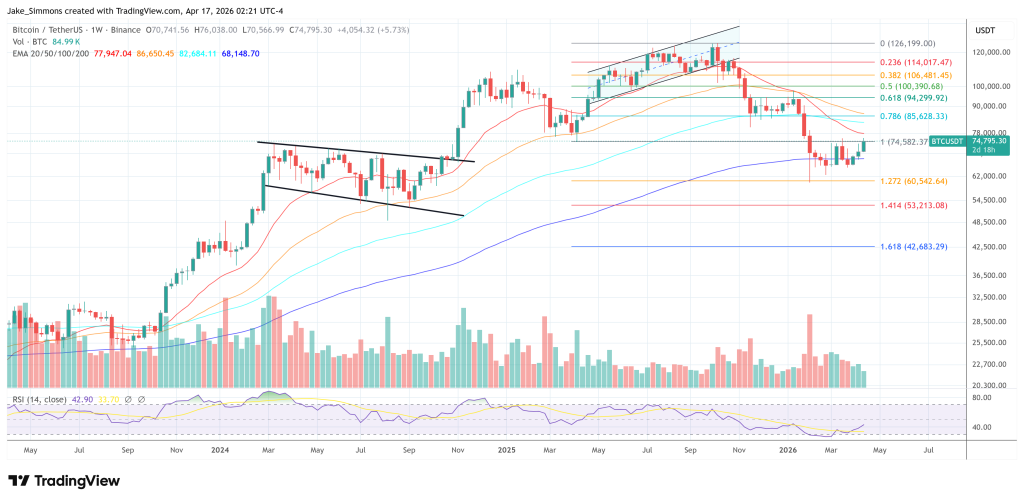
As of the latest scrawlings from the market, Bitcoin traded at a staggering $74,795, proving once again that reality is often stranger than fiction.
Read More
- Clash of Clans “Clash vs Skeleton” Event for May 2026: Details, How to Progress, Rewards and more
- Clash of Clans May 2026: List of Weekly Events, Challenges, and Rewards
- The Division Resurgence Best Weapon Guide: Tier List, Gear Breakdown, and Farming Guide
- Farming Simulator 26 arrives May 19, 2026 with immersive farming and new challenges on mobile and Switch
- Gear Defenders redeem codes and how to use them (April 2026)
- Last Furry: Survival redeem codes and how to use them (April 2026)
- Top 5 Best New Mobile Games to play in May 2026
- Mapping the Public Mind: Social Media as a Real-Time Sensor
- Total Football free codes and how to redeem them (March 2026)
- Reverse: 1999 marks its 2.5 Anniversary with Version 3.4 “Spring Unending” on April 16, 2026
2026-04-17 17:12