Ethereum’s price is currently stable, fluctuating between $2,200 and $2,400, as traders wait for a clear signal of which way it will move next. While the price hasn’t fallen, it isn’t increasing either. Recent analysis of transactions on the Binance exchange shows unusual capital movements between May 10th and 12th, hinting at planned activity beyond typical market fluctuations.
On May 10th, Binance experienced a significant surge in Ethereum deposits – the largest in six months, totaling 225,558 ETH in a single day. Usually, such a large deposit to an exchange suggests that people are preparing to sell their Ethereum, either for other cryptocurrencies or traditional money. This is a valid concern, as historical data often supports this connection.
The situation became clearer two days later. On May 12th, Binance saw a massive outflow of stablecoins – $1.32 billion left the platform at once. This showed that large investors weren’t just getting ready to sell Ethereum; they were actually withdrawing funds and reducing their ability to buy anything on the exchange.
CryptoOnchain determined this wasn’t a simple sell-off, but a significant shift in a large investor’s holdings – a rebalancing of their portfolio. The analysis focuses on explaining the actions and motivations behind these large-scale movements.
The Spot Market Is Turbulent. The Derivatives Market Is Surprisingly Calm
CryptoOnchain’s analysis reveals an unusual pattern in Ethereum’s current market structure. Recent days have seen significant ETH inflows in the spot market alongside outflows of stablecoins. However, the derivatives market on Binance is showing positive movement that isn’t reflected in the spot market activity alone, suggesting a disconnect between the two.
Ethereum funding rates on Binance have shifted from negative to positive. Just a month ago, these rates were at -0.007, but now they’re at +0.004. This change in direction is significant because consistently negative rates indicated widespread belief that the price of Ethereum would fall. Now, the shift to positive rates suggests more traders are betting on a price increase. At the same time, the total amount of open interest has grown by about 13%, meaning new traders are entering the market with confidence, rather than just holding onto existing positions.

What really sets this derivatives data apart is the lack of liquidations. Even though traders are using more leverage and there’s increased trading activity, liquidations are down 99.6% from the three-month average – almost nonexistent. This means that those adding to their positions are doing so with enough funds and confidence that price drops aren’t causing widespread, forced selling.
The report highlights two clear trends in the market. Immediate, or ‘spot,’ trading is seeing rapid shifts as large investors buy and sell quickly. At the same time, longer-term ‘derivative’ markets are building positions steadily and with increasing optimism. This combination indicates a stable, well-developed market, not one driven by risky speculation. The main risk isn’t internal; the analysis suggests that local, optimistic investment can handle pressure from within. Instead, the danger lies in unexpected economic events originating outside of the current market structure.
Ethereum Trades At A Critical Long-Term Pivot As Multi-Year Support Holds
Ethereum is currently trading around $2,250, and its price seems to be stabilizing at a key level that has previously both supported and resisted price movements during this market cycle. This suggests the market is uncertain, with neither buyers nor sellers clearly in control, leaving the possibility of both a price increase and a further decline.
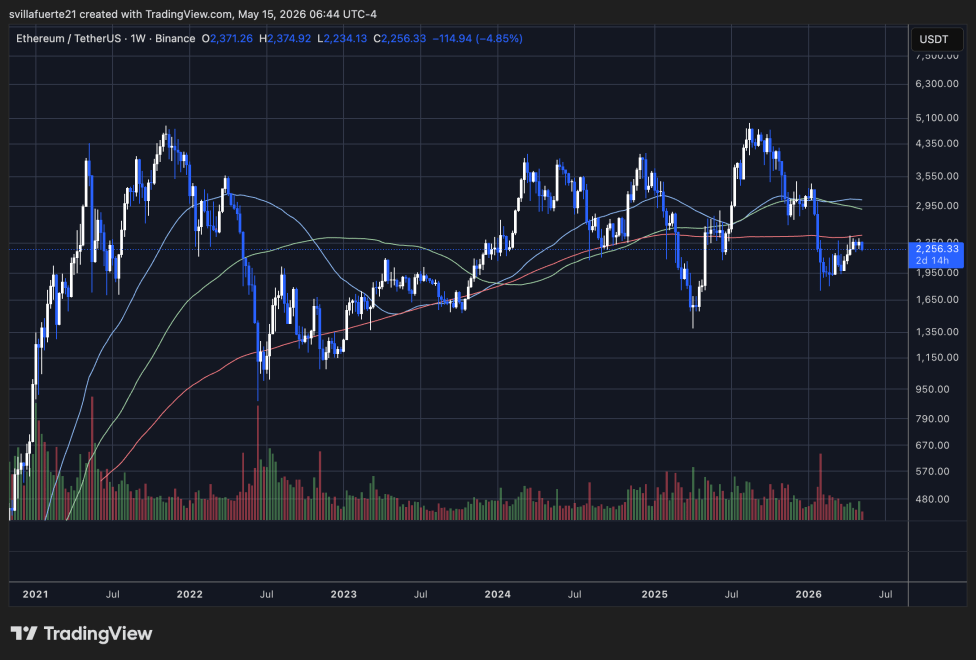
The chart illustrates Ethereum (ETH) bouncing back after a significant drop following its failure to break through the $4,000-$4,500 price range in late 2025. Although ETH briefly fell below $2,000 earlier this year, buyers stepped in and stabilized the price, holding it above a key long-term support level indicated by the weekly 200 moving average. This recovery avoided a more serious price decline and brought Ethereum back within the trading range it’s been in for the past two years.
Despite some positive signs, Ethereum is still facing challenges gaining significant upward momentum. It remains below key long-term moving averages, around $2,400-$3,000, which are acting as a ceiling on its price. The fact that it hasn’t been able to break through these levels suggests that investors are still cautious, even with recent improvements in the overall economic environment.
Trading volume has decreased notably compared to past market crashes, indicating that large-scale selling has slowed down. Currently, Ethereum is in a period of consolidation, and the outcome of this phase will likely dictate where its price goes next.
2026-05-16 06:29