Robots Learn Faster with a Little Help from Humans and Simulation
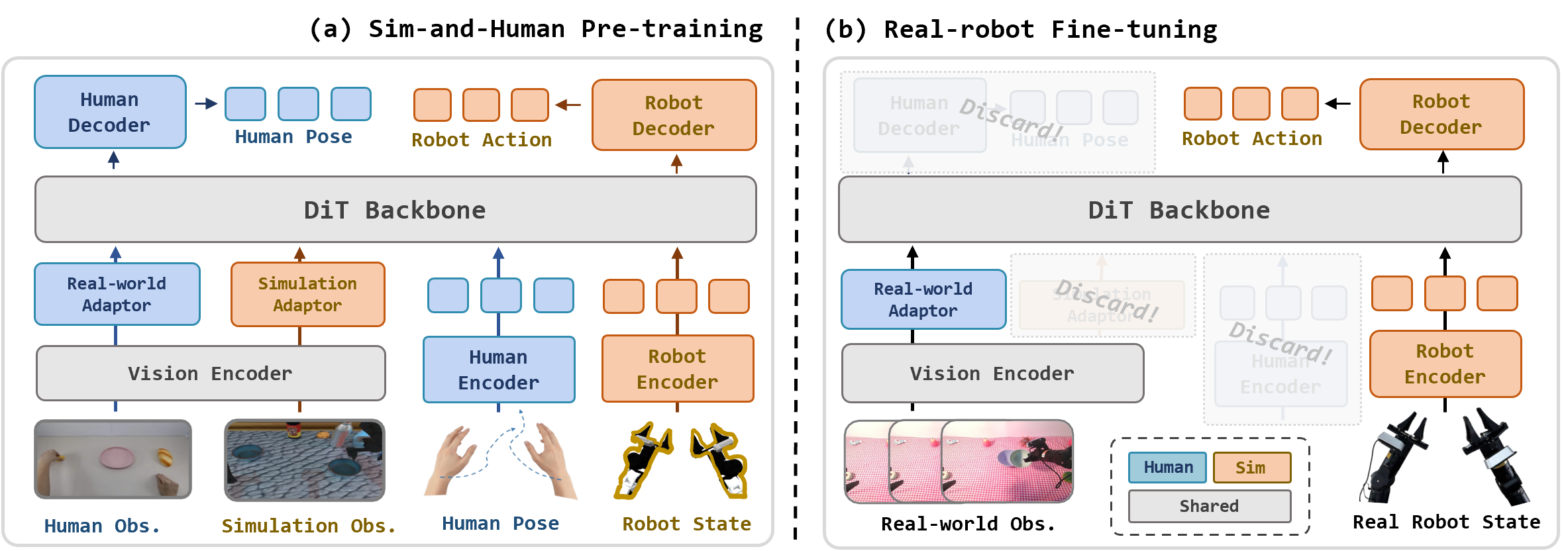
A new co-training approach combines the strengths of simulated environments and human demonstrations to dramatically improve robot learning and generalization capabilities.
A new co-training approach combines the strengths of simulated environments and human demonstrations to dramatically improve robot learning and generalization capabilities.

A new framework leverages the power of multiple AI agents to automatically optimize wireless network performance, rivaling solutions crafted by human experts.
![The system processes video input by first mapping each frame into interaction graphs [latex]G_{R}[k], G_{L}[k][/latex] representing hand movements, then translating these graphs into a coordinated, dual-arm execution plan by identifying action sequences and appropriate coordination modes-a process destined to encounter the inevitable complexities of real-world implementation.](https://arxiv.org/html/2601.19832v1/x1.png)
Researchers are leveraging information theory and scene understanding to enable dual-arm robots to learn complex bimanual tasks from simple video demonstrations.

Researchers have developed a novel neural network architecture that evolves its own structure, achieving strong performance without the need for manual design.

As robots move closer to humans, ensuring safe physical contact is paramount, and current safety standards may not be enough.
New research demonstrates that powerful AI agents don’t necessarily require massive language models, offering a path to more sustainable and accessible artificial intelligence.

New research reveals that our willingness to extend moral consideration to robots is directly linked to how much we perceive them as human, and how our personal values influence our reasoning.

Researchers have developed a powerful new AI that combines visual and textual data to accelerate discoveries in science and chemistry.

A new generation of business process management systems is emerging, powered by artificial intelligence that allows processes to execute, adapt, and improve with unprecedented autonomy.

Researchers have developed a new robotic system that leverages tactile sensing and a novel neural network architecture to achieve robust and adaptable object insertion.