Key Takeaways
- BitMart stops all trading on August 26.
- Platform operations officially end January 31, 2027.
- BMX fell roughly 47% after the announcement.
- 2026 is the heaviest year for exchange exits.
- Exchange tokens depend heavily on platform utility.
- Self-custody removes ongoing exchange counterparty exposure.
BitMart announced it stopped accepting new sign-ups, deposits, and trades starting July 26th at 1:30 AM UTC. All trading will end by August 26th at 1:00 AM UTC, and the platform is scheduled to shut down completely on January 31, 2027.
The company stated the decision followed a careful look at how it was performing, the current market, and its plans for the future. It confirmed it wasn’t facing any issues with revenue, cash flow, or customer funds.
As an analyst, I’m seeing that even a carefully managed shutdown of a crypto exchange quickly turns it into a race against time for users to withdraw their funds. This creates a really tough situation where projects and tokens tied to that exchange can become essentially worthless *before* the platform actually goes offline – which is concerning.
Important Notice
BitMart has decided to close its trading platform after thoroughly reviewing the company’s situation, current market trends, and long-term plans. This was a difficult decision, and we sincerely apologize for any inconvenience it may cause.
— BitMart (@BitMartExchange) July 26, 2026
The Practical Deadline Comes Before January 2027
BitMart’s final closure date is months away. The date that matters to active users is much closer.
Starting August 26th, the exchange will halt all trading, including current spot and futures markets. Futures accounts will only allow you to close existing positions, and no new spot orders are being taken. Features like copy trading, grid trading, and API trading will also be shut down.
If you have any open derivative trades when trading stops, they’ll be closed out using a fair market price determined by our standard rules. Importantly, traders will no longer be able to control *when* their positions are closed starting in August – five months before the platform completely shuts down.
BitMart advises users to close their trades, finish verifying their accounts, and request withdrawals by August 26th. While withdrawals should still be possible after that date, they might be handled differently and may need extra verification.
If you wait to withdraw funds or request assistance, you might experience delays due to high demand. This can mean slower processing times, more thorough compliance checks, or a longer wait for a response from our support team, especially when we’re receiving a lot of requests. Simply put, high traffic can make everything take a little longer and be more difficult.
BMX Lost the Business That Gave It Utility
After the announcement, the price of BitMart’s BMX token dropped around 47%, as shown in the daily price chart.
BMX experienced a significant drop in price, falling below its 50-day ($0.30), 100-day ($0.31), and 200-day ($0.327) moving averages. At the time of observation, the price was approximately $0.0892, much lower than where it traded before news of the closure became public.
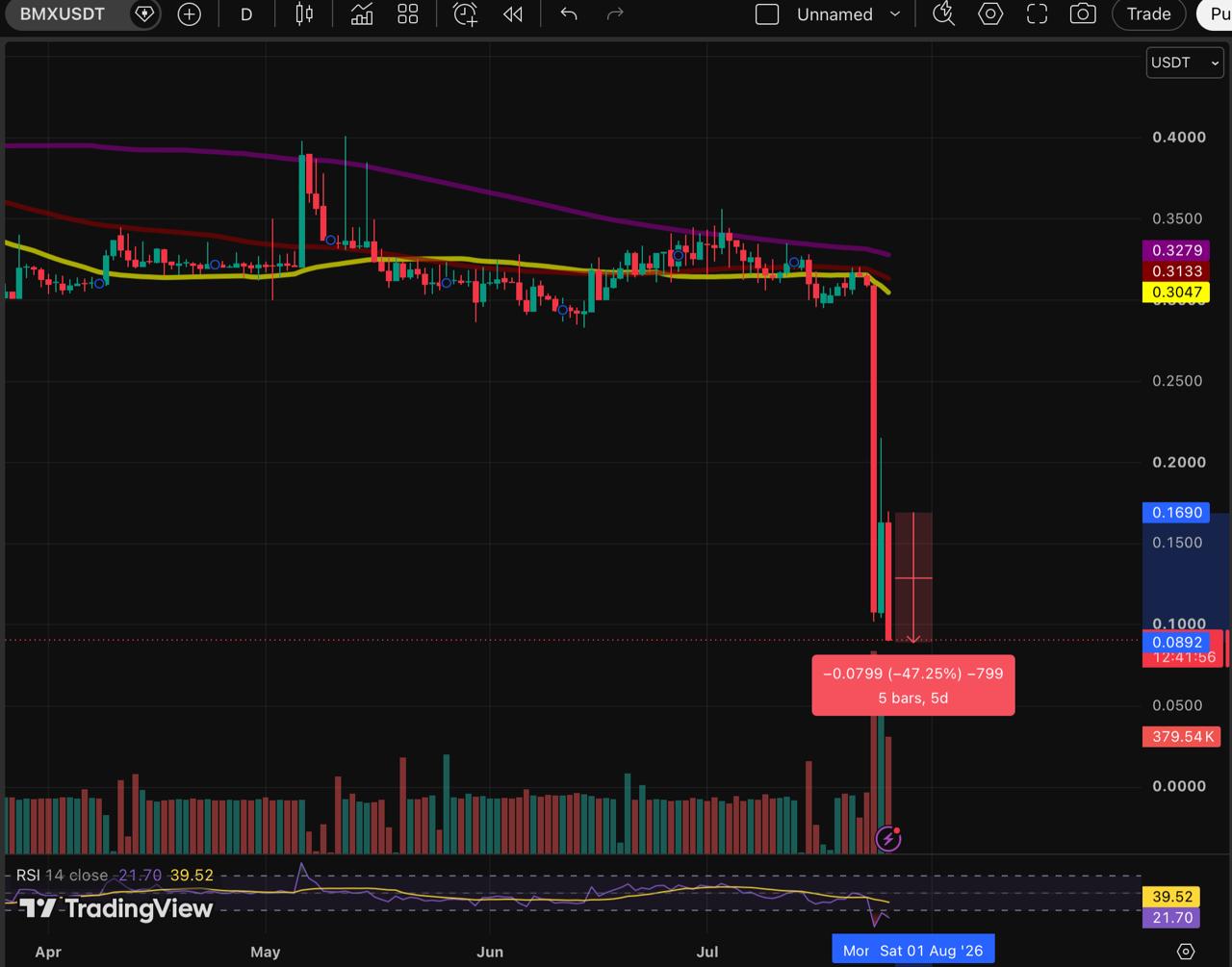
The decreasing value of BMX stems from a shift in how it’s used. Originally, as described by BitMart, the token was designed to offer benefits within their exchange – like lower trading costs. BitMart also intended to use some of its earnings to buy back and destroy BMX tokens, potentially increasing their value.
Both of these strategies rely on a functioning business. Trade discounts stop working once trading ceases, and a profit-linked buyback program loses its value if the company is shutting down.
Even after BitMart shuts down, the BMX token will still be available as an ERC-20 token. BitMart’s announcement doesn’t mention any plans for the future of the token, such as buying back tokens, continuing benefits for token holders, or any other related programs.
The Difference Between a Token and a Share
An exchange token can provide benefits like lower fees, rewards for holding (staking), and access to new projects. Its value is often linked to how well the exchange itself is doing, as these benefits are funded by the exchange’s earnings and growth.
Owning BMX tokens doesn’t give holders any rights to BitMart’s money, users, technology, or what’s left of its assets as the exchange shuts down. This is according to how BitMart has described what BMX does.
People who own these tokens can benefit when more trading happens and the platform earns more revenue. However, unlike shareholders, they don’t have any legal protections or rights to remaining assets if the business fails.
BitMart’s announcement follows a similar move by BitMEX, which plans to stop trading in September 2026. Like BitMEX, BitMart has seen a significant drop in activity – its token value fell 92%, and interest in Bitcoin trading on the platform decreased 96% from earlier in 2024. This indicates that both the token and the exchange are losing popularity and importance.
BitMEX is currently dealing with a lawsuit that claims they were involved in theft and used insider information for trading. This legal issue surfaced while the exchange was already pausing operations, but there’s no proof it was the reason for the shutdown.
Five Ways an Exchange Leaves the Market
It’s common to see a long list when people talk about crypto exchanges that have failed or shut down, but the reasons behind those failures are actually quite varied.
- Security failure: Assets are stolen through an external breach or internal compromise. BitGrail closed in 2018 after a large Nano theft, while Cryptopia was hacked in January 2019 and entered liquidation four months later.
- Insolvency: The exchange cannot meet its obligations. Mt. Gox stopped operating in 2014 after a major theft contributed to its collapse.
- Fraud: Customer assets or company records are deliberately misused. FTX collapsed in 2022 after customer deposits were misappropriated, leading to the conviction of founder Sam Bankman-Fried, while Thodex ended in 2021 and BitConnect in 2018.
- Regulatory shutdown: Authorities prevent the platform from continuing. BTC-e was seized by law enforcement in 2017 over its role in processing criminal funds.
- Commercial exit: Declining revenue, volume or strategic relevance makes continued operation unattractive. LocalBitcoins stopped active trading in 2023 after years of falling volume, and DMM Bitcoin transferred customer accounts and assets to SBI VC Trade in 2025.
Based on what BitMart has shared, it currently appears to be in the process of an orderly shutdown while still allowing users to withdraw their funds.
Nenter Chow, the former CEO of BitMart, shared information that contradicts the company’s explanation. In a post on X (formerly Twitter), he stated he was fired on July 24th, two days before the public announcement about the closure. He said he wasn’t involved in the decision and only found out about it when the news became public. Chow advised users to follow BitMart’s official updates and act quickly on the closure notice.
I’m writing to explain my views on BitMart’s announcement from July 26, 2026, about their plan to gradually close down their trading services.
On July 24, 2026, I was told my position as Global CEO was ending and that I would be leaving the company right away. I…
— Nenter (@50Nent) July 26, 2026
BitMart hasn’t officially commented on the situation, and this information comes solely from Chow’s statement. While it doesn’t explain why the decision was made, it indicates that someone higher than the CEO – likely the owners – was responsible for the timing of the closure, not the company’s management.
This categorization isn’t final and could be revised if new information comes to light. Without a clear explanation of the finances, the exact business reason remains unclear, and guessing isn’t a good enough answer.
Eight Years Put BitMart Above the Median
BitMart launched in 2017 and started its exchange operations in 2018. By July 2025, it had grown to serve over 10 million users in more than 200 countries. However, just a year later, the company is shutting down.
After operating for eight years, BitMart has outperformed most cryptocurrency exchanges. Of the 33 major exchanges that have closed down since 2012, the average lasted only four years.
- Fourteen of the 33, or 42%, closed within three years. Bitcoinica and Altsbit lasted under twelve months.
- Six lasted exactly two years, among them TradeHill, Bitfloor and FCoin.
- Only eight, or 24%, reached eight years or more.
- Four survived a decade: LocalBitcoins, KUNA, Zondacrypto and BitMEX.
As a researcher tracking the crypto space, I’ve noticed a concerning trend this year. 2026 is already seeing more crypto platform closures than any other year we’ve observed. We’ve already documented exits from Zondacrypto, Bitcom, AscendEX, BitMEX, and BitMart, and it’s only halfway through the year! This surpasses the previous high of four closures we saw back in 2019.
The group of crypto exchanges that launched in 2026 is notably mature. These five platforms have been operating for an average of over nine years, significantly longer than the typical four-year lifespan of those on this list. Two of them – Zondacrypto and BitMEX – are actually the longest-running exchanges featured, both having operated for twelve years. This year’s exchange closures primarily affect well-established platforms.
The reasons for these failures are as varied as the amount of time these businesses lasted. The list includes events like the collapse of Mt. Gox, the BitConnect scam, and LocalBitcoins shutting down by choice. Simply existing for a long time didn’t guarantee survival – lasting ten years didn’t mean a company would make it through another.
An exchange is considered a functioning business no matter how long it’s been around, but it needs consistent trading, enough income from fees, access to banking services, secure storage of assets, regulatory approval, capable leadership, and customer confidence to maintain activity. While an exchange can still operate even if some of these elements weaken, users usually only find out it’s closing after management has already spent considerable time determining if the business can be saved.
How to Exit Before the Deadline
As a researcher following these events, I believe BitMart’s approach – even with its delays – is far better than what we saw with FTX. The FTX collapse in late 2022 led to creditors only starting to receive repayments in early 2025, and distributions are still ongoing into 2026. What’s particularly concerning is that those repayments are based on the value of assets *at the time of the collapse*, meaning Bitcoin holders don’t get back the full amount of coins they originally deposited, even if their claim is fully approved.
BitMart users have been instructed to finalize any open trades, cash out their investments, obtain account histories, and move their funds. Delaying until the absolute last moment is the least favorable course of action.
The exchange notes that when you request a withdrawal, you may be asked to verify your identity, provide information about where your funds came from, and confirm your address. They also conduct checks to ensure compliance with regulations. Withdrawals might take longer than usual due to network issues or high request volumes.
The exchange has also cautioned users about scams promising quicker withdrawals, account access, or faster processing for a fee. BitMart clarifies that it will never ask for passwords, security codes, private keys, or recovery phrases via private messages.
The practical response is administrative:
- Review all spot balances and open derivatives positions.
- Redeem eligible staking, lending and Earn products.
- Complete required identity and security verification early.
- Confirm the correct blockchain and destination address.
- Download trading, deposit and withdrawal records.
- Use only BitMart’s official website and support channels.
These actions don’t rely on guessing if BMX will bounce back or if BitMart will change its mind. Instead, they focus on lessening our reliance on services that are gradually being shut down.
What “Not Your Keys” Actually Means
The saying “not your keys, not your coins” is often used to dismiss any service where you don’t directly control your cryptocurrency. However, it specifically means that if you keep your crypto on an exchange, you’re relying on that exchange to let you withdraw it – and they control whether or not that happens.
Users have funds in their accounts and have made requests to withdraw them. The platform securely controls the necessary keys to actually move those funds on the blockchain.
Taking self-custody eliminates the risk of relying on another company. However, it means you become fully responsible for keeping your private keys, backups, addresses, and transactions safe and secure.
The situation with BitMart highlights a key difference: if an exchange shuts down, users have to go through the platform’s process to get their money back – meeting deadlines, getting approvals, and waiting for withdrawals. But if you hold your assets in a wallet you control yourself, you don’t rely on anyone else.
BitMart might be able to finish shutting down smoothly and give back all remaining funds to its users. However, the fall of BMX and the timeframe for withdrawals demonstrate how rapidly things can change when a company decides to abandon a cryptocurrency project. While the digital tokens themselves still exist on the blockchain, access to them is lost as the company disappears.
- Disclaimer: This article is for informational and analytical purposes only and does not constitute financial, investment or legal advice. Users should review BitMart’s official announcements and verify all withdrawal instructions through the exchange’s authorised channels.
2026-07-27 16:33