Japan’s Liberal Democratic Party swept into office like a bargain hunter at a clearance sale, sending markets into a tizzy and briefly propelling Bitcoin above $72,000. Because nothing says “economic optimism” like a cryptocurrency that behaves like a caffeinated squirrel on a sugar high.
LDP Victory: When Democracy Meets Market Euphoria
The LDP’s win was the financial equivalent of a surprise birthday party-everyone showed up, and the Nikkei 225 even brought a cake, surging past 57,000 for the first time. According to the BBC, analysts are betting on Sanae Takaichi’s pro-business agenda to revive Japan’s economy, which has been about as lively as a retirement home bingo night. This bullish energy spread across Asia faster than gossip at a family reunion, with the Shanghai Composite reclaiming the 4,100 level like it was a long-lost heirloom.
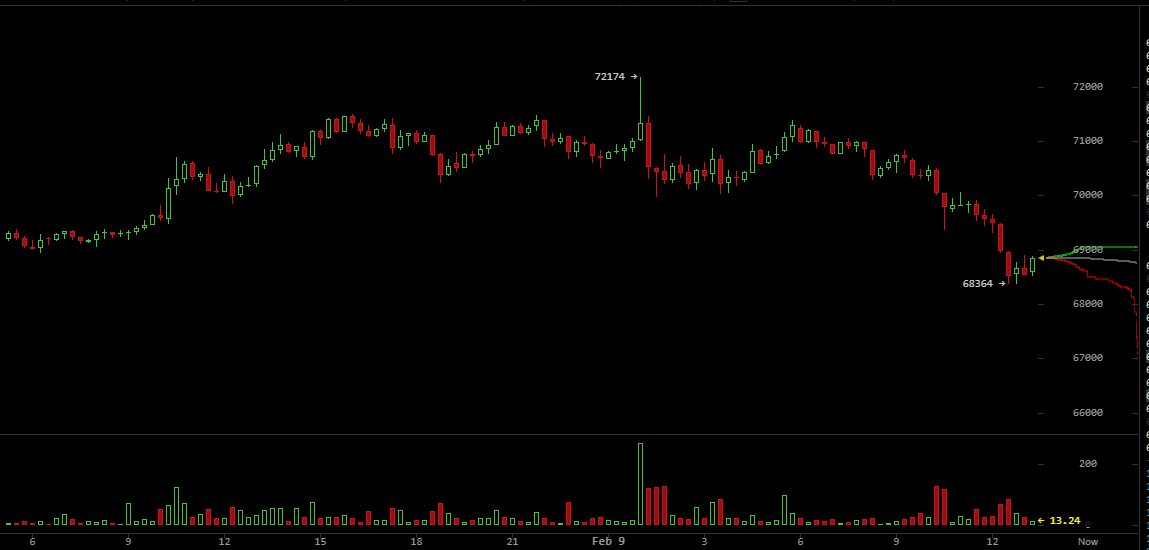
Cryptocurrency, still nursing a hangover from last week’s downturn, joined the party with Bitcoin climbing to $72,174. But like a guest who shows up just to eat all the appetizers and leave, it couldn’t hold its ground, tumbling below $69,000 by 5:23 a.m. EST. This “fakeout” left short sellers feeling like they’d been stood up on a first date, with nearly $82 million in liquidations within 12 hours. Ouch.
Adding insult to injury, South Korea’s Bithumb decided to spice things up by accidentally transferring $40 billion in Bitcoin to users. Yes, you read that right. $40 billion. Not a typo. Not a drill. Just a casual Tuesday in the crypto world. The Financial Supervisory Service (FSS) is now investigating, reminding everyone that “oops” isn’t a valid legal defense. Lee Kang-hee, the FSS chief, has vowed to tighten oversight, because apparently, the sector’s vulnerabilities are as gaping as a plot hole in a soap opera.
Recipients of the windfall are legally required to return the funds, which is about as likely as getting a refund for a bad haircut. Meanwhile, the FSS is eyeing “ghost tokens” and Bitcoin ETFs with the same enthusiasm as a parent chaperoning a middle school dance. Plans to expand authority under the Digital Asset Basic Law are underway, because nothing says “trust us” like more regulations.
China’s Dollar Divorce: Now with Extra Drama
As if Bitcoin didn’t have enough on its plate, China decided to join the fun by instructing banks to cut ties with U.S. Treasuries. Officially, it’s a response to market volatility, but let’s call it what it is: a financial cold war. Beijing is basically saying, “We’re done with your dollar-based shenanigans,” and crypto is caught in the crossfire. As the world’s two largest economies play a game of financial chicken, Bitcoin is the nervous bystander, sweating through its liquidations.
Bitcoin’s dip below $70,000 shaved its market cap to under $1.4 trillion, leaving the crypto economy at a modest $2.4 trillion. Currently stuck in the $68,000 to $70,000 range, optimists are hoping for a rebound to $72,000-$82,000 by the end of February. Pessimists, however, are eyeing a drop to $40,000 within eight months if liquidity stays as tight as a pair of skinny jeans after Thanksgiving dinner. Standard Chartered, ever the buzzkill, predicts a “worst-case” floor of $55,000 if ETF outflows pick up. Because nothing says “fun” like a financial freefall.
FAQ ❓
- How did Japan’s election impact markets? Like a shot of espresso to a sleepy economy, pushing the Nikkei past 57,000 and lifting Asian equities.
- What happened to Bitcoin after the rally? It spiked to $72,174, then tripped over its own shoelaces and fell below $69,000, liquidating $82 million in shorts. Classic Bitcoin.
- Why is South Korea investigating Bithumb? Because someone hit the “send all” button by mistake, transferring $40 billion in Bitcoin. Oops.
- How is China’s policy affecting crypto? Like a game of Jenga, Beijing’s move is adding uncertainty, putting pressure on Bitcoin and its volatile friends.
Read More
- The Division Resurgence Best Weapon Guide: Tier List, Gear Breakdown, and Farming Guide
- Kagurabachi Chapter 118 Release Date, Time & Where to Read Manga
- Last Furry: Survival redeem codes and how to use them (April 2026)
- Clash of Clans Sound of Clash Event for April 2026: Details, How to Progress, Rewards and more
- Gold Rate Forecast
- Annulus redeem codes and how to use them (April 2026)
- Silver Rate Forecast
- All Mobile Games (Android and iOS) releasing in April 2026
- Gear Defenders redeem codes and how to use them (April 2026)
- Top 5 Best New Mobile Games to play in April 2026
2026-02-09 16:17