Despite recent market challenges, the value of real-world assets brought onto blockchains (known as tokenized RWA) has significantly increased, almost quadrupling in the last year.
Even with increasing competition from Solana, Ethereum remains the leading cryptocurrency, controlling over half of the market.
RWA Growth Accelerates Despite Market Downturn
The total value of real-world assets (RWAs) held as digital tokens hit a record $26.7 billion in March, according to data from RWA.xyz. Currently, that value is around $26.6 billion – a significant increase of 309% compared to $6.5 billion a year earlier.
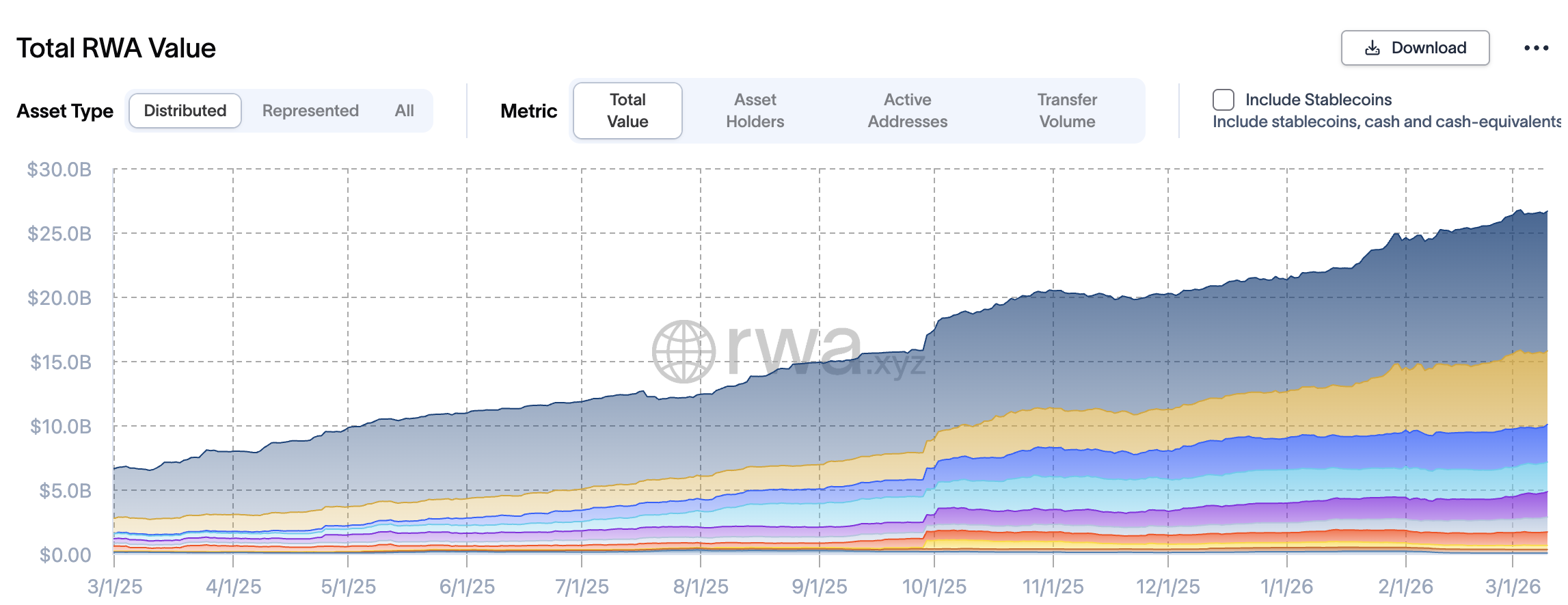
This significant growth is especially remarkable considering the current state of the market. Recently, the cryptocurrency market has been marked by a lot of uncertainty and fear.
I’m seeing more and more interest in tokenized Real World Assets, which tells me investors like me are really starting to pile into them. It seems like this trend is definitely continuing to gain momentum.
The number of people holding cryptocurrencies on Ethereum, Solana, Arbitrum, BNB Chain, and other platforms has increased significantly at the beginning of 2026. Notably, a recent BeInCrypto report showed that Solana briefly had more holders of Real World Assets (RWAs) than Ethereum.
Recent data shows Solana now has about 157,682 people holding Real World Assets (RWAs), a bit more than Ethereum. However, Ethereum still leads overall in the RWA space.
Currently, this network holds over 57% of the market for real-world asset (RWA) tokenization and powers approximately 675 tokenization projects. This solidifies its place as the top choice for institutions looking to tokenize assets.
Growing interest from traditional financial institutions is further solidifying Ethereum’s position. A recent example is JPMorgan’s launch of its inaugural tokenized money-market fund built on the Ethereum network in December.
As a researcher tracking digital asset usage, I’m excited to report that USDC activity on Ethereum has reached a new peak! February 2026 saw over $1.7 trillion in monthly transfers, which is a remarkable 250% increase compared to the previous year. And honestly, I think this is just the beginning. As we see more and more AI agents starting to operate directly on the blockchain, I expect these numbers to grow even more significantly in the years ahead.
— Leon Waidmann (@LeonWaidmann) March 10, 2026
Why Wall Street Still Picks Ethereum for Tokenization
So, why are institutions choosing Ethereum? According to experts at BeInCrypto’s Expert Council – including those from Standard Chartered and Bitwise – it’s not necessarily about believing in Ethereum’s principles. Instead, it comes down to practical factors like managing risk, feeling comfortable with the platform, and its ability to withstand challenges.
According to Geoff Kendrick, who leads digital asset research at Standard Chartered, Ethereum is expected to be the primary blockchain platform for traditional financial institutions over the next two years.
According to Geoff Kendrick at Standard Chartered, Ethereum is likely to remain dominant in the near future due to increasing involvement from traditional finance (TradFi). He believes that as banks and other financial institutions start building on blockchain technology, most of that development will occur on the Ethereum platform for at least the next two years.
Subscribe to our YouTube channel to watch leaders and journalists provide expert insights
He believes people might start using other networks later on, especially those like Solana that provide cheaper and quicker transactions.
Geoff Kendrick explained to BeInCrypto that in traditional finance (TradFi), there’s a common idea: doing the right thing can lead to problems, but taking bigger risks is often what keeps you employed. However, he believes that over the next few years, Ethereum will attract investment from TradFi and its token price will increase as a result.
Ethereum is currently the leading public blockchain, but it’s worth considering whether private or permissioned blockchains might eventually become strong competitors.
Private and permissioned blockchains are appealing to businesses and organizations because they offer more control, enhanced privacy, help with meeting regulations, speed up transactions, and provide clearer, more predictable expenses.
These systems sacrifice some of the key benefits of public blockchains, like being open to everyone and free from central control. Bitwise CIO Matt Hougan believes institutions will likely investigate these more regulated blockchain options.

I’m seeing a lot of companies cautiously exploring blockchain technology – they’re testing the waters, so to speak. And honestly, I think there’s a real chance some of these private, permissioned blockchains could become big players as more institutions start to get involved with crypto.
It remains to be seen if Ethereum can hold onto its dominant 57% market share as other cryptocurrencies gain ground, but currently, Wall Street still favors Ethereum.
2026-03-11 19:24