Markets

What to know:
- Hyperliquid will introduce portfolio margin for real trading accounts, letting users offset risk across positions and support larger trades with less collateral. (Because nothing says “I’m a pro” like risking your life savings on a spreadsheet.)
- Access to portfolio margin will be limited to master accounts with more than $5 million in weighted trading volume, aiming to confine the feature to experienced traders. (Or, as we call them, “those who’ve survived the apocalypse of their own making.”)
- The exchange will impose strict platformwide and per-user caps on supplying and borrowing assets, including stablecoins, HYPE and bitcoin, to enhance capital efficiency while containing systemic risk. (Because the universe’s tendency to collapse under its own weight is a problem we can’t solve, but we can at least limit your ability to contribute.)
Decentralized trading platform Hyperliquid will soon roll out an upgrade that makes it easier for traders to manage bigger positions without tying up as much capital. (Or, as we like to call it, “the future of financial jujitsu.”)
The upcoming upgrade will activate “portfolio margin” for real trading accounts, allowing traders to offset risk across multiple positions in their portfolio. (Imagine if your investments could multitask. It’s like a gym for your money, but with fewer mirrors and more spreadsheets.)
Instead of posting separate collateral requirements for every trade, the system calculates a net collateral requirement based on the overall risk of the portfolio, allowing users to support multiple positions with a smaller amount of capital. (Because who needs security when you can just hope the algorithm doesn’t hate you?)
The feature is set to move from pre-alpha testing to an alpha phase in the next network upgrade, meaning it will no longer be limited to experimental accounts. The Telegram announcement did not provide the exact date of the upgrade. (Because nothing says “trust us” like a vague timeline and a screenshot of a cat.)
The new margining system could further strengthen Hyperliquid’s appeal among active traders, by allowing them to deploy capital more efficiently and run larger and more complex positions in the exchange. (Or, as the CEO puts it, “we’re just here to make your life a little more interesting.”)
The decentralized platform has already gained traction as a venue for round-the-clock price discovery, particularly over weekends when traditional markets are closed. (Because nothing says “financial freedom” like trading at 3 a.m. while your friends are asleep.)
“Users will be able to borrow up to 1M USDC or USDH against their spot HYPE or spot BTC. This unlocks an unprecedented amount of capital efficiency and yield opportunities for borrowers & lenders,” Hyperliquid follower Steven.hl said on X. (And also, presumably, a lot of late-night existential crises.)
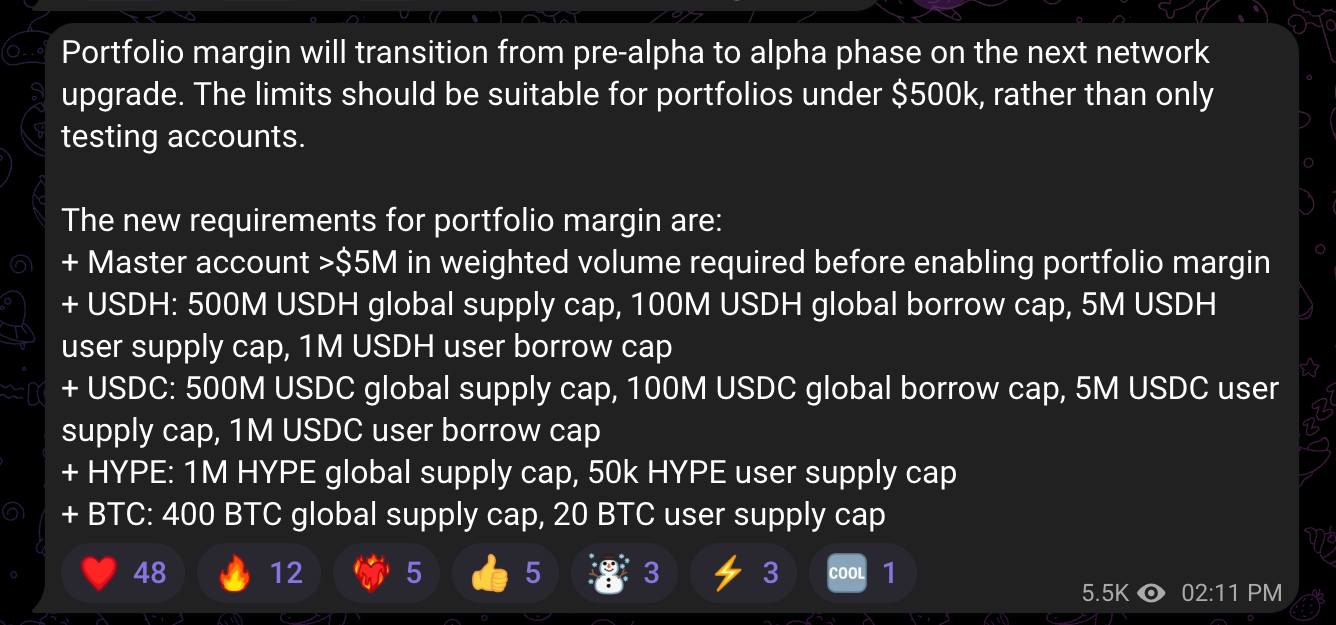
Access to portfolio margin, however, will be restricted to master accounts that have logged more than $5 million in weighted trading volume, a safeguard designed to ensure experienced participants are using the system. (Because nothing says “experienced” like a number that makes your accountant cry.)
To manage the additional risk that comes with portfolio margin, Hyperliquid will also introduce caps on how much of each asset can be supplied or borrowed, both at the platform level and per user. Stablecoins USDH and USDC, for instance, will each have a 500 million global supply cap and a 100 million global borrow cap, while individual users will be limited to 5 million supplied and 1 million borrowed. (Because the platform’s version of a strict diet is just a fancy way of saying “don’t eat the entire cake.”)
Limits will apply to other assets. HYPE deposits will be capped at 1 million tokens globally, with a 50,000 token limit per user, while bitcoin supply will be limited to 400 BTC across the platform and 20 BTC per user. (Because even the blockchain can’t handle your greed.)
The guardrails are designed to balance the capital efficiency benefits of portfolio margin with platform-wide risk controls, ensuring that traders can deploy funds more efficiently without overexposing the system. In simple terms: traders can go bigger, but nobody can accidentally blow up the system. (Or, as the developers put it, “we’re not responsible for your life choices.”)
2026-03-10 14:20