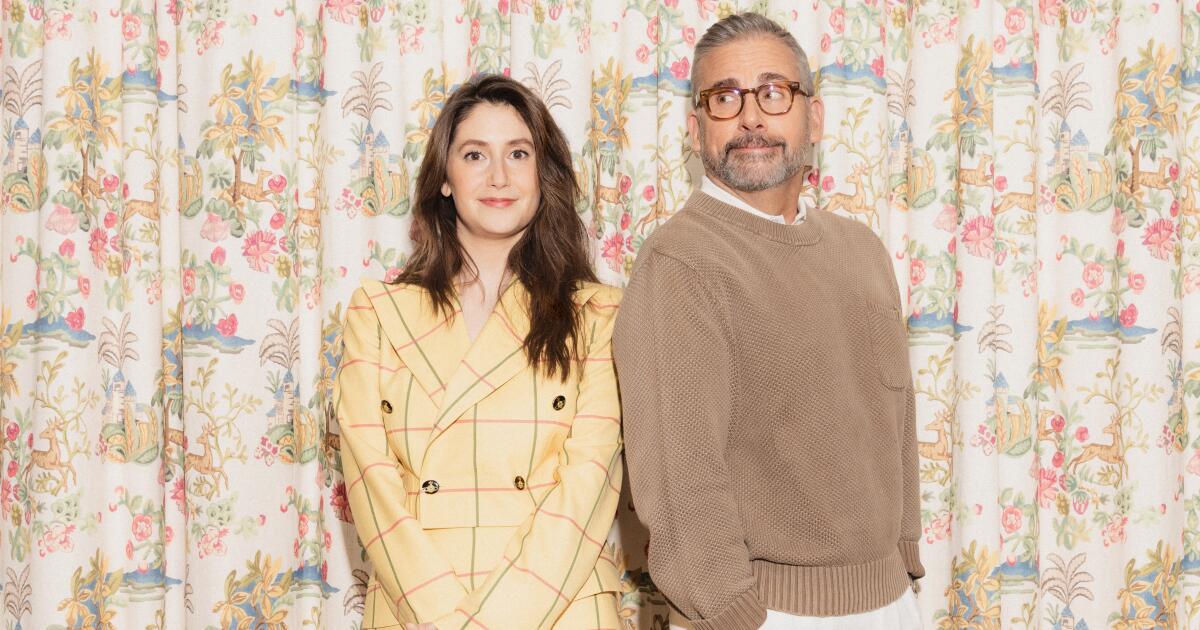
Steve Carell immediately recognized Charly Clive as the perfect fit to play his daughter in the upcoming HBO series, “Rooster.”
He recalls that it didn’t feel like Charly was trying out for the part. It felt more like two actors simply rehearsing a scene together. He even thought they were finished after that initial read-through, speaking from a Midtown Manhattan hotel room earlier this week.
Clive would have been happy with just the Zoom meeting. She says, simply meeting Steve Carell was a highlight for her.
The new series stars Greg and Katie Russo. Greg is a popular novelist known for his action-packed books and a charismatic hero named Rooster. Katie is an art history professor who’s struggling with a difficult situation: she recently discovered her husband (played by Phil Dunster from “Ted Lasso”) had an affair with a student, and they are now a couple. Seeing his daughter upset, Greg is determined to support her in any way he can. The series premiered on Sunday.

In ‘Rooster,’ Steve Carell leads a gentle comedy about a father-daughter relationship
The new HBO comedy, from the creators of shows like ‘Ted Lasso’, features Steve Carell playing a worried dad trying to support his daughter, a college professor, after a difficult breakup.
“Rooster,” a show created by Bill Lawrence and Matt Tarses, blends heartfelt character development with lighthearted humor and a generally positive tone – a style Bill Lawrence has become known for. Steve Carell and Kristen Cloke spoke about playing father and daughter on the day of the show’s New York premiere.

Steve, how did this project come to you?
Bill Lawrence called me and asked me to have lunch with his writing partner, Matt Tarses. They described a concept for a show, but it was pretty general and didn’t have many details at that point.
What was the broad idea?
Steve Carell explained that the core of the project was the father-daughter dynamic. He didn’t feel like the creator was ‘pitching’ him the idea, but rather inviting him to collaborate. The three of them all had daughters of similar ages, which helped them connect with the story’s themes. They wrote a pilot episode, and the creator would occasionally check in with Carell and discuss different aspects. Mostly, though, they worked on it independently. Several months later, Carell received the script and loved it.
Charly, you’ve only worked in the U.K., how did you get involved?
I received an email from my agent about an audition for a project simply called “Untitled Steve Carell Project.” I was so excited just at the possibility of Steve Carell seeing my audition tape, I almost didn’t even read the script! When I did, I loved the role, but thought it was a long shot for me at this point in my career. I didn’t hear back for a while and figured that was that. Then my agent called and said Bill Lawrence wanted me to do another reading over Zoom. I was thrilled! Apparently, they were trying to work around Steve Carell’s schedule. I was so nervous, I paced around my room, and of course, I cleaned my entire bedroom because I knew the Zoom call would show my surroundings. The Zoom meeting ended up happening at 10 p.m. my time.

I was at a friend’s wedding rehearsal dinner, held at a remote manor house in northern England. I had to give a speech, but I explained I needed to jump on a Zoom call – I thought it might be really important. My friend was understanding. She announced to everyone that they needed to disconnect from the WiFi and speak quietly so my Zoom call wouldn’t be interrupted, and the rehearsal dinner could continue peacefully.
Carell: I didn’t know that. Wow.
Clive: She was like, “You better get that role.”
Steve, what did you want to convey about the dynamic between a father and his adult daughter, considering they were both still learning and evolving?
Steve Carell believes many typical tropes could have easily been used to portray the relationship in the story, but Bill and Matt successfully avoided them. While some of those tropes exist because they’re based on truth – like controlling parents trying to manage their children’s lives – he understands why they’re funny. However, he feels they aimed for a very authentic depiction of the relationship, focusing on what both characters were experiencing. What really drew him in was that both characters were facing their own challenges and the story explored things from both sides. They have surprisingly similar problems, but deal with them in different ways. Despite the age difference, the older character isn’t necessarily the wiser one, and he actually ends up learning from the younger character, just as she learns from him.
We meet Katie at an incredibly low point. How did you get your head around that, Charly?
I’ve noticed a trend on TV where female characters are often portrayed as flawed or ‘messy,’ which can be interesting. However, it doesn’t always feel realistic. It seems like male characters are often allowed to be funny even when they’re flawed, while female characters are more likely to be depicted as tragic figures when they make mistakes.
What really struck me about Katie’s character is her strong resistance to appearing weak or vulnerable – she actively avoids feeling like a victim. It’s fascinating because her father is almost the opposite – he’s all about encouraging her to embrace her emotions, which I think is so important. I have a really close relationship with my own dad, and honestly, he’s a bit of an ’emotional cheerleader’ too – a surprisingly open Englishman, which you don’t see a lot of! It’s just really heartwarming to see characters supporting each other in feeling their feelings and validating those emotions. I think both Katie and her dad are going through a period of growth and self-discovery. It’s nice when you meet people who seem like they have it all figured out, only to quickly realize they’re just as much a work in progress as anyone else.

How did you start to figure out each other’s rhythms?
Steve Carell and I just clicked right away. It felt very natural and we didn’t need to discuss how to play our roles much – it didn’t feel like typical acting. I instantly felt very protective of her, especially since she was new to Los Angeles and the whole film industry. Being on the Warner Brothers lot, which is very Hollywood, I wanted to make her feel welcome, valued, and like she belonged. I realize now how overwhelming that can be, having experienced it myself.
Charly, what were your Steve Carell touchstones?
It was a huge relief to finally meet Steve in person on the first day of rehearsals. You create an image of someone in your mind, and it’s always a bit nerve-wracking to see if the reality matches up. I’m getting a little emotional just thinking about it…
Carell: And I’m so disappointing.
I was so excited, but also really nervous! Steve was a hero to my dad, so we were both amazed throughout the whole experience. I grew up loving “The Office” – it really helped me get through the pandemic – but “Little Miss Sunshine” is one of my all-time favorite movies. I watch it every year, and I think it’s brilliant. His performance in that film is incredible and so moving. So meeting him in person was surreal. I kept trying to act normal, but I was terrified! I think the first thing I actually said was how scared I was, and he admitted he was too. That made me laugh, and I knew we’d be okay.
You’ve moved between very different roles lately, from the intense drama of “The Patient” to classic Chekhov on stage. What drew you to this project, which blends emotional depth with comedy?
Steve Carell explained his role in “The Patient” stemmed from his admiration for the creators of “The Americans.” He doesn’t have a long-term career strategy, but he enjoys the character of “Rooster” because it feels authentic. As an actor, he likes the challenge of shifting between comedic and tragic moments, especially after playing something very silly. He finds it enjoyable to move from broad, physical comedy to deeply realistic scenes.

You do have some great moments of physical comedy. How do you think about playing those scenes?
I always admired someone like Peter Sellers. He was amazing at physical comedy, but he also created characters that felt surprisingly human and relatable. When I watched him, it never felt like Peter Sellers was performing; it was Clouseau, or whoever he was playing, genuinely trying – and failing – to maintain some dignity and composure as everything fell apart. That’s what I find truly funny – when you actually believe in the character. If it feels like the actor is just trying to be funny, I lose interest. It just doesn’t make me laugh.
Charly, Phil Dunster gets to keep his British accent here, but you don’t. Was that hard?
Clive occasionally worried about his accent when acting with Phil, as it was easy to fall into a relaxed pattern, especially since many of their scenes involved him scolding or getting angry with Phil. He found that strong emotions sometimes caused his accent to become more pronounced, but he actually enjoyed the challenge. Having a background in comedy, where accents and silly characters are common, helped him with this. Plus, his mother is Mexican American, so he’s been familiar with and imitating the accent since childhood.
Steve, how did you think about Greg’s alter ego, Rooster, the star of his books?
I didn’t want to play Greg as a timid or overly shy character, because I didn’t want it to feel like the ‘Walter Mitty’ story – someone who’s a total introvert, lost in their own world, and dreams of being a hero. That felt too predictable. I saw Greg as someone with a lot of good qualities – he’s intelligent, capable, and has a good sense of humor.
He’s sort of a heartthrob on campus once he gets there.
I don’t think Rooster sees himself as flawed, but he secretly enjoys the idea that people might think he is. I believe he’s generally a well-adjusted person. His wife, Katie’s mom, is a very strong and intelligent woman, so there must be something admirable about him that attracted her. I focused on that – he’s not perfect, he has his flaws, but he’s also self-aware and knows what his weaknesses are. He just doesn’t know how to improve. That internal struggle felt central to his character and the meaning of ‘Rooster’ to him from the very beginning.
2026-03-09 13:32