
What to know:
Welcome to Crypto for Advisors, CoinDesk’s newsletter designed to help financial advisors understand digital assets. Sign up here to receive it every Thursday.
In this newsletter, Nick Ducoff from the Solana Foundation explains that tokenization is making investing more accessible to everyone, much like the internet made banking more widely available over fifteen years ago.
I recently checked out the latest from CoinDesk Research, and they’re doing a Q&A session based on their February 2026 report about stablecoins and tokenization. It’s really interesting – they’re tackling questions about where these trends are headed. If you want to dive deeper, you can find the full report linked there.
– Sarah Morton
Internet capital markets: from the “unbrokeraged” to the universally invested
Fifteen years ago, over 60 million Americans couldn’t access basic banking services because traditional banks didn’t find them profitable customers. Companies like Chime and Revolut changed that by offering banking through smartphones, removing obstacles like high fees and minimum balance requirements. Now, we’re facing a similar problem, but on a much larger scale: billions of people worldwide are excluded from investment opportunities and can’t build wealth through capital markets.
Internet Capital Markets represent a new, worldwide financial system that’s always active. Here, investments are created digitally and traded primarily on mobile devices, accessible to anyone with a smartphone at any time. Powered by blockchain, this system has the potential to revolutionize investing, much like fintech changed banking, and offers significant opportunities for growth.
The scale of financial exclusion
The term “unbrokeraged” refers to two groups of people: those who don’t have any brokerage accounts, and international investors who find it difficult to invest in good-quality U.S. dollar-based investments. For example, in Pakistan, only about 300,000 people have brokerage accounts, but around 40 million use cryptocurrency wallets. This shows the technology is available, but many financial products are still hard to reach for most people.
Even if international investors can access U.S. markets through local brokers, they often face high extra costs. Plus, private market investments usually require large sums of money and are only available to accredited investors. This means these opportunities aren’t designed for average people – they’re primarily for those who are already wealthy.
Tokenization expands the playing field
Blockchain technology is changing how we invest by allowing people to own small pieces of valuable assets, cutting out expensive middlemen, and settling transactions instantly, around the clock. This significantly lowers the amount of money needed to invest and opens up opportunities to investors worldwide. For example, Hamilton Lane, a major investment firm, is now allowing people to invest in their private market offerings with as little as $500 through Republic Crypto. This is a huge improvement over the traditional $500,000 minimum, and shows how new online systems can make fractional ownership much easier.
BitGo’s recent IPO highlighted how tokenization can open up investment opportunities to more people. When BitGo became publicly traded, shares were also available as tokens on Solana, meaning anyone with a Solana wallet could buy them right away. This instant, worldwide access is now being recognized by major financial firms like BlackRock and Franklin Templeton, who have launched tokenized money market funds on blockchains, offering round-the-clock trading and clear visibility into transactions.
Why this infrastructure matters
Tokenization broadens investment opportunities instead of creating competition with existing markets. Because blockchain technology runs constantly, investors in cities like Jakarta, São Paulo, and Lagos can purchase assets as soon as they’re released, regardless of local market hours. Transactions settle immediately using stablecoins, removing the delays and extra costs – like currency conversions – that often prevent international investors from participating.
Fast transaction speeds and low costs are key. Blockchains like Solana and scaling solutions for Ethereum can handle thousands of transactions per second for just a tiny fraction of a cent, finally making fractional ownership practical. This opens the door to what some call “universal basic ownership”—the idea that anyone with a smartphone can participate in the growth of the global economy, investing in things like pre-IPO stocks and private loans that were previously only available to large institutions and the very wealthy.
The advisor’s edge: strategy and accessibility
This shift presents a valuable opportunity for financial advisors. Investing in assets like Solana is now easier thanks to new, regulated investment products – such as spot Solana ETFs (like SOEZ, QSOL, and BSOL) and European ETPs – and secure digital wallets like Phantom and Ledger. Advisors can now offer diversified investment portfolios, even in small amounts, to a wider range of clients at a lower cost. This means even everyday investors can access the same investment strategies previously reserved for larger institutions, all through their financial advisor.
From unbrokeraged to universally invested
The rise of fintech in the 2010s showed us that being shut out of the financial system isn’t about a lack of opportunity, but about how those systems are built. Tokenization is the next step in fixing this. Anyone, like a software developer in South Korea, should be able to easily invest in U.S. stocks or access investment opportunities, regardless of where they live. Similarly, small business owners in places like Argentina shouldn’t have to pay more for investments that are readily available to those in the U.S. And complex investment options shouldn’t only be for the wealthiest 1% of people.
The foundational technology and regulations are now largely in place. The next step is to expand this system and make sure it truly helps those who currently lack opportunities to build wealth. Although bringing financial services to everyone is still a work in progress, it shows us what’s possible: moving from a world where many can’t invest to one where everyone has access to investment opportunities.
– Nick Ducoff, head of institutional growth, Solana Foundation
Ask an Expert
Q: What are stablecoins and why are they important?
Stablecoins are digital currencies created to hold a steady value, often by linking their price to something stable like the U.S. dollar. Unlike cryptocurrencies like Bitcoin or Ethereum, which can change dramatically in price, stablecoins aim to offer a more predictable digital asset for holding and trading. They’re also used for things like trading, sending money internationally, decentralized lending and borrowing, and protecting against inflation. In July 2025, the GENIUS Act established national rules for U.S. dollar-backed stablecoins, creating a complete regulatory system for them.
Q: What is the current stablecoin landscape?
The stablecoin market, which had been growing for two years, has seen slower growth in recent months, though it remains near its peak value of $310 billion. A new report from CoinDesk shows that as prices for other digital assets fall, stablecoins are becoming a larger part of the overall market. In February, stablecoins made up 13.3% of the market (compared to 11.2% the month before) because of these price drops. Tether (USDT) is still the most popular stablecoin, holding 59.1% of the market, followed by Circle’s USDC with 24.6%.
Currently, how popular are digital representations of assets like stocks or commodities? And how fast is the market for turning real-world things – like property or art – into these digital tokens expanding?
As an analyst, I’m closely watching the rapid growth of tokenized real-world assets, and the numbers are really starting to stand out. By the end of February, the total market value hit a new high of $23.4 billion – a significant jump of over 22% from January. What’s driving this? Primarily, it’s tokenized Treasuries, which now make up around 45% of the market at $10.5 billion, growing by over 15% in just one month. We’re also seeing a strong surge in tokenized commodities, up 27% to $6.6 billion, now representing almost 28% of the total. Other areas, like tokenized stocks and ETFs, are also developing steadily, reaching $804.7 million with a 3.1% monthly increase. Overall, the pace of adoption is clearly accelerating across various asset classes.
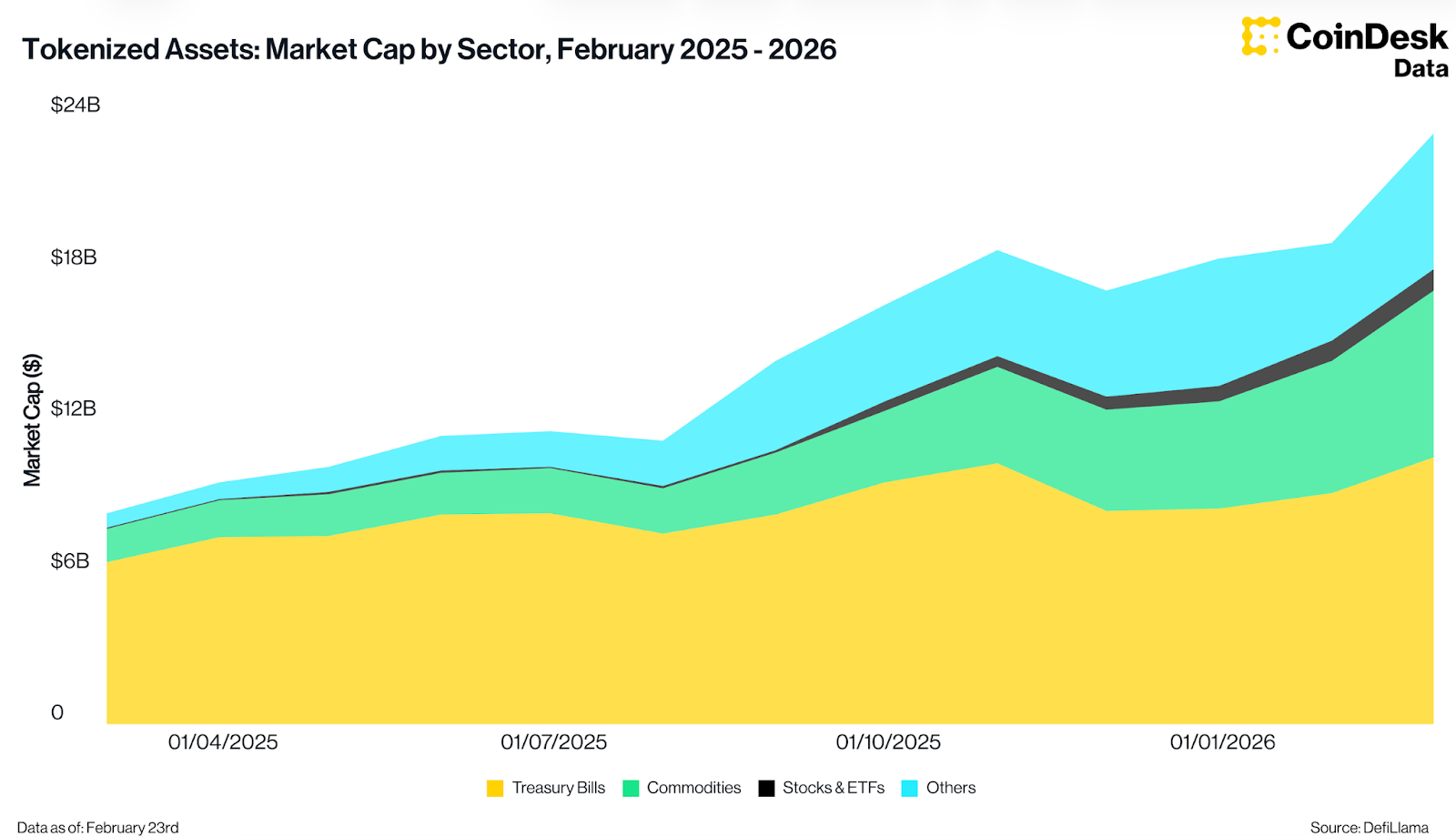
– Jacob Joseph, Specialist, Research, CoinDesk
2026-03-05 19:07