As a crypto investor, I’ve been watching gold closely, and even though it dropped over 7% from its peak around $5,590, it’s still holding above $5,160. Honestly, that’s pretty impressive – it’s actually outperformed stocks and even Bitcoin this past month. The upward trend it’s been on since late December is still solid, and big institutional investors haven’t changed their positions, which is a good sign.
Despite recent efforts, gold hasn’t managed to break out and reach new highs. The issue isn’t with gold itself – its structure or how much people want it – but likely with the price of crude oil. Here’s how these two are related.
Gold’s Bullish Channel Has Survived Every Test
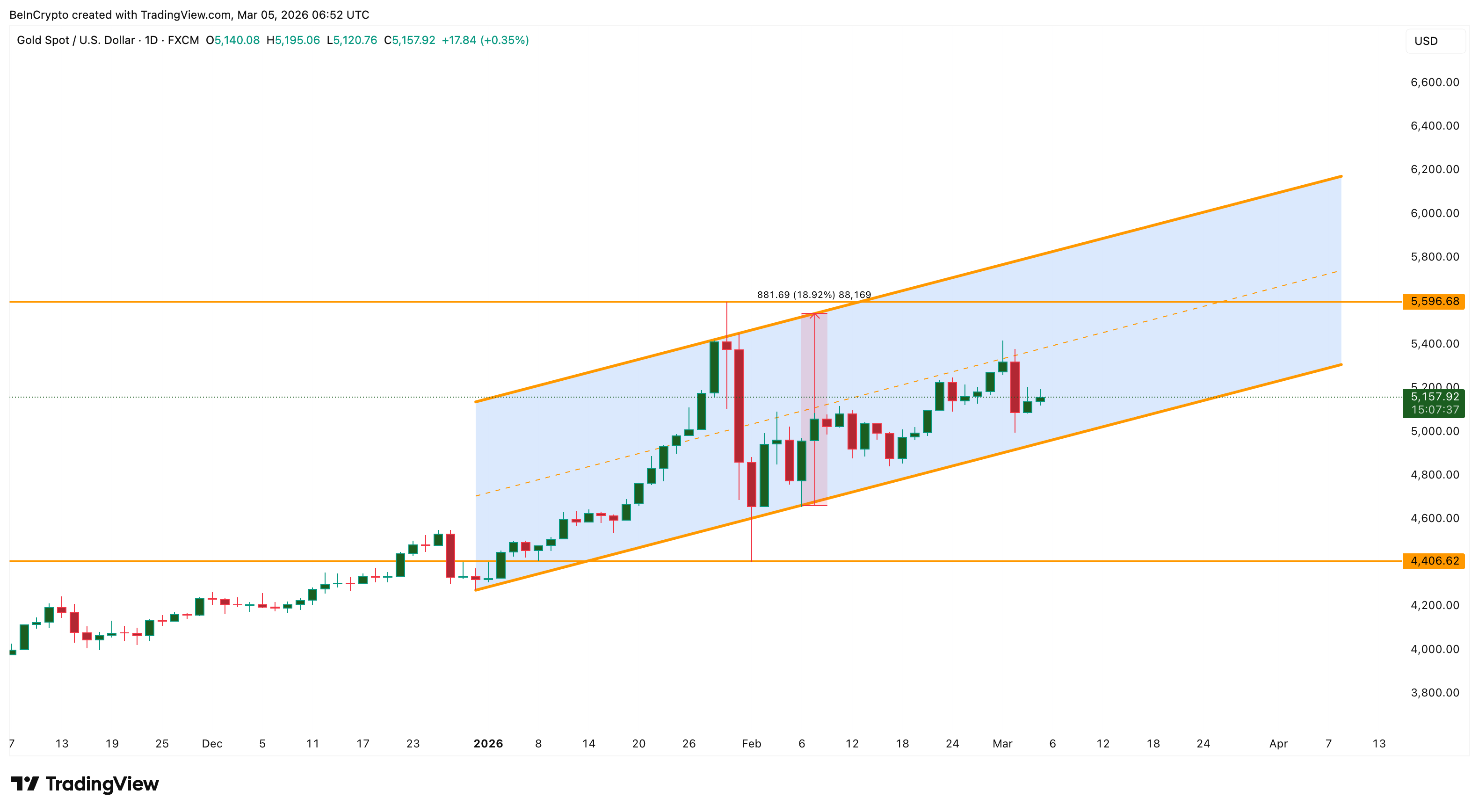
Since late December 2025, gold prices have been moving within a clear upward trend, as shown on daily charts. This trend has been tested twice: first, the price jumped to a record high of $5,590 on January 29th, and then it fell to $4,400 in early February. However, the price quickly recovered from both of these movements, indicating strong buying and selling interest at those levels.
Gold is currently trading around $5,150, right in the middle of its recent trading range. The price action looks positive, as buyers have consistently stepped in during small price drops, and the price hasn’t closed below the established range since it began.
But the structure alone doesn’t explain why gold is outperforming, up almost 8% month-on-month.
For that, you need to look at what should be hurting it and isn’t.
Oil Is Disrupting The Traditional Gold Playbook
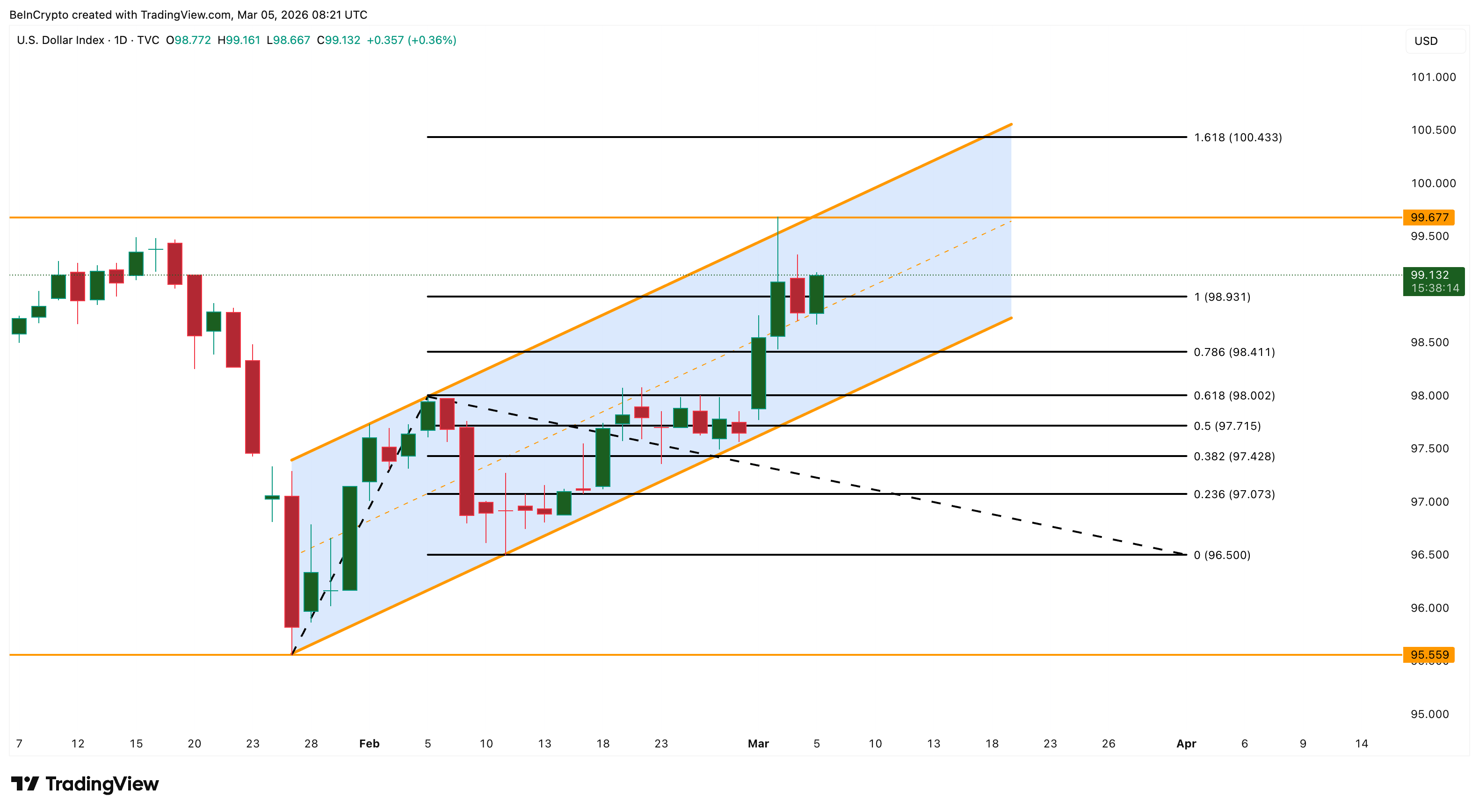
The US Dollar Index (DXY) has risen sharply from 95.55 in late January to 99.13 today. It’s currently trending upwards and could potentially reach 100.43.
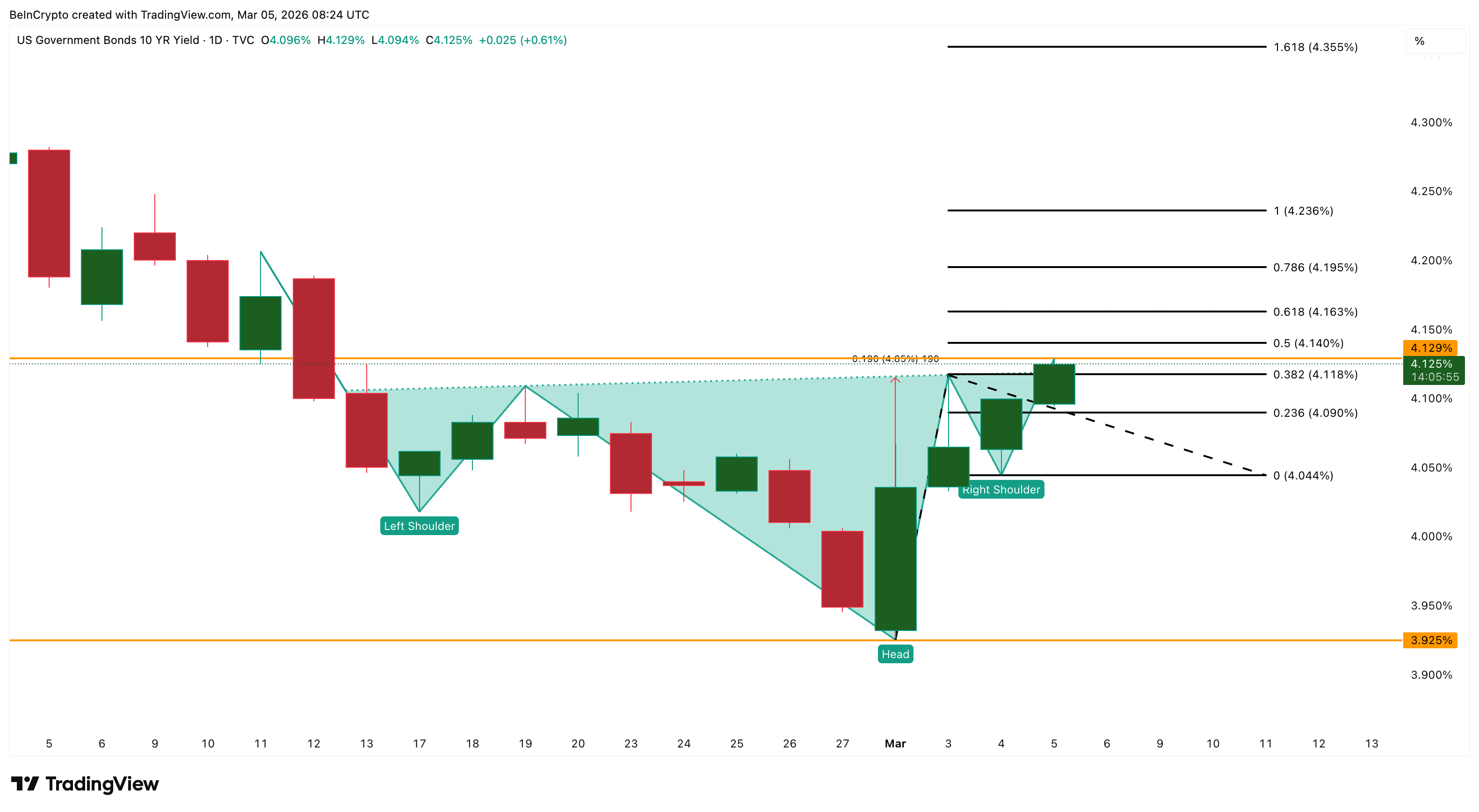
The yield on the 10-year US Treasury bond (US10Y) is showing a bullish pattern on its daily chart, forming an inverse head and shoulders. It has rebounded from 3.92% in early March to 4.12%, and could potentially rise to between 4.23% and 4.35%.
Typically, a stronger dollar and higher interest rates cause gold prices to fall. However, gold is currently handling both of these pressures surprisingly well, and that’s because the reasons behind the dollar’s recent strength are different this time.
As a crypto investor, I’ve been watching the dollar closely, and it’s been weird lately. The dollar’s been going up, and it seems to be driven by oil prices. All the tension with Iran has pushed oil higher, and because oil is bought with dollars globally, that’s actually *strengthening* the dollar and pushing up interest rates. It’s the opposite of what you’d normally expect during geopolitical instability – usually, things get shaky, the dollar weakens, and gold goes up. This time, it’s different, and it’s definitely something to keep an eye on as I navigate the crypto markets.
Oil prices are climbing quickly, now exceeding $82.50 a barrel. This means gas prices have risen almost 20% since the beginning of the year.
Pay close attention to oil prices, as they can signal whether a significant agreement or market adjustment is coming.
The global economy can’t handle oil prices reaching $100 a barrel.
— The Kobeissi Letter (@KobeissiLetter) March 5, 2026
Gold prices initially jumped to $5,400 when the conflict began, but quickly fell back as the dollar also grew stronger. While demand for safe investments usually supports gold, rising oil prices, inflation, and a strong dollar are all limiting its potential. Recently, Bitcoin has actually performed better than gold, demonstrating more resilience against dollar strength.
Yet, the price hasn’t broken down and seems flat over the past week, waiting to break free.
Gold needs this negative pattern to end. If tensions ease, oil prices could fall, which would lessen worries about inflation. This could also weaken the U.S. dollar, potentially dropping it below 98, and lower interest rates to below 4%. These changes would remove the factors currently holding gold back, allowing it to rise without fear of falling further.
Institutions Are Already In, And They’re Not Leaving
The weekly Commitment of Traders (COT) report from the Commodity Futures Trading Commission (CFTC) shows that hedge funds and Commodity Trading Advisors (known as Managed Money) were net long on COMEX Gold Futures by approximately 96,000 contracts as of February 24th, which was the date of the latest report.
The market position remained almost unchanged from the previous week. Hedge funds slightly reduced both their buying and selling positions, suggesting they were simply balancing their books rather than making a significant shift in their overall strategy.
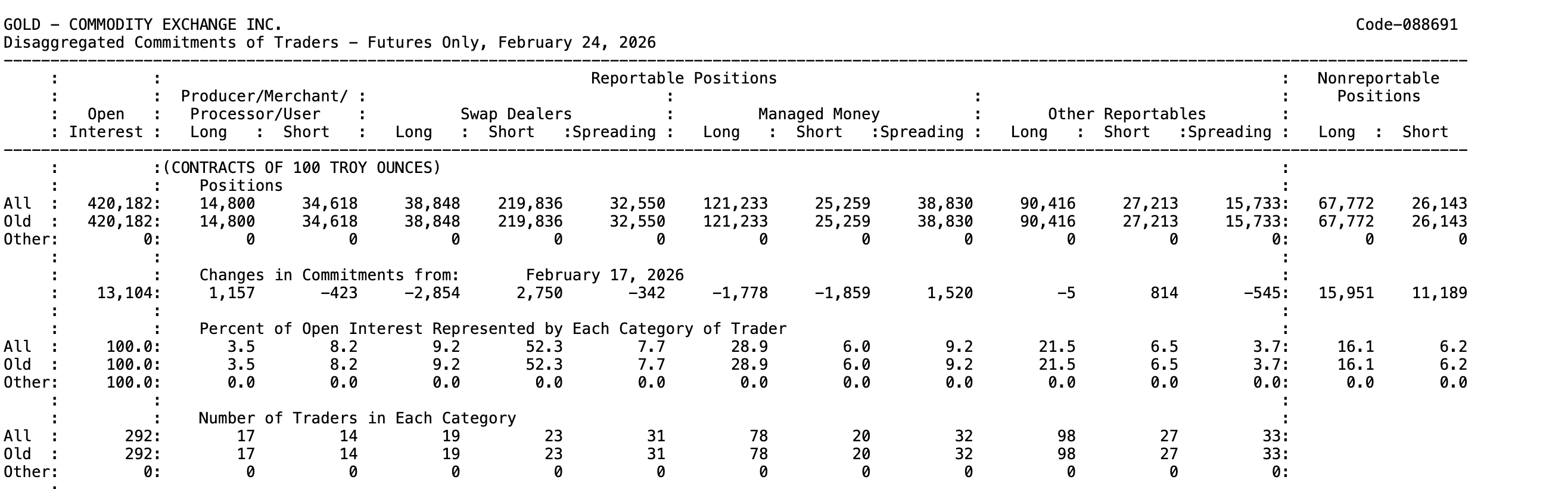
Open interest increased by over 13,000 contracts, reaching 420,182, which suggests more money is flowing into the market from larger institutions.
When the number of open contracts increases while the price stays steady, it suggests strong confidence in the market. This is different from silver, where traders only hold a small number of long positions (8,500 contracts) and the number of open contracts is actually decreasing.
Gold prices are currently on a record-breaking run, increasing for seven months straight. During this time, the price of gold has jumped 61%, averaging a nearly 9% increase each month. This surpasses the previous record of six consecutive months of gains, which last occurred in the early 2000s and the 1970s.
— The Kobeissi Letter (@KobeissiLetter) March 5, 2026
Interest in gold isn’t limited to futures trading. Recent reports from March 5th indicate that officials from the Trump administration arranged a deal to import up to 1,000 kilograms of Venezuelan gold into the US. This suggests increasing demand for physical gold from countries, in addition to the usual speculative trading activity, as shown by a rise in open interest.
Trump administration officials arranged a multi-million dollar agreement to import up to 1,000 kilograms of gold from Venezuela for sale in U.S. markets.
— The Wolf Of All Streets (@scottmelker) March 5, 2026
The relationship between gold and silver prices suggests a shift in market favor. The gold-to-silver ratio is showing a bullish pattern – an inverse head and shoulders – on its daily chart. With the ratio currently at 61.84, after a strong increase since late February, a move above 64.71 could lead to further gains, potentially reaching 69.54 and even 75.51, which would generally benefit gold.
Gold is often seen as a safe place to keep wealth and a protection against rising prices. Silver, however, is mostly used in industrial applications, accounting for about 60% of its total use.
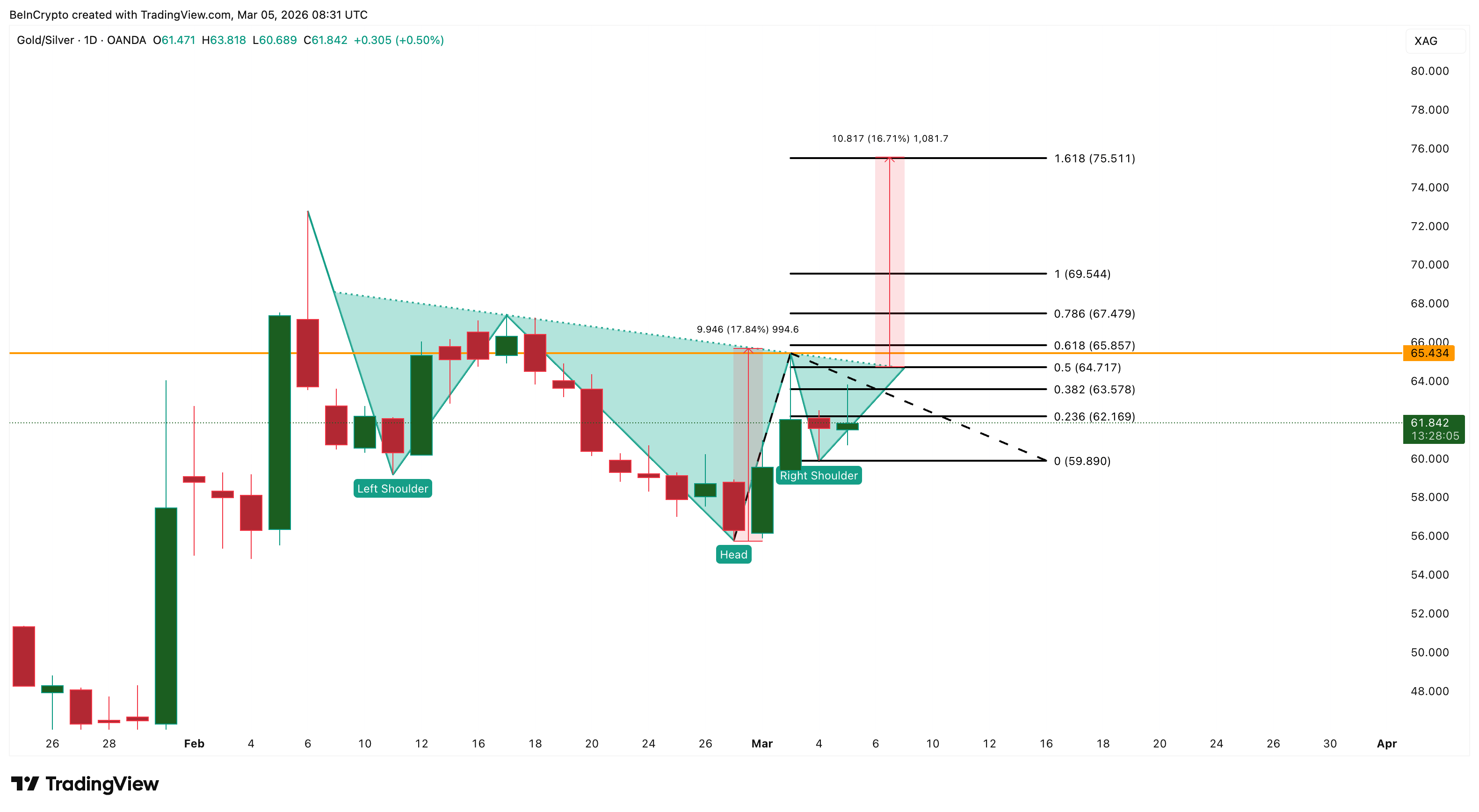
Given concerns about a possible recession and ongoing trade tensions, investors may favor gold as a safer investment option over silver, which tends to perform with the overall economy. This shift in preference suggests that money will likely flow into gold first, potentially causing its price to increase quickly once economic conditions improve.
Gold Price Levels To Watch Now
As an analyst, I continue to see an upward trend for gold, as it’s currently holding within a defined trading channel. However, a significant breakout higher is dependent on what happens with oil prices. Specifically, oil’s impact on the dollar’s strength and bond yields is acting as a constraint right now. Until we see some clarity there, gold’s potential for a larger move is limited.
As a crypto investor, I’m watching Bitcoin closely, and right now there are a couple of key price levels to keep an eye on. First, around $5,220 – if we break above that, it’s a good sign. But the big one is $5,440. Bitcoin tried to get past that level back in January but couldn’t, and it’s been stuck since. If we can *finally* close above $5,440, that could signal a real shift, turning this sideways trading into a proper uptrend.
As a crypto investor, I’m watching Bitcoin closely, and if we break above $5,440, things could get really interesting. I’m looking at potential targets around $5,730 and even the all-time high. If things *really* go well, based on Fibonacci extensions, we could see prices around $6,540 or even $6,960 – that’s almost a 19% increase from where we are now! But to get there, I think we need a few things to happen: oil prices need to fall back a bit, the dollar needs to weaken, and interest rates need to stabilize below 4%.
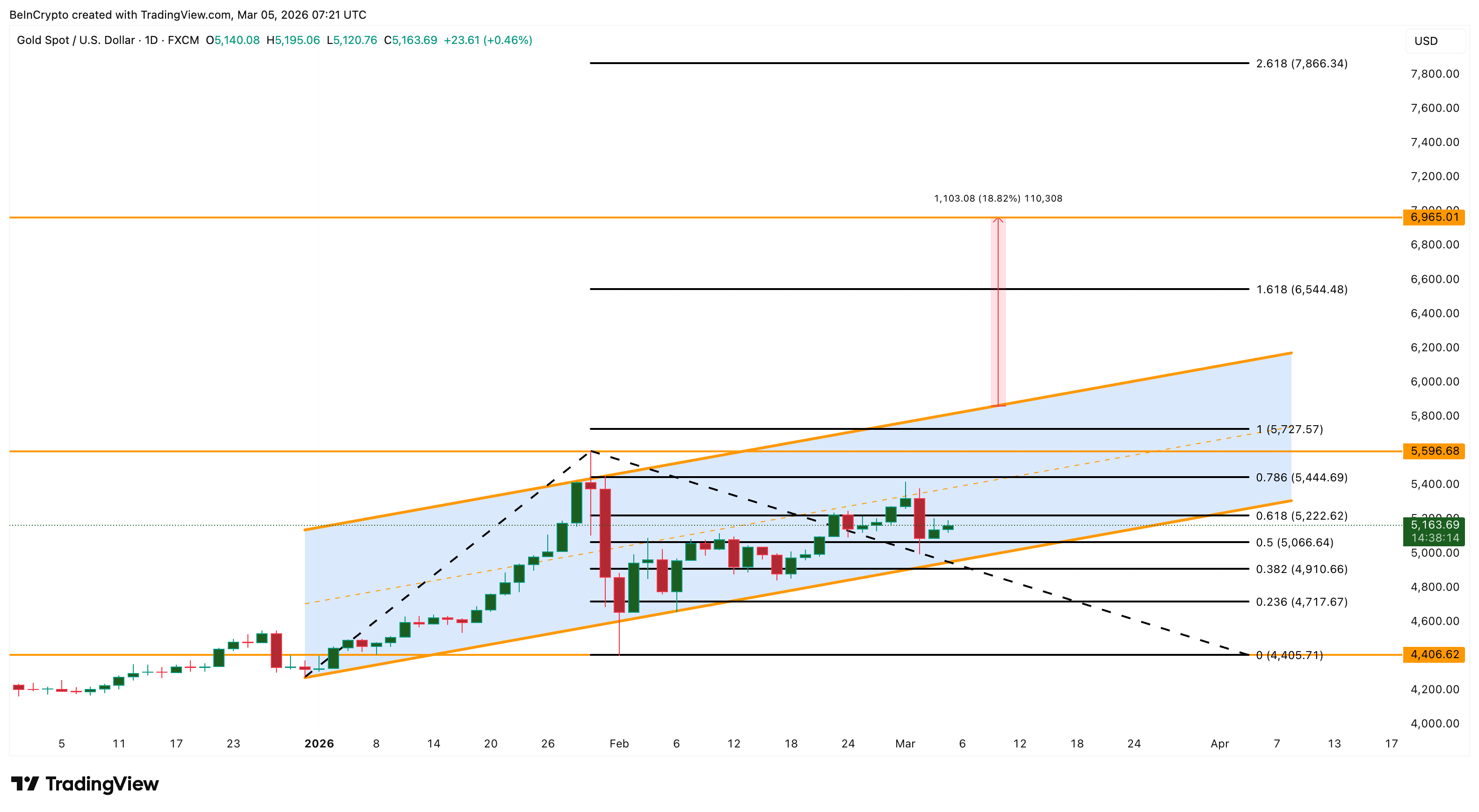
However, a $5,060 loss could cause gold prices to fall to $4,910. If the price closes below $4,910, it would break a long-standing trend it hasn’t seen since December. This is likely to happen only if the Dollar Index (DXY) and interest rates (yields) both increase.
Several factors suggest gold prices will likely increase. The main thing holding gold back from reaching $6,500 is the connection between oil, the US dollar, and investment yields. However, this connection is fragile and depends on continued global political instability.
2026-03-05 18:32