Author: Denis Avetisyan
A new system combines the power of language models with structured reasoning to deliver more accurate and transparent academic advising.
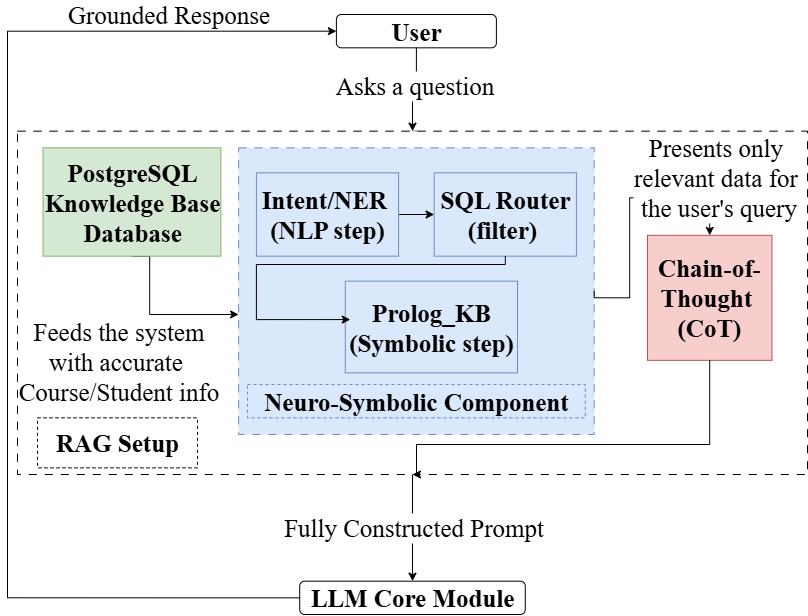
Aurora leverages neuro-symbolic AI and retrieval-augmented generation to create a scalable system for personalized curricular guidance.
Despite increasing demands on higher education institutions, academic advising remains critically under-resourced, often hindering student success and equity. To address this challenge, we introduce Aurora: Neuro-Symbolic AI Driven Advising Agent, a novel system that integrates the fluency of large language models with the rigor of symbolic reasoning and normalized curricular data. This approach yields verifiable, policy-compliant recommendations with significantly improved semantic alignment-a [latex]36\%[/latex] increase over baseline large language models-and sub-second latency on commodity hardware. Can this paradigm shift unlock scalable, transparent, and accurate AI-driven advising, ultimately fostering more equitable and effective student support?
The Inevitable Strain on Traditional Guidance
The conventional model of academic advising, historically reliant on one-on-one meetings between advisors and students, is increasingly strained by the pressures of growing student bodies. As universities strive for broader access and larger cohorts, the logistical demands of providing individualized attention to each student become unsustainable. This scalability issue isn’t simply about time constraints; it also impacts the quality of advising, as advisors face heavier workloads and reduced capacity for in-depth conversations about academic planning and career goals. Consequently, institutions are actively seeking innovative solutions, including technology-enhanced advising platforms and proactive outreach programs, to bridge the widening gap between student needs and available support, ensuring that a rising tide of students doesn’t overwhelm the resources dedicated to their success.
Current academic advising systems frequently operate on generalized pathways, failing to fully account for the increasingly diverse backgrounds, learning styles, and ambitions of today’s student body. These conventional models often struggle to adapt to rapidly changing fields of study, emerging interdisciplinary programs, and the growing prevalence of non-traditional educational routes. The result is a disconnect between prescribed advice and individual student circumstances, hindering effective goal-setting and potentially leading to suboptimal course selections or even attrition. A truly supportive advising framework necessitates a shift towards recognizing the unique challenges and opportunities each student presents, acknowledging that a one-size-fits-all approach is no longer sufficient in navigating the complexities of higher education.
The evolving demands of higher education necessitate a shift towards data-driven, personalized academic advising. Institutions are increasingly leveraging student data – encompassing academic performance, engagement metrics, and even learning analytics – to move beyond generalized guidance. This allows advisors to identify at-risk students proactively and tailor interventions to specific needs, fostering improved outcomes. By understanding individual learning styles, career aspirations, and potential roadblocks, advisors can curate personalized academic pathways, recommend relevant resources, and facilitate meaningful connections. This targeted approach not only enhances student success and retention rates but also cultivates a more supportive and effective learning environment, ultimately empowering students to achieve their full potential.
Augmenting Insight with Neuro-Symbolic Reasoning
Aurora employs Retrieval-Augmented Generation (RAG) to enhance its advising capabilities by first retrieving relevant academic information from a knowledge source and then using this information to inform the Large Language Model’s response generation. This process bypasses the limitations of solely relying on the LLM’s pre-trained parameters, allowing Aurora to access and incorporate up-to-date academic data, such as course descriptions, prerequisite requirements, and degree program details. The retrieved information is concatenated with the user’s query as context, providing the LLM with the necessary knowledge to formulate accurate and informed recommendations. This retrieval step utilizes vector databases and semantic search techniques to identify the most pertinent information, ensuring the LLM operates with a grounded and current understanding of the academic landscape.
The Aurora framework integrates Large Language Models (LLMs) with symbolic reasoning through a Neuro-Symbolic AI approach to address the limitations of LLMs in providing consistently logical and factually sound recommendations. LLMs excel at generating fluent text but can struggle with complex reasoning and maintaining consistency; therefore, Aurora augments LLM capabilities with a symbolic reasoning engine. This engine, built on established logic-based principles, allows the system to explicitly represent and enforce constraints, rules, and domain knowledge. By combining the generative power of LLMs with the deductive capabilities of symbolic AI, Aurora aims to produce recommendations that are not only natural-sounding but also logically consistent and grounded in established academic principles.
Aurora’s data infrastructure utilizes PostgreSQL as its primary database for managing the academic course catalog, including details on course prerequisites, descriptions, and scheduling information. Complementing this, SWI-Prolog serves as the reasoning engine, implementing a rule-based system to enforce academic regulations and constraints. This allows Aurora to validate potential course sequences against defined rules, such as degree requirements or prerequisite chains, ensuring the generated recommendations adhere to institutional policies. The integration of PostgreSQL and SWI-Prolog provides a scalable and verifiable foundation for the neuro-symbolic advising process.
Decoding Intent and Structuring Response
Aurora’s query understanding relies on Intent Recognition and Named Entity Recognition (NER) technologies. Intent Recognition classifies the student’s goal – for example, seeking course information, requesting transcript details, or inquiring about financial aid. Simultaneously, NER identifies and categorizes key pieces of information within the query, such as specific course codes, degree programs, dates, or student IDs. This dual process allows Aurora to move beyond keyword matching and accurately determine what the student is asking and which specific entities are relevant to the request, enabling a more precise and effective response.
Aurora’s response generation is structured around a 5W+1H Prompt Schema, a technique leveraging “Who,” “What,” “When,” “Where,” “Why,” and “How” to comprehensively address student inquiries. This schema serves as a guiding framework for the Instruction-Tuned Large Language Model, specifically DeepSeek-R1-Distill-Qwen-7B, ensuring all relevant aspects of a question are considered during response creation. By prompting the LLM to address each element within the schema, the system aims to produce detailed and informative answers, rather than relying solely on keyword matching or surface-level understanding of the query. The implementation of this schema significantly enhances the completeness and contextual relevance of generated responses.
The Aurora system employs a SQL Router to dynamically filter the academic catalog, delivering personalized results to each student. This router accesses and processes student-specific data, including completed coursework, declared major, current academic standing, and any applicable registration constraints. By formulating SQL queries based on this information, the system narrows the catalog to only those courses that meet the student’s individual requirements and prerequisites, preventing the presentation of irrelevant or inaccessible options and enhancing the efficiency of course discovery.
![This entity-relationship diagram uses colored nodes to represent entities (purple) and relationships (green), with link cardinality-ranging from zero-to-many [latex]0..\<i>[/latex], one-to-many [latex]1..\</i>[/latex], and one-to-one [latex]1..1[/latex]-encoding the connections between program offerings, courses, and skills.](https://arxiv.org/html/2602.17999v1/visuals/ER_Diagram3.0.drawio.png)
Validating Recommendations Through Rigorous Logic
The Aurora system utilizes a Prolog Reasoner to validate proposed course sequences against a formalized set of academic regulations and constraints. This reasoner functions as a rule-based engine, evaluating each potential course plan against pre-defined criteria such as prerequisites, co-requisites, maximum credit limits, and degree requirements. By integrating a Prolog-based inference engine, Aurora ensures that all recommended course sequences are academically sound and adhere to institutional policies, preventing the suggestion of invalid or non-compliant schedules. The reasoner’s logic is directly derived from official academic catalogs and policies, providing a transparent and auditable basis for recommendation validity.
Aurora’s database design strictly adheres to Boyce-Codd Normal Form (BCNF). This normalization process eliminates redundant data by ensuring that every determinant in a table is a candidate key. Specifically, BCNF prevents modification anomalies – inconsistencies that can arise during data updates, insertions, or deletions – and improves data consistency. By minimizing redundancy, BCNF also optimizes storage space and simplifies query processing, contributing to the overall reliability of the recommendation system and the integrity of student academic records.
Performance evaluations indicate a 36% improvement in the semantic alignment between system-generated recommendations and those provided by human experts, as measured by cosine similarity. The system achieves a mean cosine similarity score of 0.93, indicating a high degree of correlation with expert reasoning. Furthermore, analysis of in-scope advising queries demonstrates perfect precision and recall on approximately 50% of cases, signifying the system’s ability to accurately identify and recommend relevant courses within those instances.
Toward a More Resilient and Adaptable Educational Ecosystem
Aurora distinguishes itself through a deliberately modular architecture, engineered for seamless compatibility with the pre-existing technological infrastructure of educational institutions. This design prioritizes interoperability, enabling effortless integration with Student Information Systems (SIS) and Learning Management Platforms (LMS) already in use. Rather than requiring a complete overhaul of current systems, Aurora functions as a complementary layer, accessing and utilizing existing student data – such as academic records, course enrollments, and performance metrics – to deliver personalized support. This approach minimizes disruption, reduces implementation costs, and allows institutions to rapidly deploy and scale the framework across diverse student populations without significant technical hurdles, ultimately fostering a more adaptable and responsive advising ecosystem.
The Aurora framework distinguishes itself through a design prioritizing both scalability and adaptability, rendering it uniquely suited to a wide spectrum of educational contexts. Unlike rigid, one-size-fits-all solutions, Aurora can be readily implemented in institutions ranging from small liberal arts colleges to large research universities, and effectively serves student bodies with vastly different demographics and academic profiles. This flexibility stems from its modular architecture, allowing institutions to selectively adopt components that align with their specific needs and resources. Furthermore, the framework’s algorithms are designed to learn and adjust based on student data, ensuring personalized support remains effective even as student populations evolve and institutional priorities shift. This inherent responsiveness positions Aurora not as a temporary fix, but as a long-term, evolving asset for fostering student success across diverse learning environments.
The Aurora framework reimagines academic advising by automating routine tasks – such as course selection reminders, progress tracking, and resource suggestions – and tailoring these interventions to each student’s unique academic profile and goals. This isn’t about replacing human advisors, but rather augmenting their capabilities. By handling the logistical and readily-answerable questions, Aurora allows advisors to dedicate their expertise to students facing complex challenges – navigating financial aid, addressing mental health concerns, or charting non-traditional academic paths. The system’s capacity to identify students who would benefit from personalized intervention also enables advisors to proactively offer support, shifting the focus from reactive problem-solving to strategic student success initiatives and fostering a more holistic approach to education.
The development of Aurora exemplifies a crucial recognition within complex systems: the necessity of structured knowledge alongside the fluidity of learned patterns. This pursuit mirrors the inherent challenges of maintaining any infrastructure over time. As Edsger W. Dijkstra observed, “It’s not enough to have good intentions; you need a good implementation.” Aurora’s neuro-symbolic approach attempts to bridge the gap between the intuitive reasoning of large language models and the rigorous logic of symbolic reasoning, creating a system designed not merely to respond, but to understand curricular requirements and student goals. The system’s reliance on both retrieval-augmented generation and symbolic reasoning suggests a desire for longevity, a conscious effort to avoid the pitfalls of opaque, rapidly decaying models. This aligns with the principle that systems, like natural landscapes, benefit from a foundation of enduring principles.
The Turning of the Wheel
Aurora, as a confluence of neuro-symbolic methods and curricular knowledge, represents not an arrival, but a refinement of existing limitations. Every failure in its reasoning, every instance of misapplied symbolic constraint, is a signal from time – a reminder that knowledge representation, however elegant, is always an imperfect mapping of a dynamic reality. The system’s scalability, while promising, will inevitably encounter the entropy inherent in large datasets and the evolving nature of academic programs.
Future iterations will likely demand a more nuanced understanding of causality. Current approaches, while adept at retrieval and pattern matching, often struggle to differentiate correlation from genuine predictive power. Refactoring the symbolic layer is not merely a technical exercise; it is a dialogue with the past, a continual recalibration of assumptions based on observed systemic decay.
The true test will not be in achieving higher accuracy scores, but in gracefully accommodating the inevitable errors – in building an advising agent that acknowledges its own limitations and offers counsel tempered with appropriate uncertainty. The goal, ultimately, is not to solve advising, but to create a system that ages well within the complex ecology of the university.
Original article: https://arxiv.org/pdf/2602.17999.pdf
Contact the author: https://www.linkedin.com/in/avetisyan/
2026-02-24 05:39