Author: Denis Avetisyan
A new protocol establishes a standardized communication framework that integrates people as active nodes within AI agent networks, fostering seamless collaboration and resolving ambiguities.
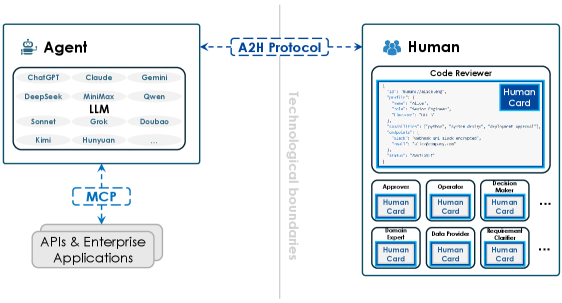
This paper introduces the A2H protocol, a formal communication schema enabling agents to interact with humans as addressable entities within a unified messaging abstraction.
While AI agents increasingly demonstrate sophisticated autonomy, current protocols treat humans as external observers rather than integrated collaborators within these systems. This limitation motivates the development of ‘A2H: Agent-to-Human Protocol for AI Agent’, which proposes a unified mechanism enabling agents to discover, address, and communicate with humans as resolvable entities. The A2H protocol introduces key components – Human Cards, a Formal Communication Schema, and a Unified Messaging Abstraction – to standardize human integration within agent ecosystems. Will this foundational protocol unlock truly human-connected intelligent infrastructures, moving beyond isolated autonomous systems towards seamless collaboration?
The Limits of Autonomy
Contemporary language model-based agents, frequently built upon frameworks like ReAct, demonstrate a notable capacity for executing individual tasks with increasing efficiency. However, these agents frequently encounter limitations when confronted with reasoning demands that extend beyond simple execution, particularly those requiring sustained, multi-step thought processes or adaptation to unpredictable circumstances. While adept at following established procedures, they struggle with novel situations demanding creative problem-solving or the ability to extrapolate from incomplete information. This inability to navigate complexity stems from their reliance on pattern recognition within training data; when faced with scenarios significantly diverging from this data, performance degrades, often resulting in logical errors or an inability to complete the intended objective. Consequently, despite advancements in task automation, a critical gap remains between these agents’ capabilities and the nuanced reasoning characteristic of human intelligence.
Autonomous agents, despite advancements in task completion, frequently stumble when faced with ambiguity or unexpected challenges. Current designs often prioritize executing pre-defined steps over recognizing their own limitations, resulting in a rigid approach to problem-solving. This inflexibility manifests as persistent errors or inefficient outcomes, as the agent continues attempting a flawed approach rather than seeking clarification or alternative strategies. Unlike human problem-solvers who instinctively request help when encountering roadblocks, these agents typically lack the mechanisms to signal uncertainty or actively solicit assistance, leading to cascading failures and hindering their ability to navigate complex, real-world scenarios effectively. Consequently, improvements in graceful degradation and help-seeking behaviors are crucial for building truly robust and reliable autonomous systems.
Bridging the Gap: Introducing the A2H Protocol
The A2H Protocol formalizes human integration into multi-agent systems by defining humans as addressable, resolvable entities within those ecosystems. This means agents aren’t simply programmed to default to human intervention when facing ambiguity; instead, the protocol establishes a structured mechanism for agents to actively seek human input as a planned component of their operational logic. This is achieved through standardized interfaces and communication protocols that allow agents to formulate specific requests for assistance, transmit relevant contextual data, and receive, interpret, and incorporate human responses back into their decision-making processes. The framework includes defined data structures for representing human expertise, availability, and response times, enabling agents to efficiently route requests to appropriate human collaborators.
The A2H Protocol facilitates proactive human-agent collaboration by defining a mechanism for agents to request human input during their reasoning process, rather than solely when encountering impasse. This involves agents assessing the confidence level of their conclusions and, when below a predefined threshold – determined by task criticality and available data – initiating a structured request for human expertise. The protocol specifies data formats for these requests, ensuring humans receive relevant context and can provide focused assistance; it also details how agent systems integrate and validate human input, updating their internal models and confidence scores accordingly. This differs from traditional human-in-the-loop systems where human intervention is typically reactive and triggered by failure states.
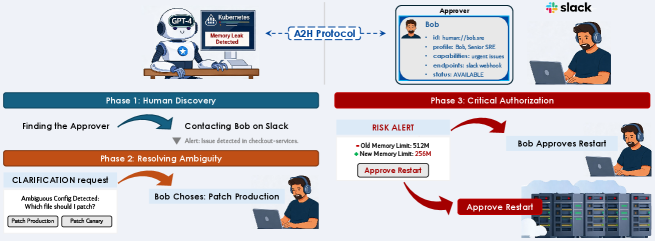
The A2H Protocol’s efficacy stems from a complementary integration of artificial and human capabilities. AI components provide rapid data processing and operate at scale, efficiently handling tasks requiring speed and volume. However, these systems are augmented by human intelligence, specifically in areas demanding critical thinking, nuanced judgment, and adaptability to unforeseen circumstances. This collaborative framework, validated by our case study, results in improved outcomes compared to systems relying solely on either AI or human processing, capitalizing on the respective strengths of each to mitigate inherent weaknesses.
Orchestrating Collaboration: A Formal Communication Schema
The A2H Protocol utilizes a formally defined communication schema to govern agent-initiated human interaction, prioritizing purposeful contact. This schema establishes pre-defined conditions dictating when an agent requests human assistance and, crucially, why that assistance is needed. Rather than random or continuous queries, the schema ensures agents only engage humans when specific, predetermined criteria are met, optimizing the human-agent workflow and minimizing unnecessary interruptions. This structured approach focuses agent interactions on situations requiring uniquely human capabilities, such as judgment, complex problem-solving, or handling ambiguous data.
The A2H protocol’s formal communication schema utilizes three primary triggers to initiate human-agent collaboration. The Ambiguity Trigger activates when the agent encounters data or a situation it cannot confidently interpret or resolve based on its programming. The Criticality Trigger is engaged when the agent identifies a high-impact event or decision requiring human oversight to mitigate potential risks or errors. Finally, the Resource Exhaustion trigger signals that the agent has reached the limit of its computational resources or available data to effectively proceed, necessitating human assistance to acquire additional information or processing power.
The Unified Messaging Abstraction facilitates human-agent collaboration by converting agent-generated outputs into a standardized, human-readable format defined by the A2H-JSON Schema. This structured data translation ensures consistent and interpretable communication, directly impacting response times. Performance metrics demonstrate a mean response time of 2.5 seconds when utilizing this abstraction, representing a substantial reduction compared to the 8-second mean response time observed with traditional, unstructured agent communication methods.
Building a Human-Centric Agent Ecosystem
The A2H Protocol introduces the Human Card, a foundational element for building collaborative agent ecosystems. This isn’t simply a directory of experts; it’s a meticulously structured registry that encapsulates critical metadata about each human specialist. Beyond basic identity information, the Human Card details an expert’s specific skill sets, current availability – accounting for time zones and workload – and crucially, preferred communication endpoints. This standardized format allows agents to programmatically query for the most suitable human for a given task, moving beyond random assignment or static escalation paths. By precisely defining what each expert offers and how to reach them, the Human Card enables a dynamic and efficient handoff between artificial and human intelligence, facilitating seamless collaboration and minimizing delays.
The A2H Protocol facilitates a dynamic connection between artificial intelligence and human expertise, enabling agents to pinpoint the most qualified individual for specific challenges. This isn’t simply about finding a human, but the right human, based on a detailed registry of skills and availability. The result is a collaborative network where agents intelligently delegate tasks, drastically reducing the need for constant human oversight. Studies demonstrate a significant impact; agents utilizing this protocol require human intervention only 12% of the time, a marked improvement compared to the 40% intervention rate observed in traditional agent systems. This enhanced efficiency stems from the agent’s ability to proactively seek and integrate human intelligence when and where it’s most valuable, ultimately optimizing performance and minimizing disruptions.
The A2H Protocol doesn’t necessitate a complete overhaul of current agent communication systems; instead, it functions as a powerful extension, building upon established frameworks to incorporate human expertise. This design prioritizes interoperability, allowing agents to leverage existing communication channels and data formats while simultaneously accessing a dynamic network of human intelligence. By seamlessly integrating the Human Card – a standardized registry of expert profiles – into agent workflows, the protocol facilitates on-demand connection to precisely the skillset needed for complex or ambiguous tasks. This adaptive approach ensures that agents aren’t simply autonomous entities, but rather components within a broader, more resilient system that effectively combines artificial and human capabilities, ultimately boosting problem-solving efficiency and expanding the scope of what agents can achieve.
Optimized Communication and Future Directions
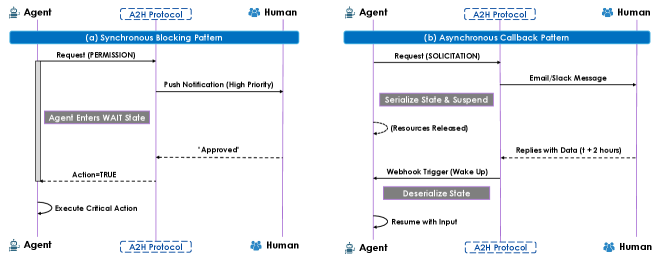
The A2H Protocol distinguishes itself through a dynamic communication strategy, skillfully employing both Synchronous Blocking and Asynchronous Interrupt patterns. For tasks demanding immediate, sequential processing – such as critical decision-making – the protocol utilizes a Synchronous Blocking pattern, ensuring complete attention and focused computation. However, when dealing with less urgent requests or complex, multi-faceted problems, it seamlessly shifts to an Asynchronous Interrupt pattern, allowing for parallel processing and efficient resource allocation. This adaptive approach isn’t merely about speed; it’s about intelligent prioritization, ensuring that the system responds appropriately to the nature of each request, maximizing efficiency and preventing bottlenecks. The protocol effectively mirrors human cognitive processes, allocating focused attention where it’s most needed and managing background tasks concurrently, resulting in a significantly more responsive and versatile AI system.
The A2H Protocol represents a significant departure from prevailing autonomous agent network architectures, such as AgentDNS. While systems like AgentDNS prioritize self-sufficiency and operate with minimal human intervention, A2H intentionally integrates human expertise into the decision-making process. This isn’t viewed as a limitation, but rather as a foundational principle; the protocol acknowledges that certain tasks benefit from, or even require, human judgment, contextual awareness, and ethical considerations that purely algorithmic systems may lack. By shifting away from complete autonomy, A2H establishes a framework for collaborative intelligence, enabling agents to request and incorporate human input when necessary, ultimately fostering a more reliable and nuanced approach to complex problem-solving.
The advent of the A2H Protocol signals a move towards AI systems distinguished by their resilience, flexibility, and reliability-characteristics enhanced by the seamless incorporation of human insight. Studies demonstrate this integrated approach achieves a substantial increase in task completion, reaching 95% success where traditional, autonomous agents manage only 75%. This isn’t merely incremental improvement; it represents a fundamental shift in AI architecture, suggesting a future where artificial intelligence and human expertise work in concert, fostering what researchers are calling true hybrid intelligence and unlocking possibilities beyond the reach of either alone.
The pursuit of a standardized communication protocol, as detailed in the A2H framework, echoes a fundamental principle of efficient systems. It strives to minimize noise and maximize signal transmission – a concept reminiscent of John von Neumann’s observation: “There is no exquisite beauty… without some kind of constraint.” The A2H protocol, by formally defining how agents interact with humans, imposes necessary constraints on communication, reducing ambiguity and fostering a more predictable, and therefore ‘beautiful’, agent ecosystem. This structured approach to human-agent interaction directly addresses the core idea of resolving ambiguities through standardized communication, mirroring a design philosophy rooted in clarity and precision.
Further Directions
The proposition of a human node within an agent network feels less a breakthrough than a recognition of existing conditions. Agents already operate through humans; this merely formalizes the interface. The core challenge remains not transmission, but translation – the inevitable loss inherent in codifying intent. A protocol can standardize the message, not guarantee its meaning.
Future work must address the limitations of a purely formal schema. Ambiguity, that stubborn residue of natural language, will not yield to rigid structures. Investigation into probabilistic interpretation, or even accepting a degree of controlled error, seems more fruitful than striving for absolute fidelity. The pursuit of a ‘perfect’ communication protocol is, predictably, imperfect.
The true test will not be technical elegance, but practical integration. Can such a system reduce cognitive load, or does it simply relocate the burden of interpretation? The value of A2H rests not on what it can do, but on what it allows humans to not do. Simplicity, after all, is the ultimate refinement.
Original article: https://arxiv.org/pdf/2602.15831.pdf
Contact the author: https://www.linkedin.com/in/avetisyan/
2026-02-19 14:26