The Bitter Truth in a Nutshell
- Robinhood’s shiny new chain hit 10 million daily transactions in three weeks. Free gas, of course. Who wouldn’t dance for free vodka?
- It throws 10% of its “net revenue” to Arbitrum’s treasury-8% to the DAO, 2% to the Developer Guild. A pittance, but a pittance with a promise.
- A 90-day gas subsidy is the real hero. Once it ends, the party might turn into a wake.
- Memecoins and DeFi rule the roost, not the tokenized stocks the chain was supposedly built for. So much for high-minded plans.
The Layer 2, built on Arbitrum’s aching back, has reached roughly 10 million daily transactions less than three weeks after its public mainnet opened-and it gives a slice of its revenue back to Arbitrum, like a tipsy uncle tossing coins to children.
The mechanism is real. The dollar amounts? A joke for now. Understanding this is what separates the sober from the drunk on social media hype.
A 10 Million-Transaction Chain, With a Giant Asterisk
Token Terminal, that oracle of onchain vanity, wrote on X that “daily transactions on Robinhood Chain reach ~10m, while average block times fall to ~100ms,” calling it a consumer-grade experience. Their chart shows the ramp was no spike: daily counts climbed through early July and have held between 7 million and 11 million since July 8, with several sessions above 10 million. Block times collapsed from 3 seconds to a flat line near 100 milliseconds. Counting methods vary, but every source points the same direction. Token Terminal’s earlier comparison, cited by CoinDesk, showed the chain overtaking Coinbase’s Base in daily transactions within two weeks of launch. Oh, the glory!
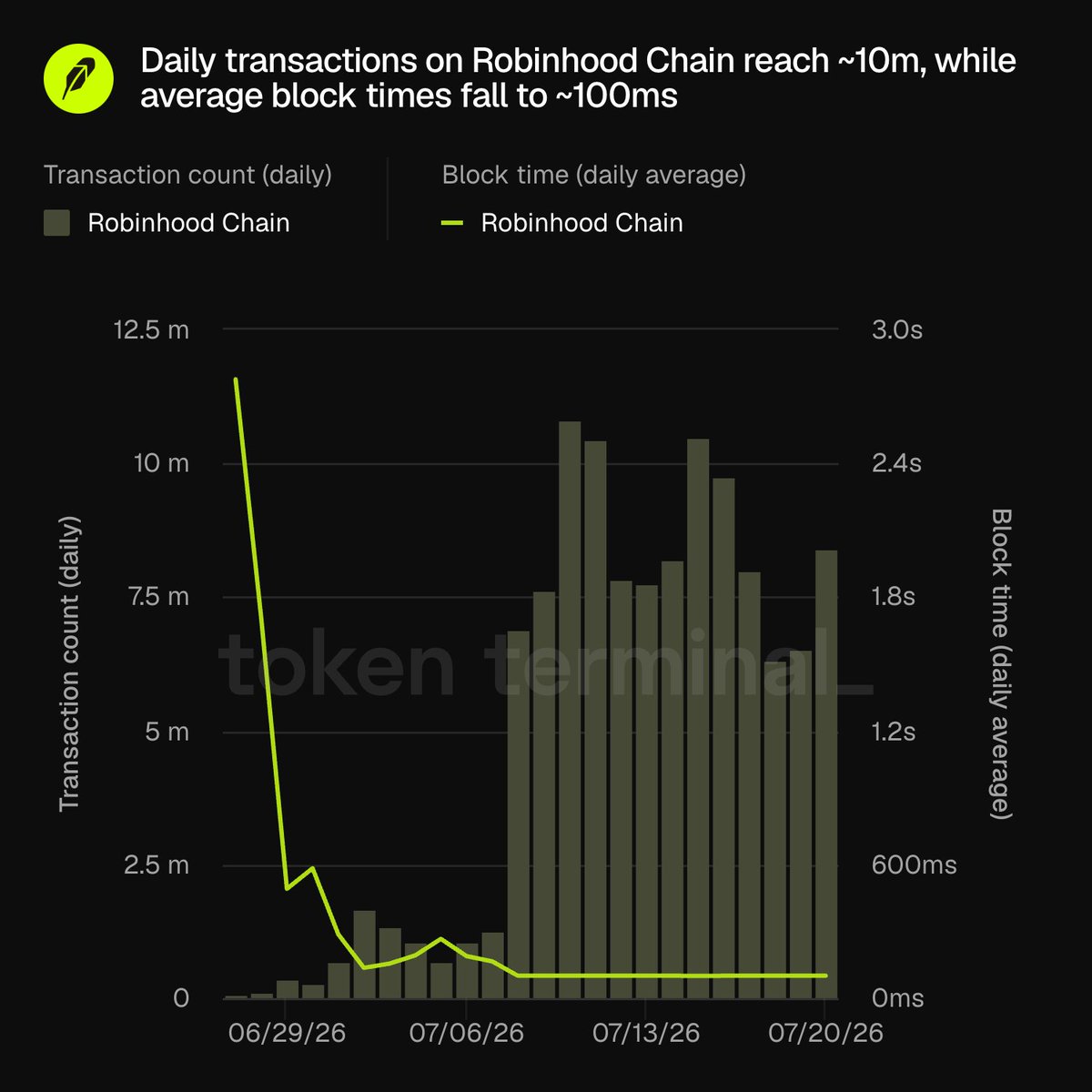
Two caveats keep that figure honest-like a drunkard’s promise. First, Robinhood is covering all user gas fees for the first 90 days, bringing transaction costs to near zero. That inflates activity like a bloated corpse. Second, the composition is not what the chain was built for: DefiLlama data found memecoins and stablecoins dominating a network holding only about $12.8 million in tokenized real-world assets, against total value locked in the hundreds of millions. The pattern echoes Base’s 2023 launch: speculation first, durable applications later-if ever.
Ten million transactions is also not ten million users. Automated contract interactions, swaps, and bot-generated activity can all produce multiple transactions per participant. The milestone is evidence of technical capacity, not adoption. For how tokenized stocks and funds actually work as products, see our guide to RWA tokenization platforms-if you still believe in fairy tales.
How Robinhood Activity Becomes Arbitrum Revenue (A Comedy of Numbers)
The economic relationship needs a clarification that most coverage skips-because it’s boring. Robinhood Chain does not transfer 10% of every transaction’s value to Arbitrum. Under the Arbitrum Expansion Program, it contributes 10% of the protocol net revenue generated by the chain: 8% to the ArbitrumDAO treasury and 2% to the Arbitrum Developer Guild, routed through the program’s fee infrastructure. That’s according to the official ArbitrumDAO factsheet, which sounds official until you see the numbers.
The connection to ARB is indirect but real. ARB holders vote on how the DAO treasury is used-meaning they can argue about how to spend this trickle of pennies. The arrangement includes no automatic ARB buyback and no direct distribution to token holders; it adds revenue to a treasury governed through ARB-based voting. Democracy in action, with crumbs.
Why the Numbers Are Still Small (Like the Dreams of a Beggar)
Here is where the thesis meets the ledger. During the subsidy period, the chain’s daily protocol fees have run at approximately $4,000. FalconX estimated in April that Robinhood Chain could generate about $1.1 million in fees over six months. Ten percent of net revenue on figures that size is not a treasury-moving number for a DAO of Arbitrum’s scale. It’s like a mouse farting in a hurricane.
The revenue thesis is therefore a forward-looking one. It depends on activity surviving beyond the subsidy, on fee-paying usage replacing subsidized speculation, and on tokenized securities and payments growing into the volumes that speculative trading currently occupies. If those conditions hold, the recurring flow to Arbitrum grows with them. If activity collapses in October, the 10% share applies to very little-like a tax on a ghost town.
The Real Boost: A Blueprint for More Chains (Or a Blueprint for More Hype)
The larger value to Arbitrum may not be this chain’s fees at all, but what its launch demonstrates. Robinhood opened the mainnet on July 1, 2026 after a February public testnet that, according to the Arbitrum Foundation, processed more than 200 million transactions before production. The company first launched its Stock Tokens on Arbitrum One in 2025, validated the product on shared infrastructure, then migrated to a dedicated chain-the “launch-and-migrate” model described in Arbitrum’s announcement. It’s a model that sounds smart until you realize it’s just a fancy way to say “we tested on someone else’s dime.”
Technically, the chain runs first-come, first-served sequencing with roughly 100-millisecond preconfirmations, settles to Ethereum using blob data availability per the official documentation, and is fully EVM-compatible: it uses ETH for gas, supports standard Ethereum wallets, and assets move in over standard infrastructure. It is also permissionless-meaning external developers deploy without Robinhood’s approval. The 100-millisecond figure describes ordering and preconfirmation speed, not final Ethereum settlement. A speed that means nothing if nobody uses it for real things.
For Arbitrum, a household-name brokerage proving that model at this scale is a sales document for every other institution weighing its own chain. Each additional Expansion Program chain adds another revenue stream to the same treasury. That compounding pipeline, more than this quarter’s fees, is the realistic version of the “Robinhood boosts Arbitrum” story. But let’s not kid ourselves: it’s still a pipeline of promises.
The competitive stakes are visible elsewhere: as our analysis of Solana’s second quarter showed, roughly 97% of tokenized-equity trading currently runs through Solana. Robinhood Chain is the most credible attempt yet to pull that market onto Ethereum-aligned rails. Credible? Maybe. But the odds are against it, like a mouse trying to steal cheese from a cat.
Confirming the Thesis (Or Waiting for the Punchline)
First, transaction counts and active addresses in October, after the subsidy expires; sustained seven-figure daily activity on paid fees would convert the launch spike into a business. Second, the share of activity coming from tokenized securities, visible in the chain’s TVL composition. Third, the actual revenue contributions appearing in ArbitrumDAO’s financial reporting, which will put a public dollar figure on what the 10% share is worth-probably a number that will make you laugh or cry.
Until then, Robinhood Chain has proven the technology scales and the revenue pipe exists. Whether meaningful money flows through it is a question the coming months will answer. Or they won’t, and we’ll all move on to the next shiny thing.
Source: Based on Robinhood and Arbitrum official documentation and announcements, the ArbitrumDAO factsheet, and network data from Token Terminal and DefiLlama, checked July 21, 2026. Also based on the author’s deep skepticism of anything that sounds too good to be true.
This article is provided for informational purposes only and does not constitute financial or investment advice. It is, however, excellent entertainment for those who enjoy watching the circus of crypto.
2026-07-21 21:08