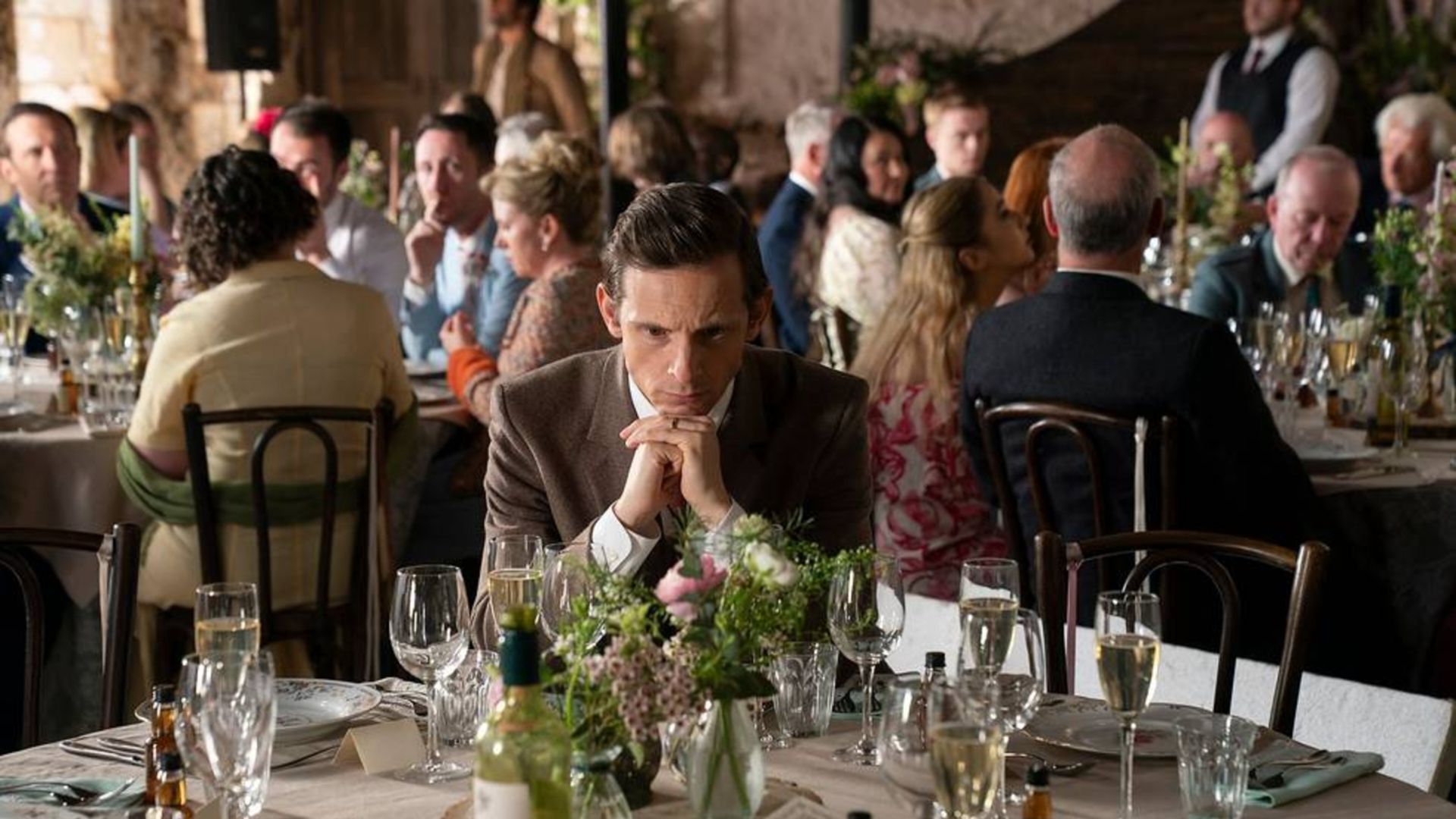
Be warned, this article contains spoilers for the final episode of Half Man. Niall Kennedy was first presented to audiences in Half Man, but Jamie Bell’s performance beautifully concludes the story of this heartbreaking character.
Richard Gadd‘s series, Half Man, spans several decades and tells the story of Niall and Ruben, who share a complicated connection – described as “brothers from another lover.” The show explores themes of masculinity, hidden emotions, and difficult family relationships. Told through flashbacks, the narrative jumps between Niall’s wedding to Albie (a past partner of Ruben’s) and the characters’ challenging childhoods and turbulent adult lives.
The conflict finally explodes in a violent clash between Niall and Ruben, who meet again after Ruben gets out of prison. They fight physically, and Ruben ends up suffocating Niall, though Niall manages to stab Ruben in the side first. While it was already known Ruben died in episode 4, Niall’s death was a surprising twist in an already dark and difficult story.
I recently spoke with Robertson about Niall’s arc throughout the six episodes of the show. It was fascinating to hear how his understanding of the character actually shifted as the story unfolded, especially in those final three episodes. He shared some really thoughtful insights into what that ending meant for Niall, and for the show as a whole, and it was great to get his perspective.

ScreenRant asked about the amazing response to Half Man and what it’s been like to see such a positive reaction.
It’s been amazing seeing the reaction to the show. People have been contacting me on Instagram and I’ve been following the buzz online. I tried to avoid reading comments at first, but with a show this popular and highly anticipated, it’s hard not to be curious. Thankfully, the response has been overwhelmingly positive. It’s been a little much trying to keep up with everything, especially all the messages from viewers I don’t even know. I initially tried to reply to everyone – I wanted to acknowledge anyone who took the time to reach out – but I quickly realized that wasn’t realistic. It was just too much to handle and I needed to protect my time and peace of mind.
SR: Especially for such a heavy show too, I’m sure that that kind of response has been refreshing.
It’s been great to see that audiences have connected with the complex relationship between Niall and Ruben, which is exactly what we were aiming for. It’s a push-and-pull dynamic – sometimes you root for them to move on, and other times you’re completely invested in seeing them stay connected. I’ve noticed that reaction online, and it’s really rewarding.
That shift in the story is really fascinating, especially in the third episode. After that, the focus moves to Jamie Bell and Richard Gadd. I was wondering what it was like for you as an actor to navigate that change, and what you discovered about your own process while seeing the characters develop in a new direction.
Robertson: I did truly learn a lot about just me as a person.
I’ve mentioned this before, but playing a character with a lot of inner turmoil – like the ones Richard creates – really made me think about my own life after the show ended. It helped me identify things I was avoiding, feelings of shame, and unhealthy patterns I kept repeating. It was a really transformative experience, and honestly, I’m still working through some of those personal reflections even now.
You know, being part of this project really changed me as an actor. I was working on it constantly for almost three months, doing several scenes each day, so I was learning something new every day. I honestly feel like I came out of it a better performer overall. It wasn’t one big lesson, though – it was more like absorbing a ton of little things along the way, and I didn’t even fully realize what I was learning at the time!
I also learned a lot from our director, Alex Brodski. She has a fantastic sense of what feels authentic and compelling. She was always searching for what made a scene interesting, and that’s something I’ve really taken to heart. Working with her has changed my approach – now I focus on finding what’s intriguing or worth exploring further, rather than just what I think is ‘good’.
I really like how episode three ends. It leaves the audience on a powerful, unresolved note. We even filmed a scene that could have provided a little bit of closure after the courtroom scene, but I’m glad it didn’t make the final cut. Leaving things at that intense moment is much more impactful than offering a small resolution.
I was really struck by something Joanna says in the third episode – the line, “Snakes can shed their skin, but they always crawl on their bellies.” It feels important to the whole series. Considering how Niall and Ruben constantly seem to be hindering each other’s progress, I’m wondering what the show is trying to say about whether people – or these two specifically – are truly capable of change?
What I admire most about Richard’s writing is that his characters are never simply good or bad. He consistently explores the idea that everyone is capable of making mistakes and even being self-destructive, recognizing that making mistakes is just part of being human.
I have a feeling this question will stay with me for a while, something I’ll suddenly realize later. Honestly, I’m not sure what the answer is. It’s hard to look away from their relationship because you can see how much they need each other, and it feels like they’re overly reliant on one another. I think things might have been easier for them if they hadn’t met, but they’re clearly connected by a strong bond they can’t break. It’s possible that being apart would have led to a smoother path for both of them.
The show creates a lot of uncertainty – it’s like something could happen one way or another, similar to the Schrödinger’s cat thought experiment. We definitely see this with Niall’s story and how things ultimately turn out for him; it almost feels like his fate and someone else’s could have been swapped. I was really interested in how you, as an actor, processed all of that. Did you read all the scripts for the season at once, or did you watch the episodes as they aired? What were your thoughts on how Niall’s story unfolded?
I hadn’t read the scripts for episodes four through six, but I had a general sense of the plot. I didn’t need to know all the details, and I intentionally avoided them. I only watched those episodes for the first time about a week or two before the show aired. It wasn’t long before the release date. Surprisingly, when I finished watching, I was a bit unsure how I felt. It’s a character I played, but now another actor is portraying him, and the character has changed significantly with the passage of time. As the story progressed, I actually started to feel less sympathetic towards Niall. His self-destructive behavior became so extreme that I lost some of my… not love for him, but definitely my sympathy, which was a really interesting realization, and honestly, how I truly felt.
SR: Yeah, like “What the hell are you doing?”
Yeah, let’s pause there for a moment. The dynamic between Ruben and Niall is constantly shifting, especially in the first three episodes. They go back and forth, each needing the other at different times – it’s like a seesaw. But starting in episode four, that really changes. One of them starts thriving while the other really struggles, and honestly, I was pretty shocked watching episodes four through six.
Did learning more about Niall throughout the first three episodes change your understanding of him? Were there any actions by Jamie or plot twists that made you see his earlier behavior in a completely new light?
Robertson admitted he wondered if the character’s increasingly self-destructive behavior in the final episodes made it hard to see him as a good person.
While playing the first three episodes, I really felt that Niall was fundamentally a good person, despite being capable of making mistakes – mistakes that seemed to stem from insecurity, shame, or a desire for self-protection. However, as I continued to episodes four through six, I started to question that initial impression and wonder if he wasn’t who I originally thought he was.
It feels like a turning point at the end of episode three when the character almost lies in court, but ultimately doesn’t. Then, he’s threatened by Ruben, someone he cares about deeply. I tend to agree with your point of view on that.
I saw the third season as a story about a character making the right moral choice. He ultimately does the right thing by telling the truth, which felt like a positive resolution. I finished the season believing he was a fundamentally good person. Because of that, I naively expected seasons four, five, and six to continue that positive trajectory, but things definitely changed, and not for the better. It was a surprise, considering where I thought his story was headed.
We’re hoping for a happy ending for Niall, maybe seeing him find happiness with Albie through marriage. There’s been discussion about why Niall marries Albie, and then later reconnects with Jamie. It makes you wonder if Niall’s relationship with Albie is partly driven by guilt over the trial, like he’s trying to show Ruben that telling the truth was the right thing to do, and that it ultimately led to something good.
That’s a really interesting idea. There’s definitely a strong connection between those two characters, both when they first meet and later on, and it makes you want to see them succeed. It’s fascinating to consider how much their reconnection might be driven by guilt. It’s entirely possible, because as people, we often don’t fully understand our own motivations. We tend to believe we know why we do things, but the real reasons can often be quite different, even the opposite of what we think.
You know, I was really struck by that ending – it wasn’t a feel-good moment, that’s for sure. Both Niall and Ruben really paid the price, and honestly, it felt right, like a proper tragedy. I was curious, after seeing how it all played out, if the director talked with Richard about that specific ending. Did they feel like this was the only place those characters could end up, or what was their take on it? It really got me thinking about their journeys.
I haven’t talked to him yet, and haven’t had the opportunity to discuss what happened. It almost feels right that their relationship leads to both of their downfalls – that it ends in destruction. It really highlights how some connections can be incredibly damaging. I would have preferred a happier outcome, but I honestly didn’t know how things would unfold. I was completely in the dark. The reveal at the end of episode five, that Ruben doesn’t survive, really emphasizes how things can escalate in a toxic relationship and that there are always consequences to your actions.
What do you think?
I felt like the story worked well. It’s really about how these characters keep hurting each other, and I wanted to see Niall find some happiness. But, even with that, the ending didn’t feel forced or undeserved.
I really hoped for a satisfying conclusion, where everything worked out for the characters. That’s what the entire series felt like – a promise that things would eventually be okay. But just when you thought they had it figured out, something always went wrong.
SR: They get too comfortable in a way [and] it blows up again.
Absolutely. It’s completely spiraled out of control. It’s like constantly putting out a fire – just when you think it’s extinguished, a small spark reignites and quickly grows bigger and bigger.
Weddings are naturally dramatic events, full of people and emotion. That makes them a fitting place for a story to reach its climax or conclusion.
SR: Yeah. No, absolutely. Absolutely. No, I was blown away when I finished it.
I watched episodes four, five, and six back-to-back, and it was a bit overwhelming to process everything afterward.
It’s been great to see so many people online talking about how excited they are for each new episode. I especially liked how the first episode was released, giving everyone time to really think about it and process what happened. It’s been nice letting the audience experience it and then coming back to them when they’re fully engaged.
This is sparking a much more engaging discussion. I have one broader question, which ties in nicely with what we’ve been talking about. Late last year or earlier this year in the UK, a six-part queer show called ‘Heated Rivalry’ came out. Some people have jokingly referred to ‘Half Man’ as ‘Heated Rivalry’ for a more intense audience. It’s led to conversations about the different sides of queer storytelling – specifically, exploring repressed sexuality and shame, and how we address those themes. I’m curious to hear your thoughts on this, considering the recent increase in shows depicting gay men grappling with their sexuality within a larger cultural context.
You know, I haven’t actually seen “Heated Rivalry” yet. Honestly, I feel like I don’t know enough about the full context to really comment. What I do know is my own experience playing Niall in “Half Man” and what I brought to that role. Specifically, growing up in the west of Scotland really shaped my understanding. It wasn’t the present day, but even as a kid and teenager, being called gay was the worst possible insult you could receive at school. There was so much shame attached to it, and people really carried that with them. So when I approached playing Niall, I knew it was crucial to explore how someone internalizes that shame, how deeply those walls get built up, and how it affects them.
Considering all of that, the film Half Man really highlights why it’s important to continue sharing these kinds of stories and looking at them from different angles. Everyone’s experience is unique, and Heated Rivalry, being set in Canada, adds another layer to that.
As a fan, I really love that the show is tackling these kinds of stories, and it’s awesome they’re setting them in such different places. We’ve got one in Canada, focusing on the world of sports, and then another in Western Scotland – totally different experiences! It’s great to see how the location impacts the story, because it really does change things. It means we don’t get just one simple story; instead, we get something richer and more complex, reflecting all the different layers of life.
I really cared about that aspect of the show and felt strongly about it. Our show has many layers, and Niall’s internal struggles are central to the story. He grapples with his identity and sexuality, and how that impacts his life. If he’d had more support growing up, things might have turned out differently for him.
All episodes of Half Man are now streaming on HBO Max.
2026-05-29 05:30