As an analyst, I’ve been watching XRP closely, and it’s been stuck in a sideways trading pattern since February. This consolidation is frustrating for investors hoping for a clear breakout, but many of us are starting to anticipate a significant move. Interestingly, the longer this period lasts, the more powerful the eventual breakout is likely to be. Recently, a report from Arab Chain highlighted a specific market condition that’s adding an extra layer of urgency to the situation – it suggests the current setup could be quite volatile when it finally resolves.
XRP’s liquidity on Binance has fallen to its lowest level since 2020, currently at 0.038. The price is around $1.39, and trading volume over the past month is about $2.74 billion. These figures indicate that XRP trading has become less active, with fewer buyers and sellers and less money being used to influence the price.
When a market has very little trading volume, even a small increase or decrease in buying or selling can cause a significant and rapid price change. Normally, a strong market needs consistent buying or selling to really move the price, as large order books can absorb initial pressure. But with liquidity currently at a five-year low, the same amount of buying or selling has a much bigger and faster impact on the price.
As a crypto investor, I’m watching XRP closely, and it feels like we’re building up to a significant move. Analysts are starting to point to data showing the potential breakout could be much bigger than just a simple range break – there seems to be a lot of liquidity ready to fuel a larger price swing.
The Market Is Thin. The Price Has Not Reacted Yet
Arab Chain’s research doesn’t just point out the decrease in market liquidity, it explains *why* it’s a problem. When liquidity drops this much, the market struggles to handle large trades without causing big price swings. Normally, a healthy market can absorb these trades thanks to a wide range of buy and sell orders. But with reduced liquidity, even relatively small trades can lead to significant price changes.

What makes the current situation with XRP so unusual is the disconnect between its price and how easily it can be bought or sold. Despite hitting a five-year low in trading volume, the price remains stable at $1.39, suggesting the market hasn’t fully recognized its own vulnerability. Essentially, the price is acting as if there’s plenty of buying and selling happening, but the data shows that’s not true, and this imbalance can’t continue forever.
Arab Chain views the recent situation as having two potential explanations. One possibility is that large investors are slowly selling their holdings, which could make the market more vulnerable without immediately causing prices to drop. The other possibility is that the decrease in trading volume is typical before a significant price increase, where fewer shares available could intensify future buying or selling.
Both ways of looking at the situation lead to the same outcome. Because there’s very little money flowing into the market – the lowest amount since 2020 – even a small increase in investment could cause prices to rise quickly. Conversely, a significant drop in investment could lead to a sharp fall in prices. Whether prices go up or down will depend on which happens first, but either way, the effect will be much larger than usual.
XRP Compresses Beneath Resistance as Liquidity Thins
XRP is currently trading around $1.39 and has been moving within a narrow price range since the sharp drop in February. The price is fluctuating with each new low being only slightly higher, but it keeps struggling to break through the $1.42 to $1.45 resistance level.
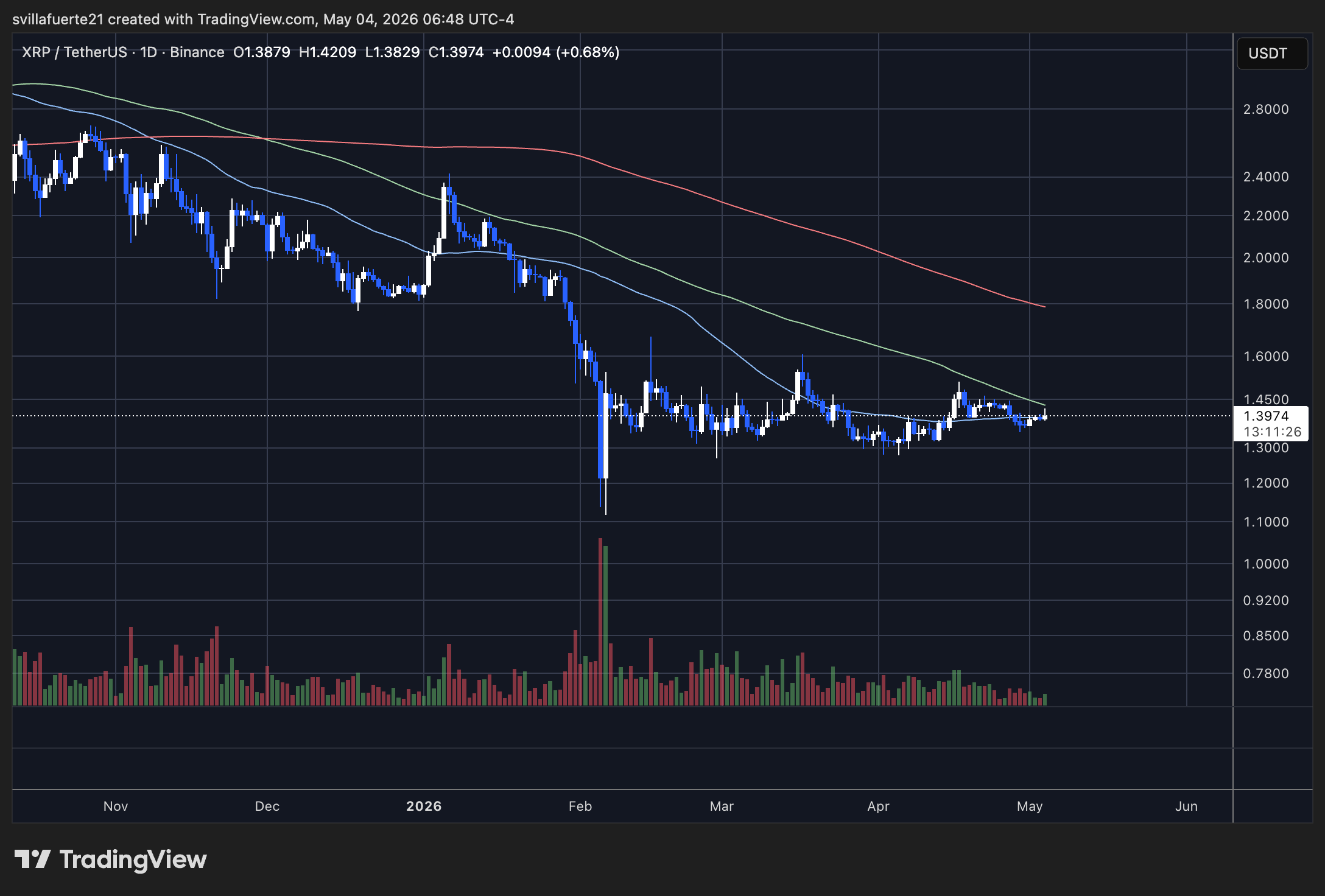
The price is currently fluctuating within a balanced range, but it’s not yet stable. It remains below key moving averages, with the 50-day and 100-day averages falling and acting as barriers to upward movement. The 200-day average is even higher, confirming an overall downward trend. However, despite these negative indicators, the price hasn’t fallen back to the lows seen in February, suggesting that selling pressure might be losing strength.
The price of $1.35 remains a crucial support level, successfully holding steady despite repeated tests, which shows buyers consistently stepping in. However, attempts to push the price up to $1.45 are consistently met with selling pressure. This is creating a narrower trading range, often a sign that a significant price move is coming.
The decrease in trading volume supports the recent price drop. Trading activity is much lower than it was during the February sell-off, suggesting fewer people are participating and that the market is less liquid.
Read More
- Honor of Kings x Attack on Titan Collab Skins: All Skins, Price, and Availability
- Yummy Tteokbokki ASMR redeem codes and how to use them (May 2026)
- The SATISFY x adidas Adizero Adios Pro 4 Debuts in Three Earthy Colorways
- Honkai: Star Rail Silver Wolf Lv. 999 Build Guide: Best Relics, Light Cone, Team Comps, and more
- Top 5 Best New Mobile Games to play in May 2026
- Total Football free codes and how to redeem them (March 2026)
- eFootball 2026 Epic National Midfielders (Ribery, Gattuso, Karembeu) pack review: Strong picks yet not endgame
- FC Mobile 26 TOTS (Team of the Season) event Guide and Tips
- Top 5 Best New Mobile Games to play in April 2026
- Last Furry: Survival redeem codes and how to use them (April 2026)
2026-05-05 07:04