In the grand theater of cryptocurrency, where fortunes are made and lost faster than one can say “blockchain,” quantum computing has emerged as a rather durable risk narrative for Bitcoin. This week, our intrepid explorer of digital finance, Alex Thorn of Galaxy Digital, had a delightful tête-à-tête with none other than the ever-ebullient Michael Saylor. This meeting occurred swiftly after Saylor unleashed his latest magnum opus, “Bitcoin Quantum Leap,” onto the unsuspecting masses on X.
“The Bitcoin Quantum Leap: Fear not, dear investors! Quantum computing shall not dismantle Bitcoin; rather, it shall fortify it like a medieval castle against marauding invaders. Active coins will undertake daring migrations while the lost ones remain in a frozen limbo. Security will ascend to dizzying heights, and supply will dwindle-thus, Bitcoin shall emerge stronger than ever!” Saylor proclaimed with all the gravitas of a man who has just discovered fire, or perhaps a particularly good wine.
Saylor Insists on Freezing Dormant Bitcoin-For Your Own Good! 🍦
During the spirited exchange, Saylor’s argument resembled less a meticulous lecture in cryptography and more a whimsical assertion of coordination: once the quantum threat is widely acknowledged (which is surely just around the corner!), the response will be as mandatory as brushing one’s teeth after a particularly garlicky dinner. Bitcoin, he insists, will follow the same upgrade trajectory as the rest of the digital economy, whether it likes it or not.
“There shall come a moment when the world collectively acknowledges this quantum menace. We may not be there yet, but fear not! The United States government will rally its defense contractors to upgrade their encryption algorithms faster than you can say ‘cryptocurrency,’” Saylor declared, presumably envisioning a grand parade of IT experts marching in lockstep.
He painted a vivid picture of a cascading wave wherein major platforms dispatch standardized, quantum-resistant libraries across consumer devices and core financial systems, complete with enforced timelines and re-authentication requirements. In such a scenario, Saylor suggests, Bitcoin’s transition would be akin to a software upgrade problem rather than an existential crisis. Simple, really! Just install the new client software-no pressure!
“They will send out a shiny new upgrade and ask you to please install it and reauthenticate yourself. You’ll have X days-90, 30, or even just a few hours. Miss the deadline? Well, your funds will be frozen. But don’t worry, it’s really for your own good,” Saylor quipped, likely winking at the audience.
Throughout his discourse, Saylor returned to the theme of incentives as the sovereign arbiter of human behavior. He maintained that those with substantial balances wouldn’t dream of opting out of an upgrade that safeguards access to their precious holdings. Naturally, this logic extends to the broader ecosystem’s ability to achieve rough consensus.
“The Bitcoin network merely runs on software, which means a quantum upgrade is inevitable. Expect quantum-resistant encryption libraries to align with widely adopted standards across operating systems and enterprise infrastructures,” he asserted with the confidence of a man who has never faced a software update himself.
Where his response takes a turn into market-relevant territory is in the downstream implications: coins that can be migrated will indeed migrate, while those that cannot-due to their owners being deceased or their keys hopelessly misplaced-will remain marooned in digital purgatory. Saylor framed this as a security enhancement event that also forces a clearer accounting of lost supply, as if we were tallying up the leftovers after a particularly raucous party.
“We shall re-encrypt all the Bitcoin and all the wallets. It will be a grand re-encryption ceremony, provided the holders of the private keys are alive and possess a fondness for money. If they’re dead, alas, they shan’t be re-encrypted. And if they’ve misplaced the keys, well, that’s just tough luck,” he remarked, sounding rather like a benevolent dictator overseeing a rather uncooperative populace.
The Imminent Bitcoin Supply Shock: Ready or Not! ⚡
And thus enters the “deflationary event” jargon: in Saylor’s view, this upgrade will effectively segregate recoverable BTC from unrecoverable BTC in a manner the market will be compelled to price. “This is going to be a monumental upgrade to network security, and it shall herald a significant deflationary event,” Saylor proclaimed. “Finally, we shall uncover the answer to the age-old question: how much BTC has been lost in this digital wilderness?”
Saylor also tackled the common retort that decentralization renders coordinated upgrades impractical. He argued quite the opposite: decentralized networks possess the uncanny ability to converge when sufficiently motivated, much like frantic shoppers on Black Friday, despite being scattered across thousands of entities.
“You really think consensus is out of reach? All those astute individuals who thought it wise to invest their fortunes in the crypto network-do you honestly believe they are the sort who would shy away from an upgrade?” he asked, no doubt imagining them donned in superhero capes, ready to save the day.
In his narrative, the practical distinction compared to a bank-driven migration lies in timing. A centralized institution can impose a short deadline; Bitcoin, due to its global and permissionless nature, may take longer-months or even years-but it will still converge, much to Saylor’s delight. “We’ll probably execute this over 30 or 90 days, or perhaps it will stretch into two years. Who knows?” he mused, the uncertainty hanging in the air like the smell of burnt toast.
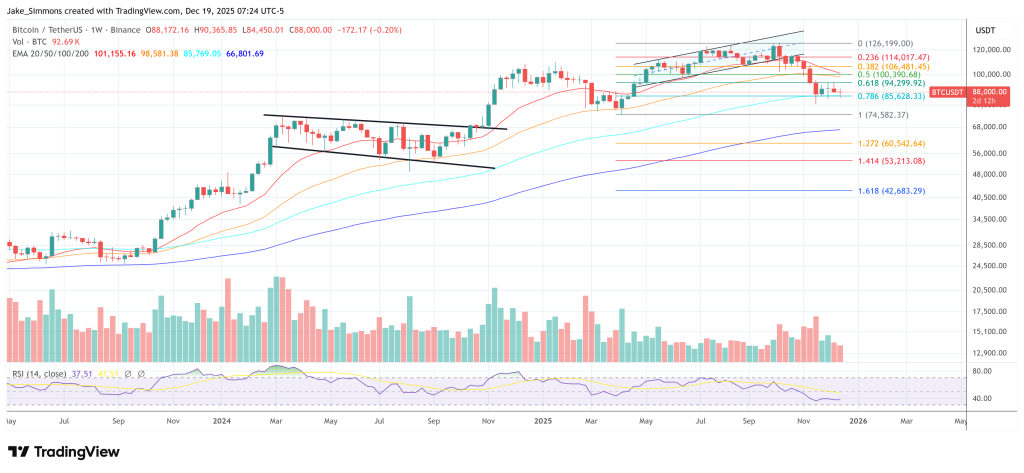
As of our last update, BTC was trading at a rather impressive $88,000, proving once again that in the world of cryptocurrency, anything is possible!
Read More
- Clash Royale Best Boss Bandit Champion decks
- Vampire’s Fall 2 redeem codes and how to use them (June 2025)
- Mobile Legends January 2026 Leaks: Upcoming new skins, heroes, events and more
- World Eternal Online promo codes and how to use them (September 2025)
- Clash Royale Season 79 “Fire and Ice” January 2026 Update and Balance Changes
- Best Arena 9 Decks in Clast Royale
- M7 Pass Event Guide: All you need to know
- Clash Royale Furnace Evolution best decks guide
- Best Hero Card Decks in Clash Royale
- How to find the Roaming Oak Tree in Heartopia
2025-12-20 03:15