So, Europe’s regulated stablecoin market is flourishing under the Markets in Crypto-Assets Regulation (MiCA), or so they say. But here’s the cosmic joke: one entire category is as empty as a politician’s promise. Nearly two years after MiCA kicked in, not a single asset-referenced token has been authorized in the EU. Not one. Zilch. Nada. It’s like throwing a party and forgetting to invite the guests.
According to the European Securities and Markets Authority (ESMA), there are 19 licensed issuers and 29 regulated stablecoins. But the parallel track for commodity- and basket-backed tokens? Oh, that’s just sitting there, sipping tea and wondering what it did wrong.
What the Numbers Actually Show (Or Don’t)
MiCA, which fully activated on December 30, 2024, splits regulated stablecoins into two categories, because why not add a bit more bureaucracy to the mix?
- Electronic money tokens (EMTs) are backed by a single fiat currency. Think of them as the reliable, if slightly boring, cousin at the family reunion.
- Asset-referenced tokens (ARTs) are backed by baskets of assets, commodities, or non-currency assets like gold. These are the wild cards, the ones who show up with a flaming dessert and a questionable story about a llama.
The March 2026 update to ESMA’s interim MiCA register shows 19 authorized EMT issuers across 11 countries, up from 17 issuers in 10 countries just two months earlier. Progress? Sure, if you squint.
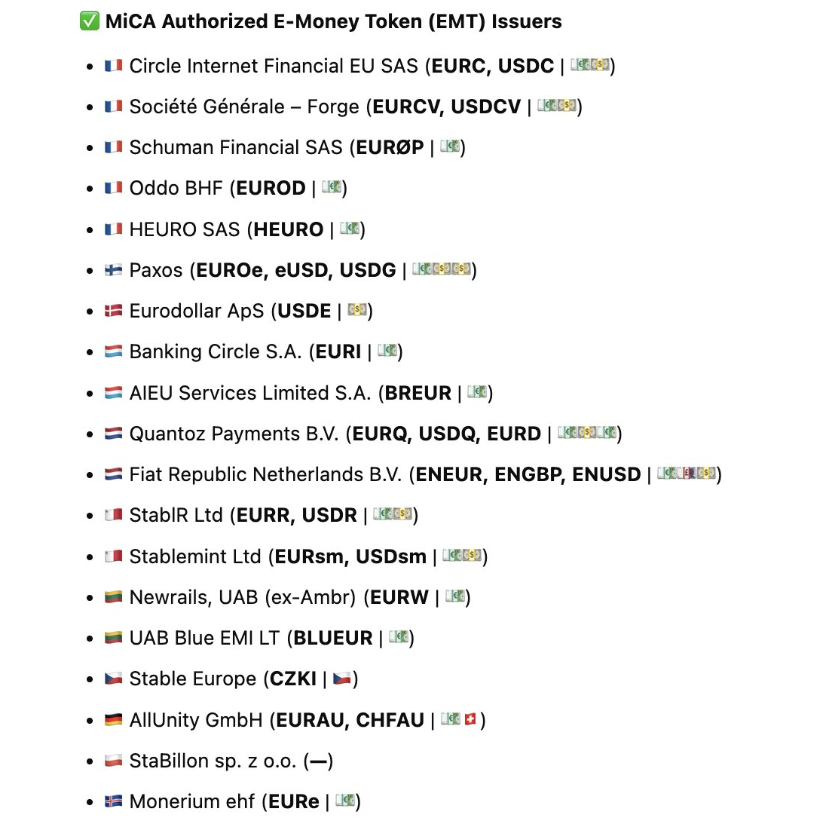
France is leading the pack with 5 licensed issuers, followed by Lithuania, Luxembourg, Malta, and the Netherlands with 2 each. It’s like a Eurovision contest, but with fewer glittery outfits and more spreadsheets.
Of the 29 EMTs in circulation, 17 are euro-denominated, 9 are dollar-denominated, and 3 are tied to the Czech koruna, British pound, and Swiss franc. The ART column? Still zero. It’s the financial equivalent of a tumbleweed blowing through a ghost town.
A Gap That Screams “Help, I’m Trapped in a Regulatory Maze!”
MiCA dedicates two full titles, Titles III and IV, to ARTs. Their absence isn’t a coincidence; it’s a neon sign flashing “Something’s Wrong Here.” It raises the question: Are the regulatory requirements more confusing than a Douglas Adams plot?
Patrick Hansen, Circle’s EU Strategy and Policy executive, thinks so. He points out that this is a sign of deeper friction in the framework. As he puts it:
“Still 0(!) ARTs, nearly two years in. Since ARTs… cover a significant part of the framework (Titles III and IV), this continued lack of uptake points to structural barriers. The upcoming MiCA review is an opportunity to address those barriers and make the ART regime workable in practice,” Hansen wrote. Or, in simpler terms, “Help, we’ve built a maze and now we’re lost in it.”
Hansen also noted that even the authorized EMTs are not yet reaching beyond crypto markets. When asked if regulated stablecoins are being used by institutions or non-crypto users, he described adoption as “mostly crypto still but growing out of it.” Translation: It’s like trying to teach a cat to fetch.
That assessment matters in context.
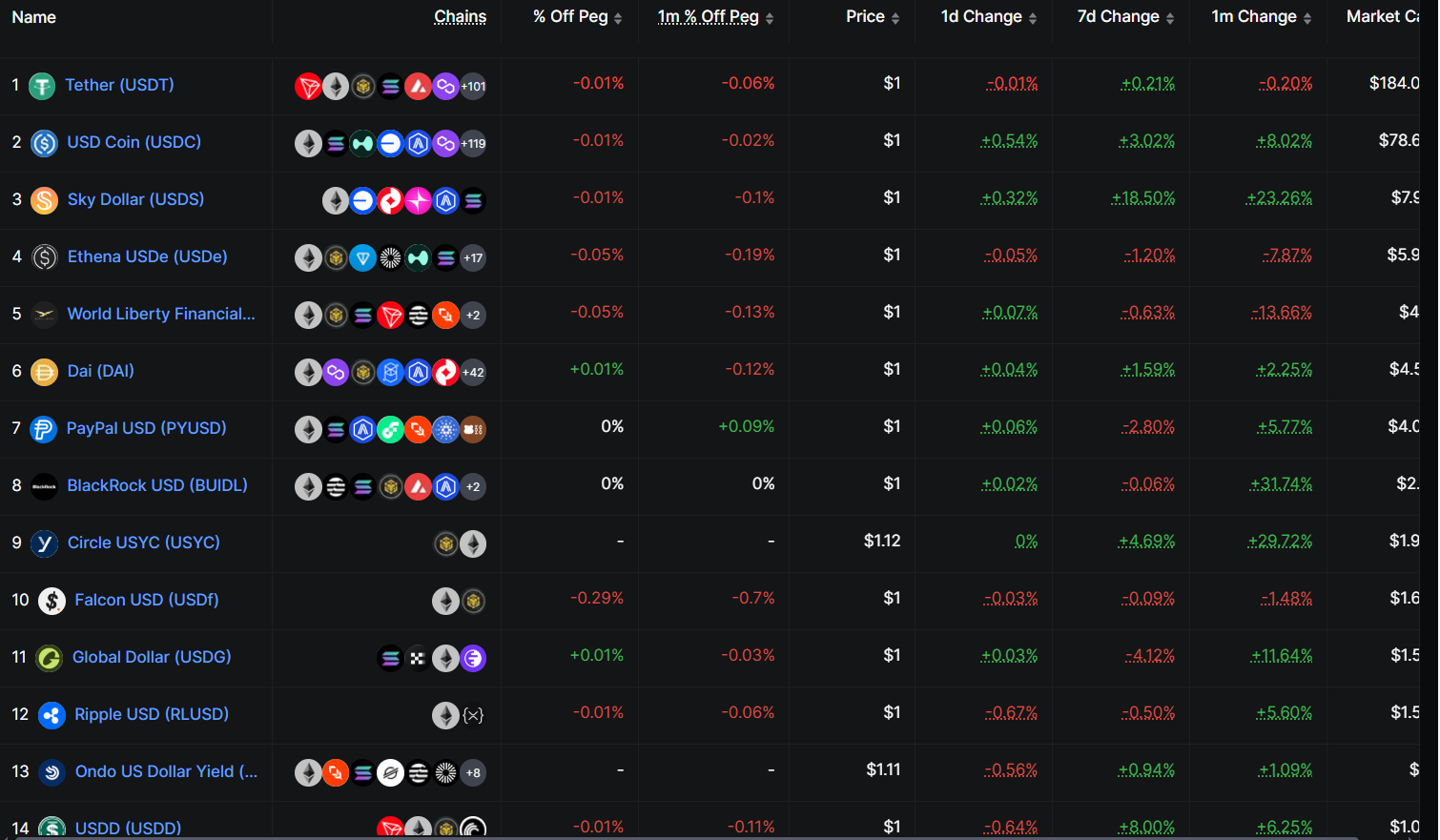
Among the top 50 stablecoins by market cap, Hansen noted that only USDC, USDG, and EURC currently meet MiCA compliance standards. That’s a narrower slice than a dieter’s pizza.
Enforcement Pressure Is Building (Or Is It Just Gas?)
The stablecoin data arrives as ESMA increases pressure on crypto-asset service providers (CASPs) to obtain authorization before their national transitional periods close. Most grandfathering periods expire by July 1, 2026, with no further extensions expected. It’s like the regulatory version of a countdown clock in a spy movie.
In December 2025, ESMA issued a statement requiring unauthorized CASPs to have orderly wind-down plans in place. They also instructed national regulators to treat last-minute applications with “considerable caution.” Because nothing says “we mean business” like a sternly worded memo.
For stablecoin issuers, the compliance window is narrowing. The white paper iXBRL format requirement entered application in December 2025, and order book record-keeping rules in JSON format took effect in April 2025. It’s enough to make even the most seasoned bureaucrat break out in a cold sweat.
The ART question is likely to surface in the upcoming MiCA review. Whether regulators treat the zero-authorization rate as a policy failure or a feature of deliberate caution will shape how the framework handles commodity-backed and basket-backed tokens going forward. Or, as Douglas Adams might say, “It’s a simple choice, really. Get it right, or spend the rest of eternity explaining why you got it wrong to a Vogon.”
Read More
- ‘Project Hail Mary’s Unexpected Post-Credits Scene Is Worth Sticking Around
- Beyond Accuracy: Gauging Trust in Human-AI Teams
- How Martin Clunes has been supported by TV power player wife Philippa Braithwaite and their anti-nepo baby daughter after escaping a ‘rotten marriage’
- Clash Royale Balance Changes March 2026 — All Buffs, Nerfs & Reworks
- Gold Rate Forecast
- CookieRun: OvenSmash coupon codes and how to use them (March 2026)
- eFootball 2026 is bringing the v5.3.1 update: What to expect and what’s coming
- The most surprising Hannah Montana cameos: From John Cena to Dwayne Johnson and even a Coronation Street soap star as show celebrates its 20th anniversary
- Genshin Impact Version 6.5 Leaks: List of Upcoming banners, Maps, Endgame updates and more
- Total Football free codes and how to redeem them (March 2026)
2026-03-11 11:31