Author: Denis Avetisyan
New research compares the cognitive structures underlying idea generation in humans and advanced AI, revealing key differences in how originality emerges.
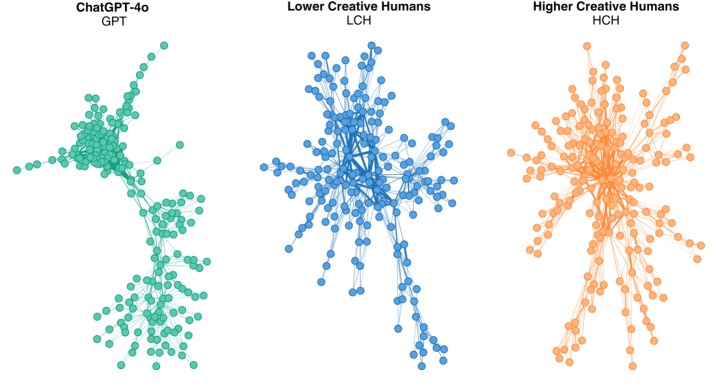
A comparative analysis of semantic network organization in human and ChatGPT-4o divergent thinking suggests limitations in current artificial intelligence approaches to creative cognition.
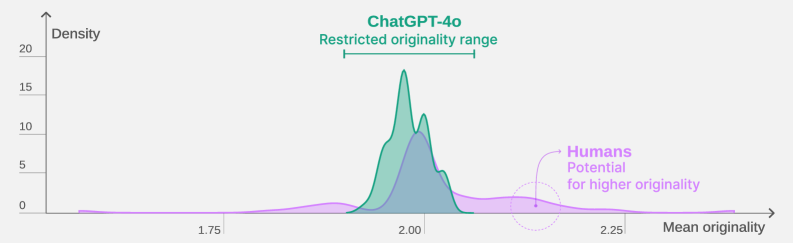
Despite growing interest in artificial creativity, a fundamental challenge remains in understanding how machine ideation compares to human cognitive processes. This research, entitled ‘Are Semantic Networks Associated with Idea Originality in Artificial Creativity? A Comparison with Human Agents’, investigates the relationship between the organization of semantic networks and the originality of ideas generated by both the large language model ChatGPT-4o and human participants. Findings reveal that while ChatGPT-4o exhibits a more rigid network structure, it can produce more original ideas than less creative humans, potentially highlighting the role of motivational factors and model hyperparameters. Could a deeper understanding of these differences unlock new avenues for designing truly creative artificial intelligence and effective Creativity Support Tools?
Deconstructing the Creative Impulse: A Framework for Artificial Cognition
The contemporary drive to build artificial intelligence increasingly prioritizes the simulation of uniquely human cognitive abilities, with creativity now recognized as a pivotal benchmark of true intelligence. Historically, AI research focused on logical reasoning and problem-solving; however, current efforts actively seek to model the generation of novel ideas, the ability to form unexpected connections, and the capacity for imaginative thought. This shift acknowledges that intelligence isn’t solely defined by what a system knows, but by its capacity to conceive of what could be. Consequently, researchers are developing algorithms and systems capable of producing outputs-be they artistic creations, scientific hypotheses, or innovative solutions-that are not simply derived from existing data, but demonstrate genuine originality, marking a significant evolution in the field of artificial intelligence.
The development of genuinely intelligent artificial systems hinges not simply on computational power, but on a deep understanding of how novelty arises in human thought. Creativity, at its core, isn’t random inspiration, but a complex interplay of cognitive processes – associative thinking, the recombination of existing knowledge, and the ability to overcome mental fixity. Researchers are increasingly focused on dissecting these processes – how the brain forms connections between seemingly disparate concepts, evaluates the potential of new ideas, and selects those most likely to be valuable. By modeling these cognitive underpinnings, artificial intelligence can move beyond rote learning and pattern recognition, achieving a capacity for genuine innovation and problem-solving that mirrors human ingenuity. This requires shifting the focus from simply what machines can do, to how they think, ultimately enabling the creation of systems capable of generating truly original and impactful solutions.
Artificial Cognition offers a potent pathway for developing genuinely creative artificial intelligence by translating well-established principles of human cognition into computational models. This interdisciplinary field doesn’t attempt to recreate human thought processes identically, but rather to abstract the core mechanisms – such as associative thinking, analogical reasoning, and conceptual blending – and implement them within machine learning architectures. By focusing on these cognitive building blocks, researchers can move beyond simply generating random outputs and towards systems capable of producing novel, surprising, and valuable ideas. This approach allows for the creation of AI that doesn’t just process information, but actively transforms it, mirroring the generative capacity central to human creativity and offering a more robust and explainable foundation for artificial intelligence than purely data-driven methods.
The Architecture of Novelty: Dissecting Divergent Thought
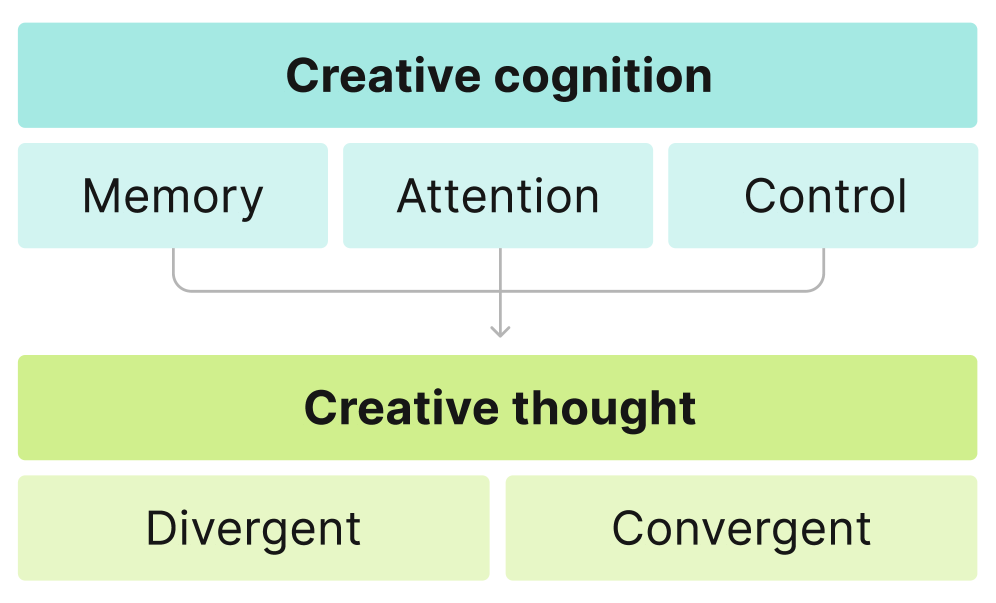
Divergent thinking, a core component of creative cognition, is characterized by the generation of numerous potential solutions to a defined problem. This cognitive process moves beyond identifying a single, obvious answer, instead prioritizing the exploration of a wide range of possibilities. The effectiveness of divergent thinking is not simply about the quantity of ideas produced, but also about the diversity and originality of those ideas; a greater number of options increases the probability of finding a novel and effective solution. Techniques designed to enhance divergent thinking, such as brainstorming or free association, aim to temporarily suppress evaluative processes that might prematurely limit the range of generated ideas, allowing for a more expansive search of potential solutions.
Divergent thinking, a core component of creative problem-solving, is fundamentally dependent on semantic memory, which encompasses an individual’s accumulated general knowledge about the world. This reliance isn’t simply on the quantity of stored information, but crucially on the capacity for flexible conceptual combination. Semantic memory organizes knowledge through associative networks, allowing for the retrieval and integration of seemingly disparate concepts. The efficiency with which an individual can access and relate information within this network directly impacts their ability to generate diverse and novel solutions; a greater capacity for semantic flexibility correlates with increased divergent thinking scores and perceived creativity.
The human semantic memory is increasingly understood as organized within a Semantic Network, a cognitive structure wherein concepts are represented as nodes and the relationships between them as connecting links. These links vary in strength and type, reflecting the frequency and nature of co-occurrence during learning and experience. This network architecture facilitates associative retrieval, allowing activation of one node to spread to related nodes, and combinatorial operations whereby distant concepts can be linked through multiple pathways. The efficiency of these processes-both the speed of retrieval and the number of possible connections-directly impacts an individual’s capacity for generating novel ideas and solutions, as it provides the foundational material for divergent thinking and creative cognition.
Quantifying the Spark: Measuring Creativity in Artificial Systems
The Alternate Uses Task (AUT) is a widely utilized psychometric test for evaluating divergent thinking, a cognitive process considered central to creativity. Originally developed by Guilford, the AUT presents participants with a common object – typically, everyday items like bricks or paperclips – and asks them to generate as many uses for that object as possible within a specified time limit. Scoring is based on both the total number of uses generated and, crucially, the originality – or statistical infrequency – of those uses. Higher scores reflect a greater capacity for flexible thinking and the ability to move beyond conventional applications, making the AUT a robust, quantifiable metric for assessing creative potential in human subjects and, increasingly, artificial intelligence.
The Alternate Uses Task, when administered to Large Language Models (LLMs), facilitates a quantitative assessment of their ideational originality. This involves prompting the LLM to generate a list of potential uses for a common object – for example, a brick – and then evaluating the responses based on both the total number of uses generated (fluency) and the statistical rarity or unusualness of those uses (originality). Scoring typically involves human raters assessing the novelty of each response, often compared against a normative dataset of human responses, or utilizing automated metrics based on semantic distance from common associations. The resulting scores provide a standardized measure allowing for comparative analysis of creative capacity across different LLM architectures and parameter sizes, and benchmarking against human performance levels.
Our study utilized the Alternate Uses Task to quantitatively assess the creative output of ChatGPT-4o, comparing its performance against a cohort of human participants. Results indicate ChatGPT-4o surpasses the average output of individuals identified as having lower creative capacity on this task, as measured by the total number of unusual or novel uses suggested for common objects. However, the model’s performance consistently falls below that of individuals categorized as highly creative, exhibiting a statistically significant difference in both the quantity and originality of generated responses. This positions ChatGPT-4o as demonstrating an intermediate level of creative capability, capable of exceeding baseline human performance but not yet matching the output of exceptionally creative individuals.
Beyond Mimicry: Charting the Future of Artificial Innovation
The essence of human creativity lies in the capacity to forge genuinely novel concepts, a feat that presents a significant hurdle for artificial intelligence. While AI excels at identifying patterns and recombining existing information, true originality demands the generation of ideas that transcend mere rearrangement – a leap into uncharted conceptual territory. This isn’t simply about statistical probability; it requires a system capable of breaking established associations and forming connections previously unseen. Consequently, evaluating an AI’s creative potential necessitates moving beyond assessments of fluency and flexibility to examine its ability to produce outputs demonstrably distinct from its training data, and to assess whether those outputs represent genuinely novel insights rather than sophisticated mimicry. The pursuit of this capacity remains central to advancing AI beyond its current limitations and unlocking its full innovative potential.
An analysis of ChatGPT-4o’s underlying semantic network architecture reveals a unique cognitive profile when contrasted with human creative thinking. The model demonstrates a notably higher modularity – a measure of network segregation – suggesting its knowledge is organized into distinct, relatively isolated modules. However, this comes at the expense of local interconnectivity, evidenced by a lower clustering coefficient, and overall network efficiency, indicated by a greater average shortest path length. Essentially, while ChatGPT-4o excels at maintaining distinct conceptual boundaries, its ability to rapidly synthesize information across these boundaries – a hallmark of flexible, human-like creativity – appears comparatively limited. This network structure suggests that the model’s innovation may stem from novel combinations within modules, rather than truly emergent connections between them, presenting both a strength and a potential limitation in its creative capacity.
The trajectory of artificial intelligence points toward increasingly sophisticated innovation across numerous disciplines, driven by ongoing refinement of models like ChatGPT-4o. However, realizing this potential hinges not simply on building more complex algorithms, but on establishing robust and nuanced evaluation methodologies. These methods must move beyond superficial assessments of output, delving into the underlying cognitive architecture of AI to understand how solutions are generated – fostering genuinely novel approaches rather than skillful recombination. Such rigorous testing will pinpoint areas for improvement, guiding the development of AI systems capable of tackling previously intractable problems in science, technology, and the arts, ultimately accelerating the pace of discovery and creative expression.
The study’s exploration of semantic network structures resonates with a sentiment echoed by Ada Lovelace: “The Analytical Engine has no pretensions whatever to originate anything.” This research, comparing human and AI cognitive processes, reveals that while ChatGPT-4o can generate novel combinations, the underlying network organization differs significantly from that of human brains. This difference suggests that current AI, despite its capacity for divergent thinking, may be limited in its ability to produce genuinely original ideas-effectively executing pre-programmed instructions, rather than initiating truly novel concepts. The ‘bugs’ in the system, as it were, expose the constraints of its design, highlighting the chasm between computation and authentic creativity.
Unraveling the Source Code
The observed divergence in semantic network organization between human agents and even advanced language models like ChatGPT-4o suggests a fundamental gap-not necessarily in processing power, but in the very structure of association. The research highlights that simply generating novel combinations isn’t equivalent to originality. Reality, after all, is open source-the system is there, but current AI approaches appear to be parsing the code rather than rewriting it. The question isn’t whether machines can produce something new, but whether they can genuinely understand the principles governing novelty itself.
Future work must move beyond simply quantifying network characteristics and delve into the dynamics of semantic exploration. Static snapshots of network structure reveal little about the process of creative thought – the controlled chaos, the unexpected leaps, the iterative refinement. A critical path lies in developing computational models that can simulate these dynamic processes, incorporating elements of curiosity, constraint relaxation, and-perhaps most challenging-a form of internal ‘aesthetic’ evaluation.
Ultimately, this line of inquiry isn’t merely about building more creative machines. It’s about reverse-engineering the human mind. By attempting to replicate the architecture of originality, the research offers a unique lens through which to examine the cognitive mechanisms underlying human creativity – and, in doing so, to better understand the source code of reality itself.
Original article: https://arxiv.org/pdf/2602.02048.pdf
Contact the author: https://www.linkedin.com/in/avetisyan/
See also:
- ‘Project Hail Mary’s Unexpected Post-Credits Scene Is Worth Sticking Around
- Total Football free codes and how to redeem them (March 2026)
- Limbus Company 2026 Roadmap Revealed
- The Division Resurgence Specializations Guide: Best Specialization for Beginners
- After THAT A Woman of Substance cliffhanger, here’s what will happen in a second season
- Brawl Stars Sands of Time Brawl Pass brings Sandstalker Lily and Sultan Cordelius sets, along with chromas and more
- Brawl Stars Brawl Cup Pro Pass arrives with the Dragon Crow skin and Chroma, unique cosmetics, and more rewards
- Clash of Clans April 2026 Gold Pass Season introduces a Archer Queen skin
- XO, Kitty season 3 soundtrack: The songs you may recognise from the Netflix show
- Gold Rate Forecast
2026-02-04 04:11