Taiwan’s justice ministry has been hoarding 210 Bitcoins, which is roughly $14 million. Most governments would treat that as a footnote. The Bitcoin Policy Institute thinks it should be a starting point. Presumably, they’re also suggesting a national fleet of flying cars and a 50% chance of winning the lottery.
A Case Built On Worst-Case Scenarios
In a report published Tuesday, BPI research fellow Jacob Langenkamp made the case that Taiwan should build a national Bitcoin reserve – not mainly as a financial play, but as protection against the possibility of a Chinese military blockade or invasion. Because nothing says “strategic foresight” like relying on a cryptocurrency that’s more volatile than a caffeine-addled squirrel.
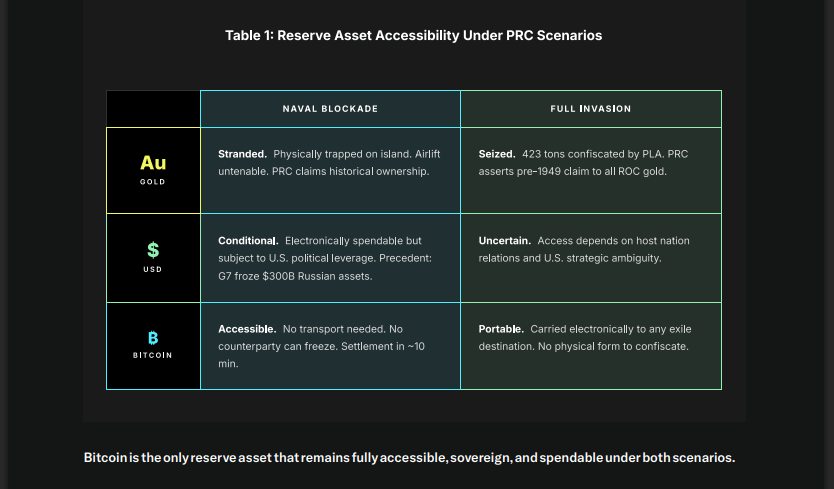
His argument is simple: if China cuts Taiwan off, gold cannot be moved and dollar reserves can be frozen. Bitcoin, he wrote, requires no physical transport and remains accessible regardless of what happens on the ground. Presumably, this assumes the ground isn’t currently a flaming asteroid.
Taiwan’s central bank had already looked at the idea and walked away from it. In December, the bank concluded that Bitcoin was too volatile, too hard to store safely, and too thin in liquidity to serve as a reserve asset. All valid concerns, but also the same logic that would’ve stopped the invention of the wheel.
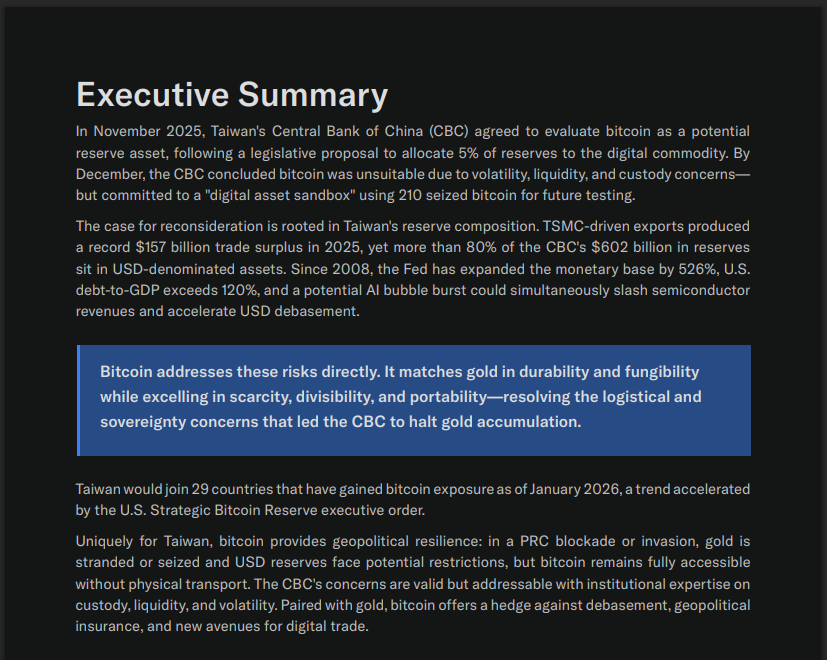
It pointed to the US dollar as the more sensible option. Langenkamp acknowledged those concerns are real – but argued they can be solved with the right institutional know-how on custody and risk management. Which, in simpler terms, means “we’ll just trust the same institutions that gave us the 2008 financial crisis.”
The Dollar Problem Analysts Say Taiwan Is Ignoring
The report’s broader warning centers on how exposed Taiwan already is to the US dollar. At least 80% of the central bank’s reserves are held in dollar-denominated assets, and most of its trade runs through the same currency. Because nothing says “economic stability” like betting your entire economy on a single, overleveraged currency.
Langenkamp listed several pressures that could erode the dollar’s value over time – rising US government debt, Federal Reserve money expansion, a possible downturn in AI-sector valuations, and shrinking semiconductor revenues. All of which are as predictable as a toddler’s tantrum at a buffet.
Bitcoin, he argued, could pair with gold to offer a buffer against those risks, giving Taiwan’s central bank a hedge before other countries make the same move. Because nothing says “forward-thinking” like a currency that’s 90% hype and 10% code.
Taiwan’s central bank did not fully close the door after its December decision. Officials said the bank would continue testing digital asset technology through a sandbox program, using crypto the country already holds. Because nothing says “innovation” like playing with a toy that’s more likely to blow up than revolutionize.

The Numbers Behind Taiwan’s Existing Holdings
The 210 Bitcoin figure came from lawmaker Ko Ju-Chun, who disclosed it on social media last year. According to data from crypto treasury tracker BitBo, those holdings – if officially counted – would rank Taiwan seventh among nations holding Bitcoin, just behind El Salvador and ahead of Finland. Because nothing says “global power” like holding Bitcoin.
Whether Taiwan’s government acts on the BPI report remains to be seen. The think tank has no formal role in Taiwanese policy, and the central bank’s position has not changed. Because nothing says “democracy” like ignoring the advice of a think tank that’s probably run by a guy in a basement with a PhD in memes.
But the report adds a new dimension to the global debate over Bitcoin as a state-level asset – one that goes beyond economics and into the question of what a country does when access to its own money is at risk. Which, in all fairness, is a question even the most seasoned economist would answer with a shrug and a “probably not this week.”
Read More
- ‘Project Hail Mary’s Unexpected Post-Credits Scene Is Worth Sticking Around
- Beyond Accuracy: Gauging Trust in Human-AI Teams
- Gold Rate Forecast
- Clash Royale Balance Changes March 2026 — All Buffs, Nerfs & Reworks
- The most surprising Hannah Montana cameos: From John Cena to Dwayne Johnson and even a Coronation Street soap star as show celebrates its 20th anniversary
- eFootball 2026 is bringing the v5.3.1 update: What to expect and what’s coming
- EMEA Masters Winter 2026 introduces official Qualifier for Esports World Cup
- Genshin Impact Version 6.5 Leaks: List of Upcoming banners, Maps, Endgame updates and more
- Brawl Stars Sands of Time Brawl Pass brings Sandstalker Lily and Sultan Cordelius sets, along with chromas and more
- Total Football free codes and how to redeem them (March 2026)
2026-04-03 05:56