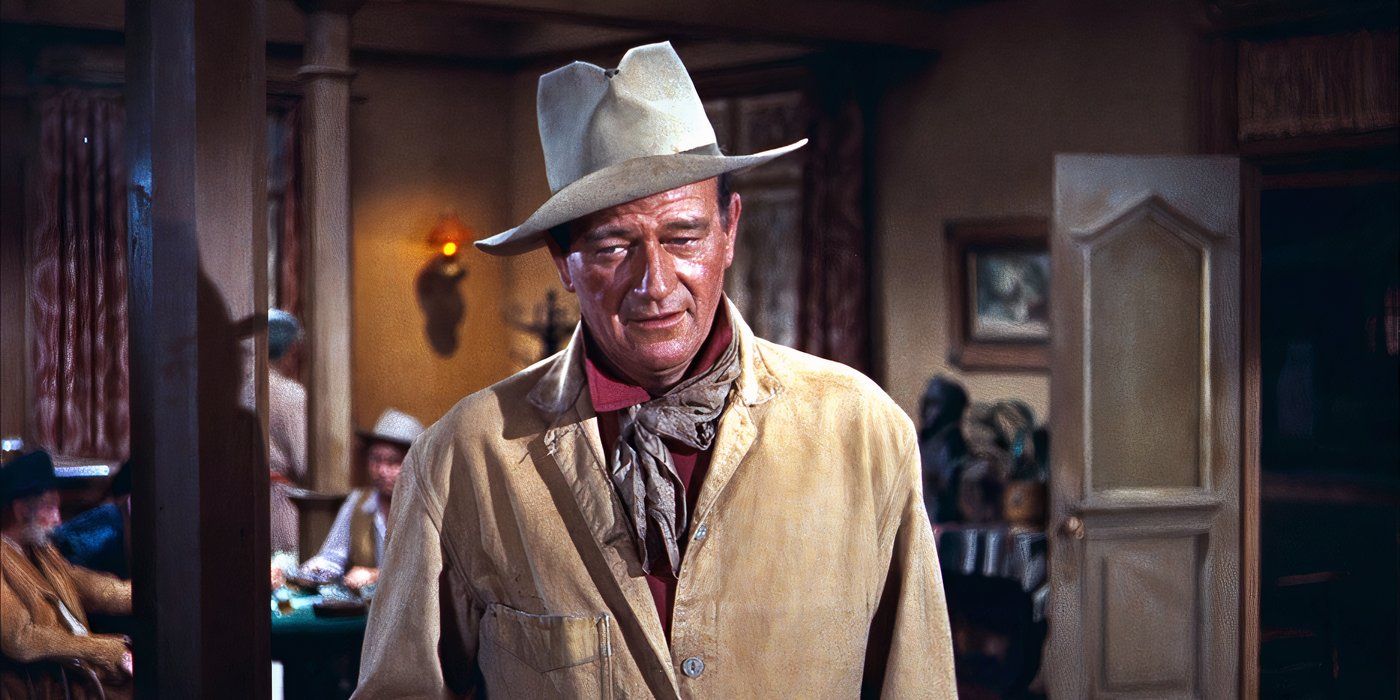
Quentin Tarantino became famous with his 1992 film Reservoir Dogs and has since become one of Hollywood’s most respected directors. He’s worked across many genres, including war, Westerns, action, and crime. Though known for his exciting action scenes, what truly sets his films apart is his ability to create characters that audiences genuinely care about – a skill he credits classic Westerns with inspiring.
Quentin Tarantino is known in Hollywood for his deep love of film, and few directors can match his enthusiasm and understanding. He’s a big fan of classic filmmakers like Sergio Leone, Sergio Corbucci, John Ford, and Stanley Kubrick, and clearly has excellent taste. His storytelling, especially in Westerns, is heavily influenced by films he admires, which he readily acknowledges. Surprisingly, he once named a 1959 John Wayne Western as his all-time favorite, and its unique style and mood significantly impacted how he develops characters.
This Controversial Movie Inspired Howard Hawks’ Magnum Opus
Fred Zinnemann’s 1952 film quickly became a defining movie of the decade. It stars Gary Cooper as Will Kane, the town marshal of Hadleyville, who is about to start his honeymoon. However, his plans are disrupted when he learns a dangerous criminal he previously imprisoned is being released and is headed back to town. Despite this, Kane feels obligated to stay and defend the town. He desperately tries to gather a posse, but the townspeople refuse to help, leaving him to face the outlaw and his gang alone as the clock ticks down. The story unfolds in real-time, highlighting Kane’s realization that he must defend a town that doesn’t seem to appreciate his efforts.
Despite being considered a classic film and even praised by Presidents Reagan and Clinton, High Noon caused controversy when it first came out. John Wayne strongly disliked the idea that a town would abandon its marshal, and he found the need for outside help troubling, believing it was unpatriotic. Many see High Noon as a criticism of the silence and inaction within Hollywood and American society during the McCarthy era. Given that Wayne often played the quintessential American hero, his disagreement with the film’s message makes sense. He subsequently collaborated with director Howard Hawks to create Rio Bravo in 1959, a film now considered a masterpiece and potentially the best work from either man’s impressive careers.
Rio Bravo Is A Western Masterpiece
The film Rio Bravo opens with a tense situation: Joe Burdette, the son of a wealthy rancher, shoots a man during an argument with Sheriff Chance and his troubled deputy, Dude. After the shooting, Chance arrests Joe to await trial. Joe’s powerful father, Nathan Burdette, doesn’t take this well and begins to threaten and intimidate Chance and his deputies, even going so far as to murder one of Chance’s friends. With limited help – an aging deputy named Stumpy and another named Colorado – and Dude battling severe alcoholism and withdrawal, Chance realizes he’s facing a dangerous standoff against Burdette’s men.
The town lawmen brace themselves for trouble, continuing their daily lives despite the arrival of Feathers, a widow fleeing from a dangerous man and with a bounty on her head. Though they start off at odds, the sheriff and Feathers quickly connect, drawn to each other by her strong and independent spirit – a type of character the sheriff has often portrayed in his work. As he grows to admire and fall for her, he knows he must resolve a pressing matter involving a man named Burdette before he can pursue a relationship. Throughout their time together, she proves to be one of the most compelling and well-developed female characters in the genre.
When Nathan Burdette’s gang finally attacks, the town erupts into a full-scale battle, pushing our heroes to their limits. This is where young Colorado gets a chance to prove his bravery, Dude confronts and overcomes his drinking problem, and the underestimated Stumpy rises to the occasion. Though the movie is largely a character-driven story, the climax is filled with exciting action, including explosions and gunfights. The film truly captures the spirit of the Old West and provides the satisfying, optimistic conclusion that High Noon didn’t.
Quentin Tarantino’s Love For Rio Bravo, Explained
Quentin Tarantino has often praised Rio Bravo as a personal favorite, even playfully mentioning he’d screen it for dates to gauge their film sense. He calls it the “ultimate hang-out movie,” a description that reflects his own filmmaking style, seen in films like Jackie Brown, Pulp Fiction, and Once Upon a Time in Hollywood. Like Rio Bravo, Tarantino excels at creating character-focused stories driven by dialogue, allowing audiences to truly connect with people like Vincent Vega and Cliff Booth. Though action is present in his films – as it is in Rio Bravo – his priority is making viewers care about the characters. Given that Tarantino considers Once Upon a Time in Hollywood his greatest work, it’s clear he still believes that a relaxed, character-driven experience makes for the best movies. In Rio Bravo, audiences become invested in the characters, rooting for Dude to succeed and Chance to find happiness, and the film delivers on those hopes.
Quentin Tarantino has often spoken about his love for Rio Bravo, describing it as a film you can really settle into and connect with the characters – almost like making friends with them. He particularly appreciates how the film presents a strong, positive vision of masculinity, even saying it served as a kind of guiding force for him growing up without a father, almost like director Howard Hawks was a father figure. This wasn’t accidental; Hawks and John Wayne intentionally created Wayne’s character, Chance, as a contrast to the hero in Hawks and Wayne’s previous film, High Noon. They wanted a self-reliant lawman who took charge, unlike the character played by Gary Cooper who constantly sought assistance. Ultimately, whether viewers prefer Rio Bravo or High Noon is a matter of taste, but Tarantino rightly points out that Rio Bravo excels at developing compelling characters, an approach he’s been incorporating into his own filmmaking since the 1990s.
The film Rio Bravo fully leans into classic Western tropes – think John Wayne as the brave sheriff, Angie Dickinson as the strong, independent woman often found in director Hawks’ films, and John Russell as the quintessential Western villain. This approach is similar to Quentin Tarantino’s storytelling, where characters represent the core elements of their genre. Tarantino often prioritizes genre conventions, and you can see this in his work. Rio Bravo delivers a classic Western character study, focusing on the compelling people of the Old West. Unlike many films that switch between action and drama, Rio Bravo feels designed to showcase a character’s journey, where the action serves to enhance their relationships and stories.
Tarantino Isn’t The Only Howard Hawks Admirer
Quentin Tarantino is a well-known fan of Howard Hawks’ Rio Bravo, but many other Hollywood directors share that admiration. The film has inspired countless tributes, and much of modern Western cinema feels like a celebration of it. Rio Bravo centers on a small group of lawmen trapped in their station by a dangerous gang, who are forced to enlist the help of prisoners to defend themselves. This concept is essentially the foundation for a suspenseful, almost psychological thriller.
Arnold Schwarzenegger took on a remake of the classic film Rio Bravo in his 2013 action movie, The Last Stand. He plays the sheriff of a small Arizona town that a dangerous criminal is using as a route to escape into Mexico. With the criminal closing in, the sheriff enlists the help of some old friends and prepares for a final showdown in the town center, resulting in a large gunfight. Because the story of a brave lawman defending his town is so straightforward and appealing, it’s a theme that Hollywood—and audiences—will likely continue to revisit, just as Rio Bravo originally did.
Read More
- ‘Project Hail Mary’s Unexpected Post-Credits Scene Is Worth Sticking Around
- Total Football free codes and how to redeem them (March 2026)
- Limbus Company 2026 Roadmap Revealed
- The Division Resurgence Specializations Guide: Best Specialization for Beginners
- After THAT A Woman of Substance cliffhanger, here’s what will happen in a second season
- Brawl Stars Sands of Time Brawl Pass brings Sandstalker Lily and Sultan Cordelius sets, along with chromas and more
- Brawl Stars Brawl Cup Pro Pass arrives with the Dragon Crow skin and Chroma, unique cosmetics, and more rewards
- Clash of Clans April 2026 Gold Pass Season introduces a Archer Queen skin
- XO, Kitty season 3 soundtrack: The songs you may recognise from the Netflix show
- Gold Rate Forecast
2026-04-06 02:12