Despite predictions of a Senate vote soon, traders on prediction markets don’t believe the Digital Asset Market Clarity Act will actually become law by 2026.
Key Takeaways
- Polymarket prices a 39% chance the Clarity Act becomes law by December 31, 2026.
- Kalshi bettors set 67.8% odds the Senate votes on the bill before August 8.
- A $3.1M Kalshi market puts crypto market structure law odds at 61% before April 2027.
On Polymarket, the market asking whether the Clarity Act (H.R. 3633) gets signed into law before December 31, 2026, has drawn nearly $1.94 million in volume.
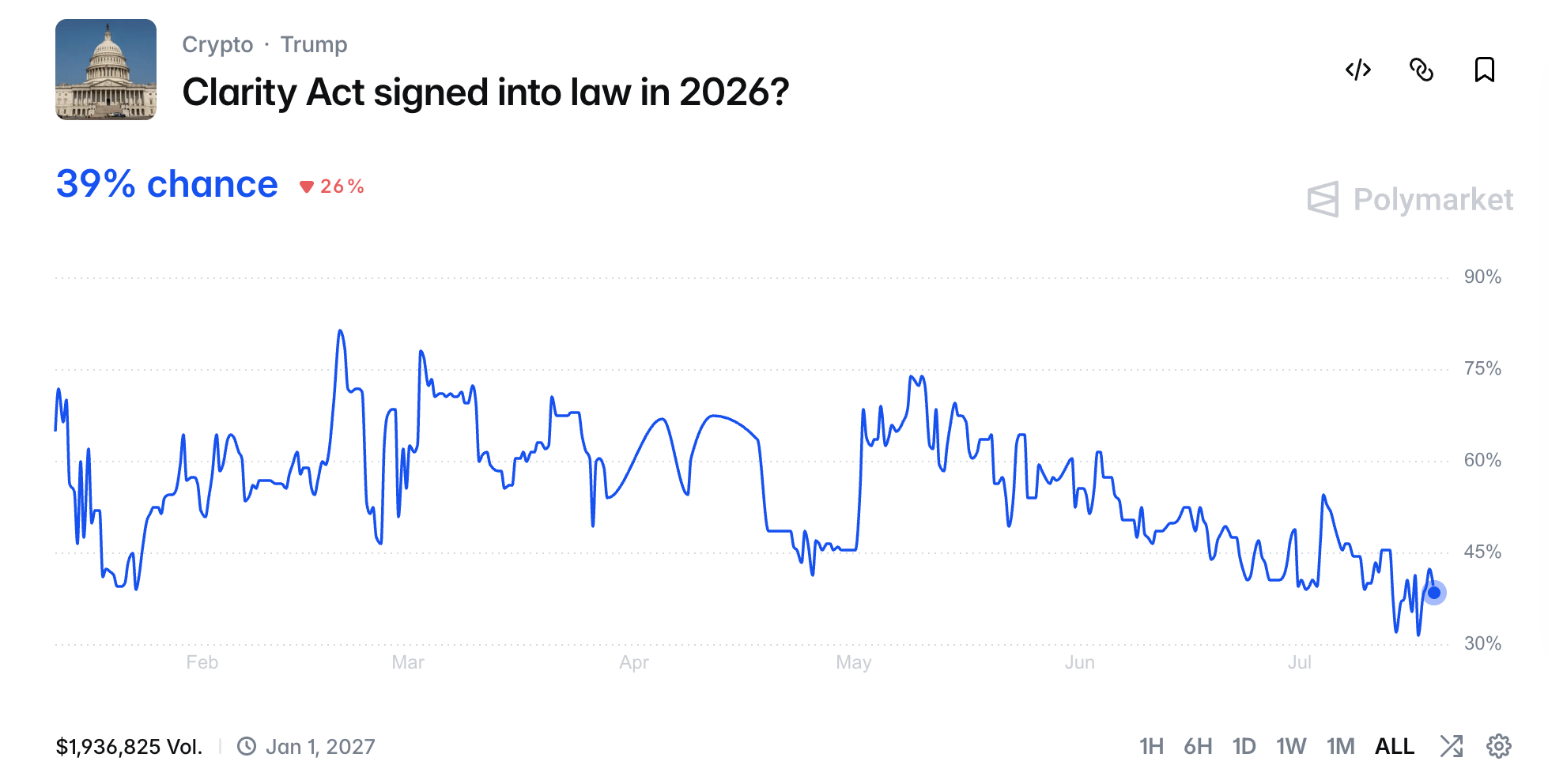
Current odds sit at 39% for “yes” and 62% for “no.” That “yes” figure has fallen roughly 26% from recent highs.
Senate Vote Odds Run Hot on Kalshi
I’m also watching the Kalshi market focused specifically on whether the Senate will actually vote on the Clarity Act before they break for August. Interestingly, traders there seem much more certain it will happen – currently, contracts predicting ‘yes’ are trading at 68 cents, which translates to roughly a 67.8% probability.
The market will be open from July 10th to August 8th, but could close sooner if a formal vote triggers its closure. Only official, recorded votes will be counted – verbal agreements or decisions about procedure won’t affect the closing date.
A Third Market Tracks the Bigger Picture
A third Kalshi market, with $3.1 million in volume, asks a broader question: will crypto market structure legislation become federal law at all, and when. That market breaks odds out by target date. Traders price a 61% chance of enactment before April 1, 2027, 53% before July 1, 2027, and 57% before October 1, 2027.
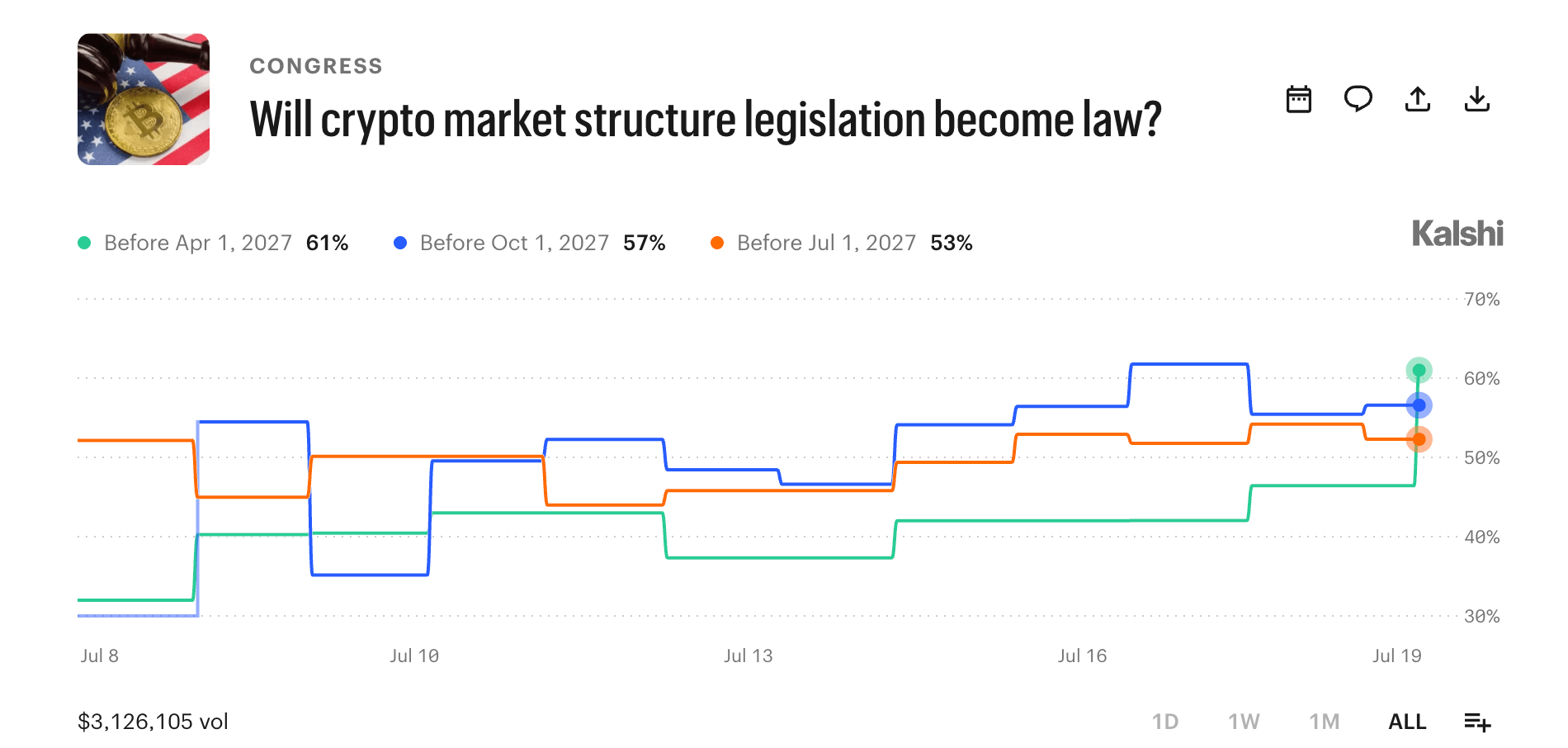
This market has more specific requirements for resolving outcomes than the Polymarket contract. To qualify, a bill must establish comprehensive rules for digital assets, clearly divide oversight responsibilities between the SEC and CFTC, and specify what defines a security versus a commodity. Bills focused solely on stablecoins, like the GENIUS Act, won’t qualify. Similarly, legislation about only central bank digital currencies (CBDCs), or bills that don’t pass both the House and Senate, won’t count either.
Where the Bill Actually Stands
The Clarity Act received support from both parties and passed the House of Representatives in July 2025. In June 2026, the Senate Banking Committee, led by Senator Tim Scott, approved the bill with some changes and added it to the list for Senate votes. A year after the House passed the bill, the House Digital Assets Subcommittee held a hearing in New York to discuss it further.
Those who support the bill highlight endorsements from the Trump administration and senators like Cynthia Lummis. They believe it would move away from the SEC’s current approach of taking action against companies after the fact, and instead create a clear set of rules for cryptocurrency exchanges, those who hold digital assets, and developers.
Critics, including some Senate Banking Democrats like Elizabeth Warren, warn that DeFi carve-outs in the bill could weaken anti-money laundering enforcement. They point to groups like North Korea’s Lazarus Group as a reason to keep oversight tight on decentralized platforms. Alongside this, President Trump’s own crypto investments have sparked more scrutiny.
What the Odds Tell Traders
As I’ve been monitoring the Kalshi markets, the difference in how they’re reacting to potential outcomes is really telling. What we’re seeing is strong belief that the Senate will vote on this soon. However, there’s much less confidence that it will actually become law before the end of the year. It’s important to remember a Senate vote is just one step – it doesn’t mean the bill *will* pass, and even if it does, the final version might look quite different from what the House has already approved.
Polymarket’s declining “yes” odds track that same skepticism. Congress has a history of letting crypto legislation stall even after committee approval. FIT21, the Clarity Act’s predecessor, passed the House in 2024 and never reached a Senate vote.
For traders positioning around crypto policy risk, the spread between a near-term procedural bet and a full-year enactment bet offers a read on where confidence actually sits. Kalshi bettors trust the Senate to show up for a vote. They trust Congress far less to finish the job before the year runs out.
2026-07-19 19:28