SpaceX, owned by Elon Musk, has delayed its Starship rocket’s 13th test flight until Friday, July 24th. The delay is due to bad weather that could have interfered with important imaging of the heat shield. This setback comes as the company’s stock price has remained below its initial public offering price of $135 since mid-July.
Key Takeaways
- SpaceX delayed Starship’s 13th flight test to July 24 after a July 16 engine abort and weather scrub.
- SPCX shares have traded below their $135 IPO price since July 17, down nearly 23% since debut.
- Friday’s window opens at 6:45 p.m. ET, with Starship set to deploy 20 Starlink V3 satellites.
Third Setback in Just Over a Week
SpaceX has delayed the launch of its Starship rocket again, this time because of the weather. They’re now aiming for a launch on Friday, July 24th. This is the third time in less than a week that the launch has been pushed back, and it’s a crucial vehicle for Elon Musk’s plans to send astronauts to the moon and further into space.
The trouble began on July 16, when several of Booster 20’s Raptor engines failed to ignite in the final second of the countdown. Musk described the failure on X as an automatic launch abort triggered when some of the engines didn’t start, and engineers swapped out two of the booster’s Raptors before clearing it for another attempt.
Another launch attempt on July 23rd was postponed. This time, the issue was the need for clear weather so ground cameras could get detailed pictures of the Starship’s heat shield tiles as it flew. SpaceX says this data is crucial for demonstrating that the vehicle can be safely reused.
Friday’s rescheduled attempt opens a 90-minute window at 6:45 p.m. ET (5:45 p.m. local time) from the company’s Starbase facility in South Texas. If it flies, the Super Heavy booster is expected to separate, perform a boostback burn and splash down in the Gulf of Mexico, while the Starship upper stage deploys 20 Starlink V3 satellites (its first delivery of an operational payload) before attempting a controlled entry and splashdown in the Indian Ocean.
A Bitcoin Treasury Riding Along
As a crypto investor, I’ve been following the Starship launches, but something else caught my eye: SpaceX’s Bitcoin holdings. Recent filings related to their potential IPO revealed they’re sitting on 18,712 BTC – worth around $1.29 billion as of May 20th. That makes them one of the biggest corporate Bitcoin holders in the U.S., which is a pretty significant detail beyond just the rockets!
Tesla, which is related to SpaceX, holds approximately 11,509 Bitcoin. While the value didn’t change much during the last three months, they reported a $112 million loss on their financial statements due to standard accounting practices.
Trackers listed SpaceX as the eighth-largest public company bitcoin holder at the time of its filing, well behind Strategy’s treasury of more than 840,000 BTC but ahead of most other Nasdaq companies that have added bitcoin since 2024. Unlike Tesla, which has held its bitcoin since 2021 and books it under standard corporate accounting rules, SpaceX’s position only became public knowledge through IPO disclosure requirements.
A Rocky Nasdaq Debut
SpaceX’s stock market performance has proven almost as turbulent as its test flights. The company priced its June 12 IPO at $135 a share, valuing SpaceX at roughly $1.75 trillion, but SPCX shares slipped below that IPO price for the first time on July 17 (the day after the failed launch attempt) and have stayed underwater since, down nearly 23% since the stock joined the Nasdaq-100. Moreover, the company’s stock is currently trading $118, over 40% lower than its all-time high of nearly $202.
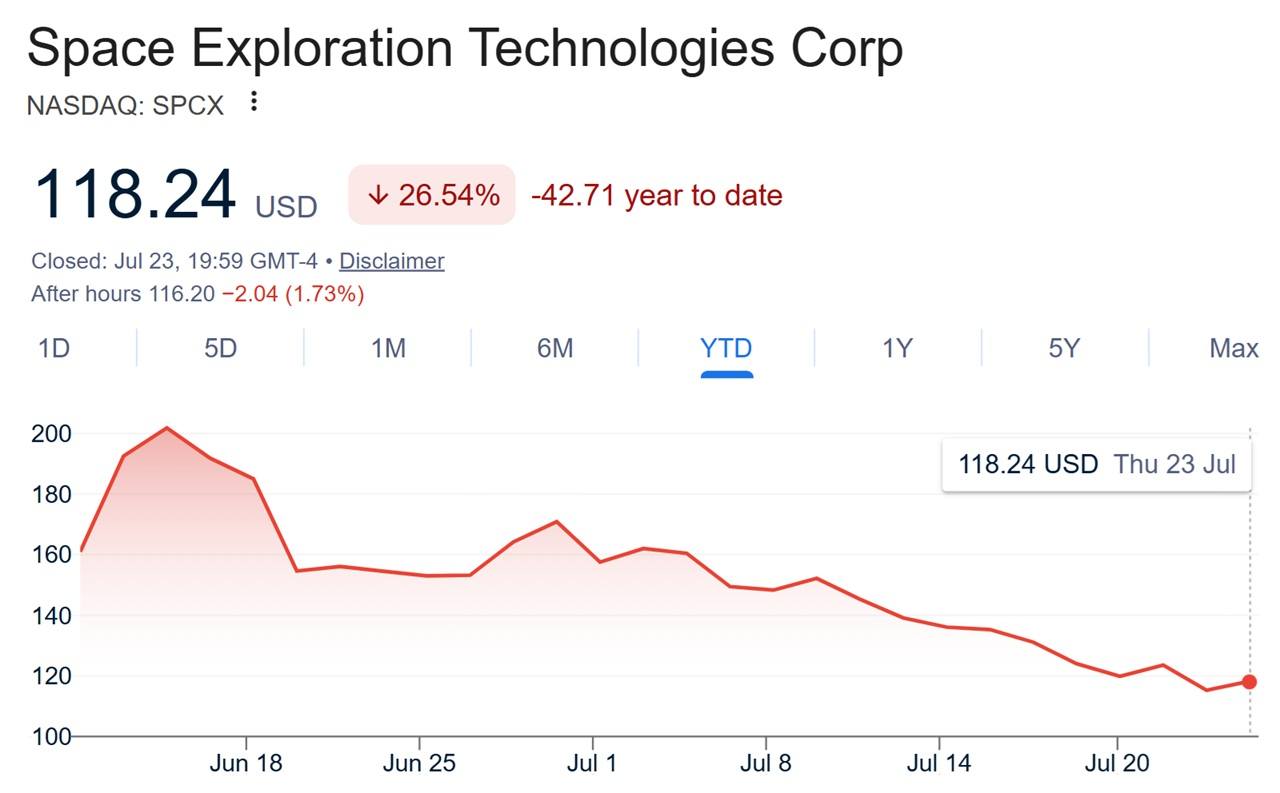
Following the launch attempt on July 16th, Elon Musk stated SpaceX aimed to try again “in a few days,” and they’ve largely stayed on track despite a weather-related setback. If Starship launches successfully on Friday, it will be the first time it’s deployed a working satellite, offering a strong signal of reliability to SpaceX’s recent investors – many of whom invested at a higher price. Until then, both the rocket’s performance and the company’s stock price remain below their initial levels.
2026-07-24 10:58