Charles Hoskinson, the creator of Cardano, recently announced progress on Leios, the next big upgrade to Cardano’s system. Input Output, the company behind Cardano, has proposed a funding plan worth ₳27.7 million to move Leios from its initial testing phase to a version ready for main network use. This upgrade is considered a key part of Cardano’s plans for improving its capabilities by 2030.
Charles Hoskinson announced on X that a new feature called Leios is on the way for Cardano. This followed a statement from Sebastian Nagel indicating Leios would be released if Cardano’s community governance approves. This highlights that the next step in Cardano’s development depends on both the technical work being completed and a decision from the Cardano community.
Cardano’s Biggest Scaling Bet
Carlos Lopez de Lara and Nagel are requesting DReps to approve a funding withdrawal of ₳27,714,342 to cover six to nine months of development work. This work will advance Leios from its current testing phase to a version ready for use on the main network. The proposal states that each development goal will be verified separately, and any unused funds will be returned to the treasury.
Leios is an upgrade to Cardano’s existing system, Ouroboros Praos, intended to improve its performance, not replace it. The upgrade will add ‘endorser blocks’ and use committees to verify transactions, allowing for more transactions without sacrificing security. Input Output Global (IO) believes this will help Cardano grow without harming its decentralized nature or making it difficult for stake pool operators to continue running their services.
Cardano aims to significantly increase its transaction speed to achieve its goals for 2030, and the Leios project is designed to make that happen. This funding will support the transition from a public testing phase to a fully functional version ready for mainnet launch, ultimately increasing transaction capacity by 10 to 65 times. This improvement is crucial because Cardano plans to grow from around 800,000 transactions each month to over 27 million by 2030.
The request for funding is largely based on a goal for 2030. The proposal explains that reaching this goal would require increasing current capacity by at least six times. Leios is projected to exceed this, potentially increasing capacity tenfold based on testing. A related article details that Leios could gradually increase throughput on the main network from two to thirty times the current level, with full capacity already proven on a test network.
This project focuses on three main goals. First, we aim to deliver a test version featuring major improvements to how agreement is reached within the system. This includes adopting a new block structure called Leios, designed for the upcoming Dijkstra phase, and rigorously verifying it against a formal specification using Agda. We plan to integrate all of this into our main software by the end of 2026.
We also focused on building strong confidence through thorough testing – including exploring different settings, simulating heavy usage, and actively trying to find weaknesses. Finally, we prepared for a major software update, which involved updating how users and developers interact with the system, creating clear documentation, offering training, ensuring compatibility with related tools like DB-Sync, Mithril, and Blockfrost, running test updates, and establishing clear governance and backup plans.
The proposal clearly distinguishes between tasks IO can manage directly and those that rely on outside factors. While IO could initiate a major network upgrade (a ‘hard fork’), its success still hinges on the wider network being prepared, a formal proposal being submitted, and a community vote. The document honestly presents these as potential challenges, not guaranteed outcomes.
Funding will be managed using Intersect’s secure smart contract system, releasing funds as specific goals are achieved and with independent verification. The total budget of ₳23.83 million will primarily focus on development (86%), with the remaining funds allocated to areas like infrastructure, security checks, legal compliance, supporting the ecosystem, operational costs, governance, and other expenses.
The section on risks clearly states that several factors could delay or restrict the launch. These include how prepared the community is, the timing of a potential hard fork, successfully integrating the Cardano node, and possible limitations with how the system is governed. It also points out technical challenges, like potentially higher costs for stake pool operators, a growing blockchain size, and the fact that the system’s performance relies on certain assumptions about how users might behave.
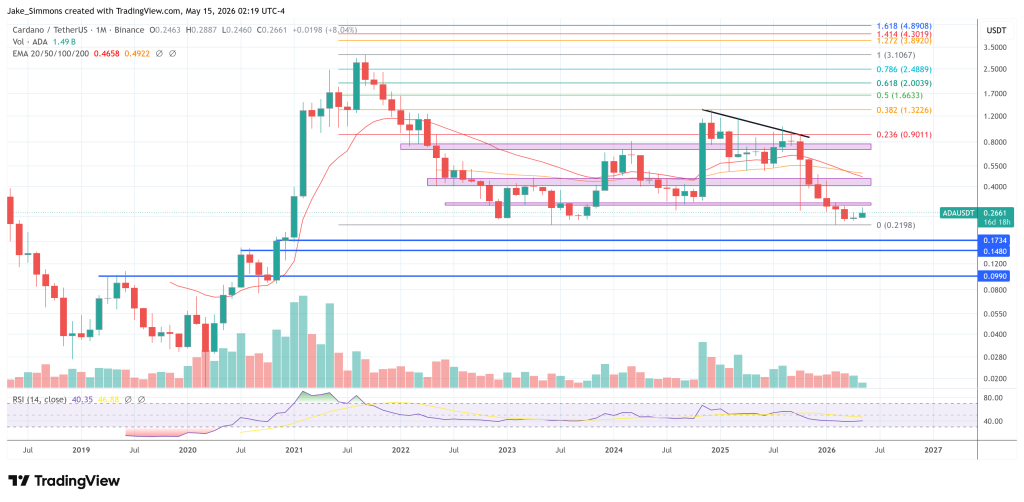
At press time, ADA traded at $0.2661.
Read More
- Total Football free codes and how to redeem them (March 2026)
- Last Furry: Survival redeem codes and how to use them (April 2026)
- Pixel Brave: Idle RPG redeem codes and how to use them (May 2026)
- Clash of Clans May 2026: List of Weekly Events, Challenges, and Rewards
- Light and Night brings its beloved otome romance experience to SEA region with a closed beta test starting May 20, 2026
- Top 5 Best New Mobile Games to play in May 2026
- Gear Defenders redeem codes and how to use them (April 2026)
- Skip Bayless and Stephen A. Smith to reunite on ESPN’s ‘First Take’ for one day only
- FC Mobile 26 TOTS (Team of the Season) event Guide and Tips
- Painful truth about Alexa Demie after she vanished… then emerged with drastic new look: Insiders spill on Sydney Sweeney feud and Euphoria star’s plan for revenge
2026-05-15 14:27