Senator John Thune, the Senate Majority Leader, has stated that the CLARITY Act won’t be passed before the Senate’s August break. This news has led traders on Polymarket to significantly lower their expectations of the bill becoming law in 2026, now giving it only a 33% chance.
Summary
- John Thune has ruled out CLARITY Act passage before the Senate’s August recess.
- Ron Hammond says election politics is drowning out the bill’s bipartisan support.
- Polymarket traders now give the CLARITY Act a 33% chance of passage in 2026.
According to Fortune, Senator Thune doesn’t believe the Senate will vote on the crypto market bill before they finish their work in Washington. This removes a key deadline that supporters of the bill were hoping would lead to its approval this year.
Now that the November elections are over, Congress will soon address important issues like funding the government and passing defense bills before time runs out. According to Ron Hammond of Wintermute, while there’s still support from both parties for this legislation, it’s become complicated by political disagreements during an election year.
As a crypto investor, I’m starting to think the biggest hurdle for getting clear regulations passed isn’t actually getting enough votes in the Senate – it’s politics. With Democrats gearing up to attack Trump and talk about corruption leading into the election, I suspect some Senators will be hesitant to publicly back any big crypto legislation right now. They don’t want to give their opponents ammunition, so a bill could easily get stalled because of that.
Hammond explained to Fortune that while enough votes exist to pass something, current political noise surrounding the election is overshadowing that fact. He believes this noise will likely fade after November, creating a brief opportunity for action.
Election politics has become the main obstacle
Even though Republicans suggested they might be open to regulating lawmakers’ involvement with cryptocurrency, a disagreement about Donald Trump’s crypto-related businesses is making negotiations difficult. Democratic senators are insisting on rules that would stop high-ranking officials from personally benefiting from cryptocurrency through their positions in government.
The current proposal would have the Department of Justice enforce ethics rules for Trump and other federal officials. However, some Democrats oppose this plan, arguing that because the Justice Department answers to the President, it shouldn’t be the only entity able to enforce rules against a current president.
According to a report from crypto.news on July 23rd, seven Democratic senators are also against the revised bill due to worries about ethical issues, consumer safeguards, and how the rules would be enforced. With Republicans controlling 53 seats in the Senate, they need at least seven Democrats to join them to reach the 60 votes typically needed to move the bill forward.
According to Fortune, Senate Minority Leader Chuck Schumer is advising Democrats to focus their campaigns on claims of corruption related to Trump. Experts like Hammond suggest this approach might discourage Democratic senators from cooperating with the White House on any legislation – even things they generally agree with, such as regulations for cryptocurrency – before the midterm elections in November.
As a crypto investor, I’m seeing more pushback from traditional banking groups – this time regarding potential rewards programs for holding stablecoins. They’re essentially worried that if people can *earn* something on their stablecoins, it could lead to folks moving money out of banks and into crypto, which would cut into the banks’ lending capital. It feels like they’re trying to protect their business model by stifling innovation in the stablecoin space.
Hammond says that banks and others deliberately stalled the bill by dragging out negotiations until it was too late to pass. This tactic allowed them to continue arguing about key issues like rewards for stablecoins, who should regulate them, and ethical guidelines, as time ran short in the Senate.
Despite this, Goldman Sachs CEO David Solomon has distanced himself from banking groups pushing for stricter regulations. According to crypto.news, Solomon actually favored the legislation, believing it would create a clear framework for the U.S. cryptocurrency market and provide digital asset firms with more defined guidelines.
Solomon admitted there were still details lawmakers might want to discuss, but urged Congress not to reject the proposal altogether just because it wasn’t perfect. He thought the legislation could help keep markets steady and create a more level playing field for businesses, though he stopped short of fully supporting the controversial section about rewards for stablecoins.
Passage odds have fallen to 33%
Despite the limited time left, cryptocurrency leaders are still urging Congress to pass legislation. Brad Garlinghouse, CEO of Ripple, agreed with his company’s lawyer, Stuart Alderoty, who cautioned lawmakers against delaying a workable bill while trying to reach a perfect agreement.
According to crypto.news, Coinbase CEO Brian Armstrong believes the proposed cryptocurrency legislation is prepared for review by the Senate after extensive discussions. However, despite these efforts, a vote hasn’t been scheduled, and Senator Thune suggests the Senate will likely break for recess without resolving all disagreements.
Traders on prediction markets are now less optimistic about the CLARITY Act passing. Currently, Polymarket estimates it has a 33% chance of becoming law by 2026, and over $2.56 million has been bet on this outcome.
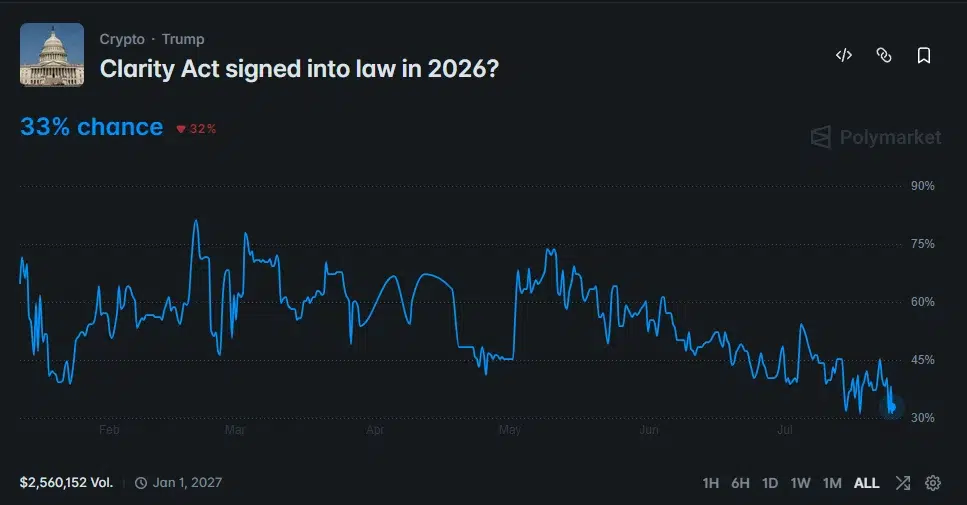
Polymarket’s data indicates that expectations for the bill’s passage were high in late February, exceeding 80%. However, over the next few months, those odds decreased. By July, the probability had fallen to around 30% due to ethical concerns, resistance from banks, and fears of a recession – all of which eroded confidence in its approval.
After the elections, Treasury Secretary Hammond believes there will be a brief window where pressure from campaigns lessens, potentially allowing negotiations to resume. However, according to Fortune, these talks will have to compete with pressing funding needs and defense bills, giving senators limited time to resolve outstanding disagreements about ethics, banking regulations, and enforcement issues.
2026-07-24 18:32