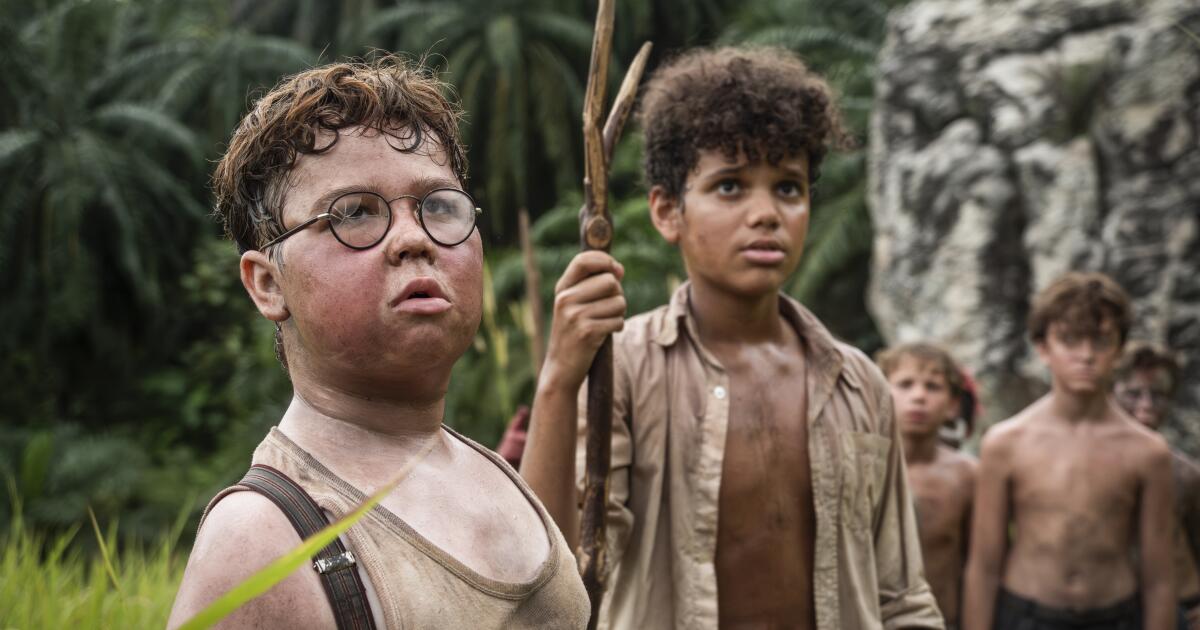
This article contains some spoilers for “Lord of the Flies” on Netflix.
It was late at night, and an eleven-year-old boy in Britain couldn’t sleep. He found a thin book on his mother’s shelf – a book she’d secretly taken from the school where she worked.
“Lord of the Flies.”
As a critic, I can tell you this novel really stuck with me, even as I’ve followed the author’s career. You can feel its influence in everything he’s done since – from co-writing the stage play ‘Harry Potter and the Cursed Child’ and the movie ‘Wonder,’ to his work on the TV series ‘His Dark Materials’ and ‘Adolescence.’ He clearly draws on that early, powerful experience when exploring the worlds of young people.
Jack Thorne, the creator of a new miniseries based on ‘Lord of the Flies’ debuting on Netflix Monday, says the book has profoundly shaped his worldview. He explains that he’s been revisiting the story for 36 years, and it’s become deeply ingrained in who he is.
The movie closely follows William Golding’s 1954 novel. It begins with a plane crash on a deserted tropical island, leaving a group of British schoolboys stranded with no adults. About thirty boys survive, ranging in age from young children to teenagers. Among them, Ralph, a likeable and natural leader, is quickly chosen as their chief. Piggy, the most intelligent of the older boys, has good ideas for survival but is quickly bullied. Jack, originally a choir singer, embraces a more savage side and challenges Ralph’s leadership, while Simon, a quiet and sensitive boy, struggles to fit in with the increasingly wild group.
At first, the boys work together under Piggy and Ralph, focusing on essential tasks like building shelters, keeping a signal fire going, and finding food and water. However, the group of boys who become hunters quickly begin to behave differently, becoming careless and increasingly violent, which eventually destroys the fragile order they’d established.

Thorne first connected with the character of Simon, describing him as someone who struggles to fit in and understand why the other boys mistreat him.
He recalls reading the part of the book where Golding killed Simon with the same vividness he remembers any childhood memory.
Thorne believed television was ideal for expanding on the story. He explained that a key change he made to Golding’s novel was to present each episode through the eyes of a different character. This ‘relay race’ of perspectives allows the audience to understand the island’s dynamics from four viewpoints and ultimately, how the tragedy unfolded.
Thorne and director Marc Munden expanded a scene involving a fire started by the boys’ bad choices – and their ignoring of Piggy’s advice. According to Thorne, this emphasizes their helplessness against the forces of nature, a key theme of the story.
Thorne developed detailed histories for all the characters, even if only small parts of those stories made it into the film—like Piggy’s fondness for the Marx Brothers. He spent the most time building out Jack’s background. “I didn’t like Jack when I was younger,” Thorne admits. “He reminded me of kids I knew on the playground. But the more I studied the book, the more I realized Golding was aiming for a certain vulnerability in Jack’s character.”
Thorne created additional scenes, such as one where Jack’s confidence falters during a climb and a discussion between Simon and Jack about their fathers and anxieties. Munden enhanced these moments with close-up shots of Jack, highlighting that he, unlike his enthusiastic followers, realized the extent to which he’d misguided them.
Thorne explains that it’s not simple to pinpoint why things go wrong – you can’t just say Jack’s problems stem from his father, because Simon also struggles with his own father. However, by exploring these smaller choices, we begin to understand how Jack makes the wrong decisions and how those ultimately lead to the island’s downfall.

Thorne revised Piggy’s final scene, though the outcome stays consistent with the original story. He wanted to give Piggy a meaningful moment, which happens during a scene focused on Ralph. Thorne explains that Piggy’s ending reflects Ralph’s growth. While Ralph initially drops Piggy’s nickname to fit in with Jack, he ultimately comes to truly value Piggy as a kind and wonderful friend. This realization is a hopeful part of the story, showing that Ralph isn’t destroyed by the events, but instead learns a valuable lesson about what it means to be human.
Thorne allowed Munden, a frequent partner, to put his own spin on the script. Having seen Peter Brook’s 1963 film version before reading the source material, Munden requested that Thorne remove certain lines of dialogue.
Munden describes scenes in the book that don’t rely on dialogue, such as when the character Roger tests his power by throwing stones near younger boys, prompting him to ask the author to include that moment. He also focused on extending the scene where the hunters paint their faces, emphasizing how this contributes to their growing savagery and tribal behavior.
The miniseries features scenes reminiscent of “Apocalypse Now,” and even includes a clear, playful nod to the film. Director Munden suggests this connection might go deeper, as Francis Ford Coppola knew author William S. Burroughs (who wrote “Flies”) in the 1960s, potentially meaning Burroughs’ work influenced Coppola’s classic film.
However, Munden also brought his unique visual style to the project. He used vibrant colors, disorienting close-ups to reflect the characters’ feelings, and striking images of both grand natural scenes – like powerful fires, crashing waves, and intense storms – and tiny details, such as ants eating an insect.
He explained that he aimed to portray the delicate balance of the rainforest, mirroring the equally sensitive relationships between the boys. He noted that, like the rainforest, their interactions involved both mutually beneficial partnerships and harmful ones.
As a real film buff, I found it fascinating how the director would just grab shots whenever inspiration struck. He wasn’t afraid to use his iPhone – even while scouting locations or during those incredible forest chase scenes – to get really intimate close-ups of things like insects. It added such a unique, raw feel to the movie.
The film’s artistic touches truly shine thanks to the natural performances of the young actors, especially Winston Sawyers as Ralph, David McKenna as Piggy, Ike Talbut as Simon, and Lox Pratt as Jack, who completely immerse themselves in their roles.
Casting director Nina Gold admits it felt overwhelming to assemble a large group of around 30 new, young actors, but she says they had plenty of time to find the right people. She and her partner, Martin Ware, searched across the UK, reviewing thousands of children before inviting many boys to audition.

Gold, Ware, and Munden were willing to consider many options during their casting process. Gold explains that while they had a general idea of what they wanted for the character of Piggy, they were open to seeing what each actor brought to other roles. Most of the actors auditioned for multiple parts as they explored different combinations.
Ware explained that they held six to eight sessions with potential performers. They weren’t just looking for talent, but also for kids who could work well with others and maintain their energy throughout long days of filming.
The team observed the child actors not just during rehearsals and acting drills, but also during downtime. According to Gold, even casual moments, like when the kids were eating lunch, were valuable parts of the evaluation process.
Before filming started, Munden spent five weeks rehearsing in Malaysia. Filming on location presented challenges like typhoons, scorpions, and snakes, and working with child actors meant limiting the length of each workday. Munden primarily filmed in a documentary style, often using just one camera to capture spontaneous moments with the young actors.
Though “Lord of the Flies” is still a dark and warning story, director Thorne, who has wanted to adapt it for 15 years, finds some optimism within it. He believes that despite the serious challenges facing the world today, the novel ultimately points to humanity’s capacity for renewal – a powerful message from Golding, even while exploring themes of destruction.
Munden believes the story resonates today because it touches on the darker aspects of human nature, a theme Golding expertly examined.
He explains that there are two main groups: one led by a dedicated and honest man named Ralph, and the other by a self-centered and insecure person – someone who seems to only care about themselves. He believes this show will reveal how society is falling apart.
Read More
- Honor of Kings x Attack on Titan Collab Skins: All Skins, Price, and Availability
- FC Mobile 26 TOTS (Team of the Season) event Guide and Tips
- Top 5 Best New Mobile Games to play in May 2026
- Total Football free codes and how to redeem them (March 2026)
- Honkai: Star Rail Silver Wolf Lv. 999 Build Guide: Best Relics, Light Cone, Team Comps, and more
- eFootball 2026 Epic National Midfielders (Ribery, Gattuso, Karembeu) pack review: Strong picks yet not endgame
- Farming Simulator 26 arrives May 19, 2026 with immersive farming and new challenges on mobile and Switch
- Talking Tom Gold Run introduces its new Relic Rush event with a “toxic” twist
- Gold Rate Forecast
- Top 5 Best New Mobile Games to play in April 2026
2026-05-04 13:32