Key Takeaways
- Tokenized real-world assets tripled year over year to roughly $36.7 billion.
- More than half the tokenized market by value records no weekly transfers.
- Instant payment rails already deliver 24/7 clearing without blockchain.
- Cross-border legal finality remains the unresolved problem.
According to a CoinDesk report, Graseck stated that traditional banking schedules and slow, batch-oriented processes are becoming obsolete.
The two panelists shared their individual perspectives, not necessarily the official stance of their organizations, and the changes they discussed have been happening gradually over the last ten years. Looking at the detailed data reveals a more nuanced situation than what was initially stated.
What the Banking Day Actually Was
For years, banks have routinely processed requests made outside of normal business hours. Customers often make transactions late at night, schedule transfers for weekends, or arrange international deals from different time zones. However, processing doesn’t actually begin until the request is received.
One part of the process handles money movement, while another tracks who owns what. Before a trade is fully completed, various institutions – like custodians, payment networks, and clearing houses – share information and compare their records. Traditionally, the length of the banking day wasn’t determined by business hours, but rather by how long it took to complete these reconciliations.
As a crypto investor, I see blockchain as fundamentally changing how transactions happen. Instead of everyone keeping their own separate records and then trying to reconcile them later, blockchain creates one shared record that all authorized parties can access. Once a transaction is confirmed by the network, we’re *all* on the same page instantly – no more waiting for banks or other institutions to update their internal systems and agree on what happened.
Tokenization brings the benefits of blockchain technology to traditional investments like bonds, fund shares, and bank deposits. It works by creating a digital token that represents ownership of these assets, with all ownership and transaction records stored on a blockchain. This allows both the asset and the payment for it to be transferred simultaneously, ensuring that the seller receives payment as soon as the asset changes hands and eliminating the risk of one party not fulfilling their end of the deal.
Instant Payment Rails Got There First
The biggest problem with Graseck’s idea is that 24/7 clearing happened without using blockchain technology at all.
Payment systems like Pix in Brazil, UPI in India, FedNow in the US, and SEPA Instant in Europe allow for continuous payments, 24/7, including weekends and holidays. Pix handles billions of transactions each year. Importantly, none of these systems rely on blockchain technology. If blockchain is credited with eliminating traditional banking hours, it’s unclear why these established, faster payment systems didn’t achieve that first.
To be clear, these quick payment systems are limited in scope. They only work within a single country and use the local currency, handling only the money transfer itself. They process payments, but don’t involve the delivery of any goods or assets, and they don’t work internationally.
This is where tokenization truly comes into play. Ensuring simultaneous exchange of funds and assets across different regions – with both collateral and securities moving on the same systems – is a complex challenge that existing fast-payment networks weren’t designed to handle. Traditional banking hours are becoming less relevant for asset transfers, and the groundwork for payment processing was mostly complete even before blockchain technology emerged.
The Numbers, Including the Awkward One
By June 2026, the value of real-world assets turned into digital tokens, or “tokenized,” reached around $36.7 billion – nearly three times the amount from the previous year, according to data from RWA.xyz. Tokenized US Treasury bonds are the most valuable, totaling about $16 billion, with major financial firms like BlackRock, Franklin Templeton, Apollo, Hamilton Lane, and WisdomTree already offering these products. In May, the DTCC started testing tokenized securities, and the SEC gave Nasdaq the green light to allow some stocks to be traded and finalized as tokens.
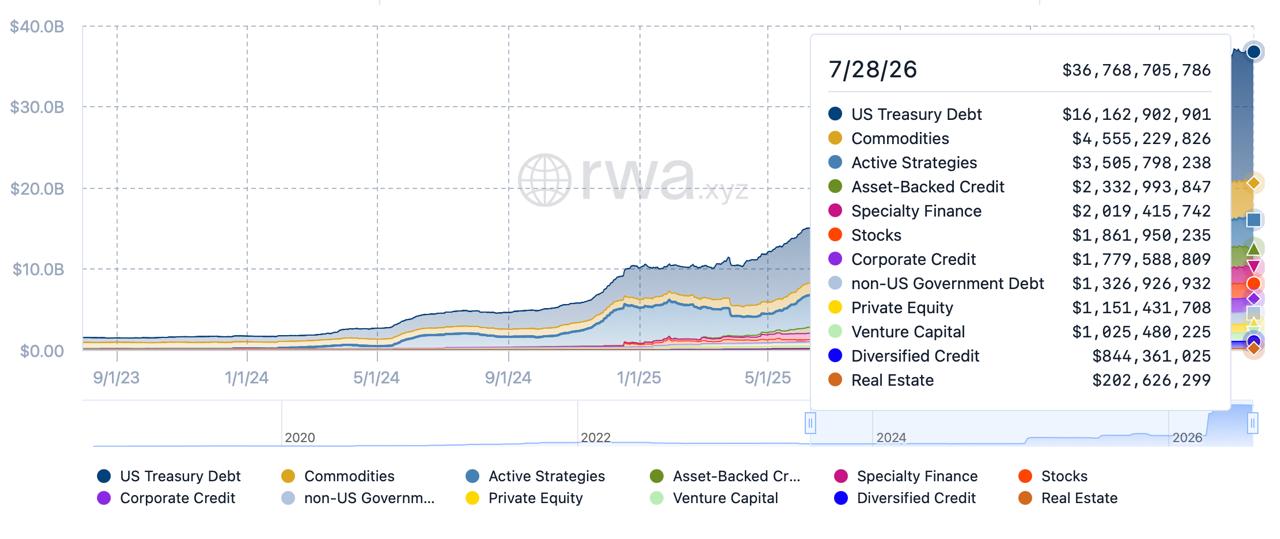
It’s a genuine pledge from companies known for taking their time, but the amount is relatively small considering their overall financial resources.
According to Forbes, even though there’s around $60 billion worth of digital tokens available – covering about 7,000 different products – over $32.9 billion in assets (across 910 types) haven’t been traded at all in the last week. Looking at the overall market, more than half of all token value isn’t being actively moved or exchanged.
Currently, less than 10% of real-world assets turned into digital tokens are used in decentralized finance (DeFi). However, a recent study by Standard Chartered predicts this could increase to 30% by the year 2030.
Something valuable exists digitally but isn’t actually being used, despite having the potential to be moved or activated at any time. The reasons given for its existence – like needing supporting systems – don’t match up with how it’s currently being utilized. Anyone suggesting traditional banking is obsolete needs to explain this disconnect.
Programmable Ownership Is the Substantive Change
Before blockchain, most financial assets were already handled digitally. Things like stocks, bonds, and money in bank accounts have been recorded electronically for years. The main missing piece was the ability to share and automate processes with them.
Typically, when a company holds an electronic asset, it’s stored within their own systems. Moving that asset to another company requires a lot of back-and-forth communication, confirmations, and checks to ensure everything matches up – systems weren’t originally built to easily share information. However, with tokenization, more of the rules governing the asset travel with it. This means the asset’s code can control things like who can own it, when it can be transferred, where it’s allowed to be used, and how any earnings or payouts are distributed.
With new technology, investment funds and bonds can be created digitally and automatically enforce rules. For example, a digital fund can limit access to confirmed investors and process transactions constantly. A digital bond can prevent transfers if they don’t meet the issuer’s requirements. This means that compliance is built directly into the asset, rather than being checked after each trade.
The practical applications span a financial product’s whole life:
- Issuance: securities created and distributed through blockchain platforms.
- Settlement: ownership and payment updating in one transaction.
- Servicing: interest, distributions and redemptions following programmed rules.
- Collateral: eligible assets identified, pledged and transferred without waiting for custodians to reconcile.
- Distribution: regulated products reaching investors through digital wallets and onchain platforms.
Denny Galindo, a strategist at Morgan Stanley Wealth Management, suggested that tokenized stocks and money market funds might be how most people first experience blockchain technology, potentially before they invest in cryptocurrencies themselves.
Collateral Moves Faster, and So Does Stress
Tokenization could significantly change how banks and investors handle collateral. They currently hold large amounts of assets like government bonds and cash to support loans, trading, and other financial commitments. However, these assets are essentially locked within specific custodians, legal structures, or clearing systems, limiting their flexibility and potential value.
When assets are tracked on a shared network, authorized parties can easily see who owns what and its current status. This allows eligible assets to be used as collateral or transferred when needed. Funds that would otherwise remain unused overnight or over the weekend can then be put to work for other approved purposes.
Faster speeds make financial crises happen more quickly. Traditionally, when problems arose, there was a delay – overnight, usually – allowing risk managers, clearinghouses, and central banks time to evaluate the situation and work together on a solution. Blockchain technology cuts down on risks between parties, but it also dramatically shortens the timeframe for dealing with market issues. Because markets are now open around the clock, we need constant oversight, liquidity support, and emergency plans that operate at all times as well.
Stablecoins Forced Banks to Rebuild the Cash Side
It’s difficult to trade assets around the clock because payments are often delayed by traditional banking processes like daily cutoff times and international transfer schedules.
Stablecoins were among the first solutions for 24/7 trading in the crypto world. These tokens, typically pegged to the US dollar, allowed investors and businesses to quickly transfer value without the delays of traditional banking hours. Now, ‘tokenized deposits’ are emerging as a new approach. Instead of relying on a stablecoin company, customers directly hold a digital token representing money held in a regulated bank account. The actual funds remain safely within the bank, while the token itself can be easily moved and used within compatible systems.
While stablecoins and tokenized deposits use similar technology, they operate under different legal frameworks. Stablecoin owners rely on the company that issued the coin and its backing assets. A tokenized deposit, however, remains a direct claim on the issuing bank and can maintain the same regulatory protections as traditional bank deposits.
Coindoo has previously discussed how banks are creating digital versions of deposits as a way to compete with stablecoins, and also covered Swift’s use of blockchain for faster payments. Essentially, banks are trying to offer the same speed and flexibility as cryptocurrencies, but within a secure and regulated banking system.
The biggest challenges arise with traditional correspondent banking, which involves many intermediaries handling international payments. Each intermediary reviews the transaction, charges a fee, and maintains its own record. Using blockchain technology simplifies this by reducing the number of parties needed to just transmit payment details. Banks still handle important services like verifying identities, exchanging currencies, safeguarding funds, and ensuring regulatory compliance. However, blockchain eliminates the need for multiple firms to confirm that a payment actually occurred.
Onchain Finality Is Not Legal Finality
While speed is important, banks also require assurance that a finished transaction will be legally valid and accepted by all relevant parties, including courts, regulators, and those handling assets and potential bankruptcies.
While a blockchain quickly verifies a token has been transferred between digital wallets, it doesn’t determine who legally owns the actual asset. Important questions remain about whether the transfer is valid if fraud is suspected, and what happens to the token if the company that created it, the wallet provider, or the owner faces financial difficulties.
International legal issues are the most challenging when it comes to smart contracts. A transaction might be considered complete on the blockchain, but different courts in places like the US, the UK, and Germany could have varying legal interpretations of the same transaction. These courts might focus on who controls the digital wallet, who is officially listed as the owner in separate records, the contractual agreements in place, or the location of the actual asset. Essentially, blockchain creates a single, technical history of an event, but there’s no universal legal agreement on what that history actually means.
The problem is made worse by how spread out digital assets are. If an asset exists on one blockchain network, it might not be usable as collateral on another, and using ‘bridges’ to connect these networks introduces risks related to the underlying code, security, and the parties involved. Creating multiple digital versions of the same asset splits up trading volume, meaning even a normally easily-traded asset can become harder to use if its different digital forms can’t work together smoothly.
Protecting privacy is also crucial. While public networks are open, banks need to keep customer account details, investments, and trading connections confidential. Systems must balance protecting this sensitive information with providing regulators and authorized parties the necessary access for monitoring and compliance.
These issues offer a clearer explanation for the low activity rates than any technical difficulties could. Surprisingly, fixing the underlying systems was the simplest part of the process.
What Banks Become
When I first started researching blockchain, it was presented as a way to cut out the middleman in finance – to eliminate banks and other institutions. But what I’ve seen happen with bank adoption is far more nuanced. It’s not a simple replacement; it’s become something much more complex.
Tokenizing assets still demands secure storage, clear ownership rights, verified investors, and ongoing support services. A digital bond, for example, is only valuable if investors are confident it represents a legitimate and legally enforceable claim. This shifts the role of banks – they remain essential, but for different reasons than before.
Traditionally, banks were essential for all money and asset transfers because they owned the necessary systems. Their exclusive databases, limited payment networks, and set transaction times meant people had to go through them to send money. However, newer, more open networks are changing this, reducing banks’ control and creating competition based on the services offered *around* those transactions.
- Custody of digital and tokenized assets
- Connections between bank accounts and blockchain networks
- Issuance of regulated securities and tokenized deposits
- Identity checks and investor eligibility controls
- Liquidity between onchain and traditional markets
The extent to which control changes really varies depending on the specific network being used. Many banking groups are using permissioned ledgers – systems limited to trusted participants – and when all users are known and verified companies, it’s debatable whether these networks offer significant benefits over a well-built shared database with good data access tools. The industry hasn’t decided this yet, but the answer will determine if tokenization fundamentally changes how markets operate or just updates current systems.
As an analyst, I’ve observed a clear dynamic in these situations: if one bank can move collateral overnight, it immediately puts pressure on others to justify why their process takes significantly longer – like three business days. It highlights inefficiencies and raises questions about operational speed.
The Direction Is Clearer Than the Timeline
Graseck’s assessment is accurate when looking at the underlying technology, but it doesn’t quite reflect the current state of the market. While tokenized assets have grown rapidly – tripling in a year – and major financial firms are actively offering related products, significant progress is still needed. Notably, over half of all tokenized assets by value haven’t been traded in a week, suggesting limited liquidity.
Banks are shifting towards always-on systems because failing to do so will eventually lose customers. The speed of this change depends on resolving legal issues, maintaining sufficient funds, and protecting customer privacy. This means traditional, delayed processing methods are being phased out not because of technological limitations, but due to legal decisions and how the financial market is structured.
- Disclaimer: This article is for informational purposes only and does not constitute financial, investment or legal advice. Market size figures for tokenized assets vary by methodology and source.
- Methodology: The analysis uses CoinDesk’s report of the July 29 panel discussion, Forbes reporting on tokenized asset activity levels, RWA.xyz-derived market size data as reported across industry coverage, and Coindoo’s earlier coverage of tokenized deposits and Swift’s blockchain ledger. Public instant-payment systems referenced are Pix, UPI, FedNow and SEPA Instant.
2026-07-29 22:04