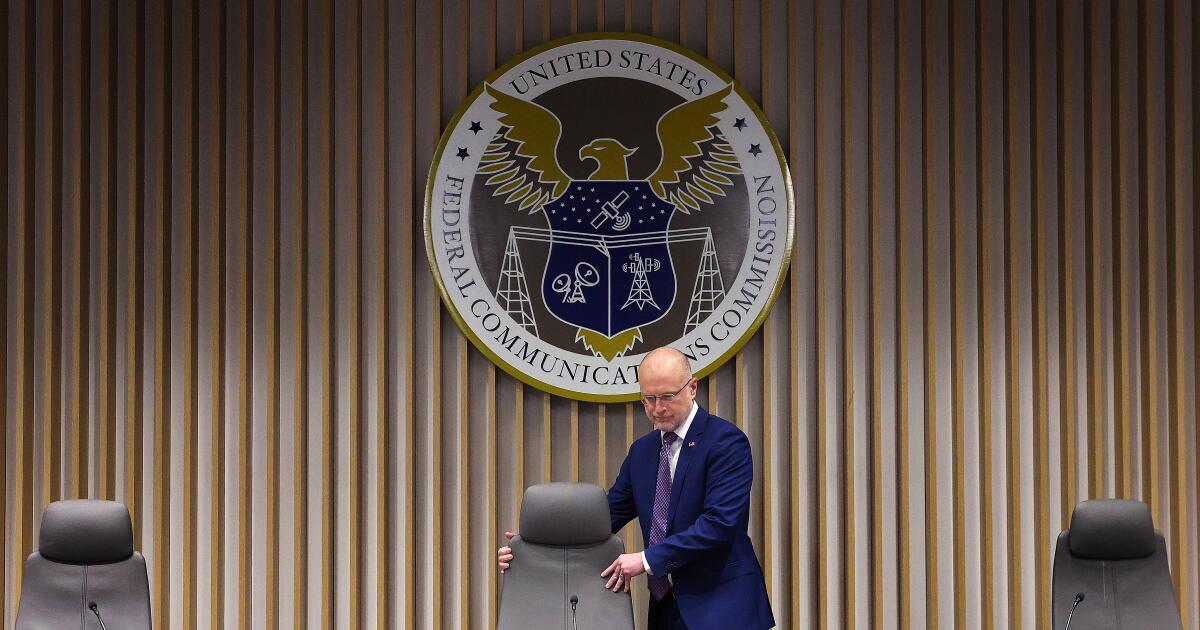
Federal Communications Commission (FCC) Chairman Brendan Carr is publicly challenging news reports about U.S. military actions in Iran, specifically those critical of President Trump. This represents a significant increase in tension between Carr and the media.
I saw a post from Carr on X over the weekend, and it really got my attention. He basically said that TV stations could lose their licenses – the permission they need to broadcast on public airwaves – if they don’t truly serve the public. It feels like he’s saying they need to prioritize what’s best for viewers, not just profits.
So, after making his announcement, Carr retweeted something from Trump. It was basically Trump complaining about articles in the New York Times and Wall Street Journal. Those articles were about reports that Iranian missiles had hit five refueling tankers at the Prince Sultan Air Base in Saudi Arabia – pretty serious stuff, if true.

Hollywood Inc.
Major changes are coming to two TV news organizations as they merge under new ownership by Paramount, which acquired Warner Bros. Discovery. These changes are expected to include job losses and pressure to align with the preferences of Donald Trump.
Carr used Trump’s statement as an opportunity to caution television networks, which the president often criticizes when he dislikes their reporting.
This is the most recent effort by the head of the FCC to push back against media organizations that have drawn criticism from Trump with their reporting on his presidency.
Since becoming head of the FCC last year, Brendan Carr has frequently suggested he’ll use the agency’s authority to penalize TV and radio stations that draw criticism from Donald Trump. This pattern of behavior has worried groups dedicated to protecting free speech.
FCC Commissioner Nathan Carr stated that television and radio stations spreading false or misleading information have an opportunity to improve before their operating licenses are reviewed. He asserted that stations are legally required to serve the public interest, and failure to do so could result in the loss of their licenses, though he didn’t offer specific examples to support his claims.

Hollywood Inc.
The Defense Secretary’s statements have increased concerns that the news channel will try to avoid conflict with the Trump administration once the merger between Paramount Skydance and Warner Bros. Discovery is finalized.
I’m really concerned about what Carr is doing. He’s saying he wants to hold broadcasters accountable to the public interest, which sounds good, but it feels like a threat. We saw this happen before last fall when Jimmy Kimmel made some comments about Charlie Kirk. Two big TV groups actually pulled Kimmel’s show off the air for a week because of it, and I’m worried Carr will use this ‘public interest’ thing to censor content he doesn’t like.
I’ve noticed that Donald Trump and Pete Hegseth seem really quick to criticize any news outlet that doesn’t portray the situation in Iran as a complete win. It’s frustrating to see them dismiss anything less than overwhelmingly positive coverage, and it feels like they’re not interested in an honest assessment of what’s happening.
On Friday, Hegseth criticized CNN, stating that he believes it would improve if David Ellison became its leader.
If Paramount successfully buys Warner Bros. Discovery, its CEO, Bob Ellison – who has close relationships with the White House, built with his father – will then oversee both CNN and CBS.
David Carr insisted that CBS News appoint an independent ombudsman as a requirement for approving Shari Redstone’s Skydance Partners deal to buy Paramount last year. Paramount also faced criticism for paying $16 million to settle a lawsuit brought by Donald Trump against “60 Minutes” regarding the editing of an interview with Kamala Harris, who was then Vice President. Legal experts generally considered the lawsuit to be without merit.
The Federal Communications Commission (FCC) doesn’t have authority over CNN. That’s why FCC Commissioner Brendan Carr often criticizes ABC, CBS, and NBC instead, as these networks broadcast on local television stations. He’s expressed his distrust in these traditional media outlets, once stating on X (formerly Twitter) that “More Americans trust gas station sushi than the legacy national media.”
On Sunday, Trump expressed his strong approval of Carr’s statements and pledged to back his campaign against news outlets he considers unpatriotic.
Trump criticized certain media outlets, claiming they receive billions of dollars worth of free access to American airwaves and use this platform to spread false information, not just in their news coverage, but across nearly all of their programming, even late-night shows where hosts earn high salaries despite low viewership.
According to Andrew Jay Schwartzman, a communications lawyer in Washington D.C. who focuses on public interest issues, the actions and threats made by Carr infringe on First Amendment rights. He also predicts that any effort to revoke licenses would likely face lengthy legal battles.
Hollywood Inc.
According to Schwartzman, even if Brendan Carr attempted to block a license renewal immediately, he wouldn’t be at the FCC to see the process through. The legal rules make it very difficult for the FCC to deny a renewal, and the process takes years. During this time, the license holder can continue operating as usual.
Democrats and free speech advocates quickly criticized Carr’s statements on Saturday, pointing out that the FCC isn’t responsible for monitoring or controlling the news media.
FCC Commissioner Anna Gomez criticized the agency Monday, saying it’s acting as if it can regulate how news is covered. She pointed out that the FCC has very limited control over national news networks, as it only licenses local stations—and those licenses aren’t up for renewal until 2028.
California Governor Gavin Newsom criticized a potential threat from Donald Trump, stating that if Trump disagrees with how the war is being reported, he might use the Federal Communications Commission to revoke a broadcaster’s license. Newsom called this action clearly unconstitutional.
Senator Ron Johnson, a Republican from Wisconsin who typically supports the Trump administration, voiced his worries about the comments made by Carr.
Speaking on Fox News Sunday, Johnson said he strongly believes in the First Amendment and generally opposes government intervention, whether from Republicans or Democrats. He prefers the federal government to allow the private sector to operate with as little oversight as possible.
Gomez explained that trying to revoke licenses is likely a mistake, but Carr’s aggressive comments and criticism of the media could discourage reporting and undermine public trust in journalism.

Hollywood Inc.
Since becoming chairman of the communications agency, Carr has brought attention back to concerns about news bias and started investigations into diversity programs at Comcast and Disney. Recently, he publicly criticized NBC’s reporting on the Kilmar Abrego Garcia situation.
According to Gomez, the Federal Communications Commission has recently been critical of the media, continuing a long-term effort by the current administration and its supporters to undermine trustworthy, objective reporting and accuse the press of losing public confidence. Gomez argues that, in reality, it’s the FCC itself that is quickly losing credibility and public trust.
It’s not unusual for a president to try and use TV station licenses to respond to unfavorable news. During the Watergate scandal in the 1970s, supporters of Richard Nixon tried to revoke the licenses of three television stations owned by The Washington Post.
The effort didn’t get far.
The last Los Angeles radio station to lose its license was KHJ in 1987. At the time, it was owned by RKO General, a company connected to the General Tire and Rubber Company. The reason for the license revocation wasn’t the station’s programming, but rather improper business practices by the company itself.
It took seven years to officially cancel the RKO licenses, starting from the date the FCC initially approved the cancellation.
According to Schwartzman, legal challenges since then have mainly focused on small, locally-owned radio stations. These cases typically involve issues like dishonesty with the government, criminal convictions, or unpaid fees. He noted that in a recent instance, a station owner convicted of tax fraud was still allowed to keep their broadcasting license.
There would be other logistical hurdles to the FCC making good on Carr’s threats.
As Gomez pointed out, the FCC under Carr only regulates the television stations that broadcast network signals. If these stations stopped showing network programs for any reason, they could break their agreements with the network and lose valuable content like NFL football, which attracts many viewers and generates significant income.
Sinclair Broadcast Group demanded an apology from Kimmel to the Kirk family and a donation to his organization, Turning Point USA, as conditions for airing his late-night show.
That did not happen and “Jimmy Kimmel Live!” returned to Sinclair’s stations anyway.
Read More
- ‘Project Hail Mary’s Unexpected Post-Credits Scene Is Worth Sticking Around
- Total Football free codes and how to redeem them (March 2026)
- Limbus Company 2026 Roadmap Revealed
- The Division Resurgence Specializations Guide: Best Specialization for Beginners
- After THAT A Woman of Substance cliffhanger, here’s what will happen in a second season
- Brawl Stars Sands of Time Brawl Pass brings Sandstalker Lily and Sultan Cordelius sets, along with chromas and more
- Brawl Stars Brawl Cup Pro Pass arrives with the Dragon Crow skin and Chroma, unique cosmetics, and more rewards
- Clash of Clans April 2026 Gold Pass Season introduces a Archer Queen skin
- Wuthering Waves Hiyuki Build Guide: Why should you pull, pre-farm, best build, and more
- XO, Kitty season 3 soundtrack: The songs you may recognise from the Netflix show
2026-03-17 02:32