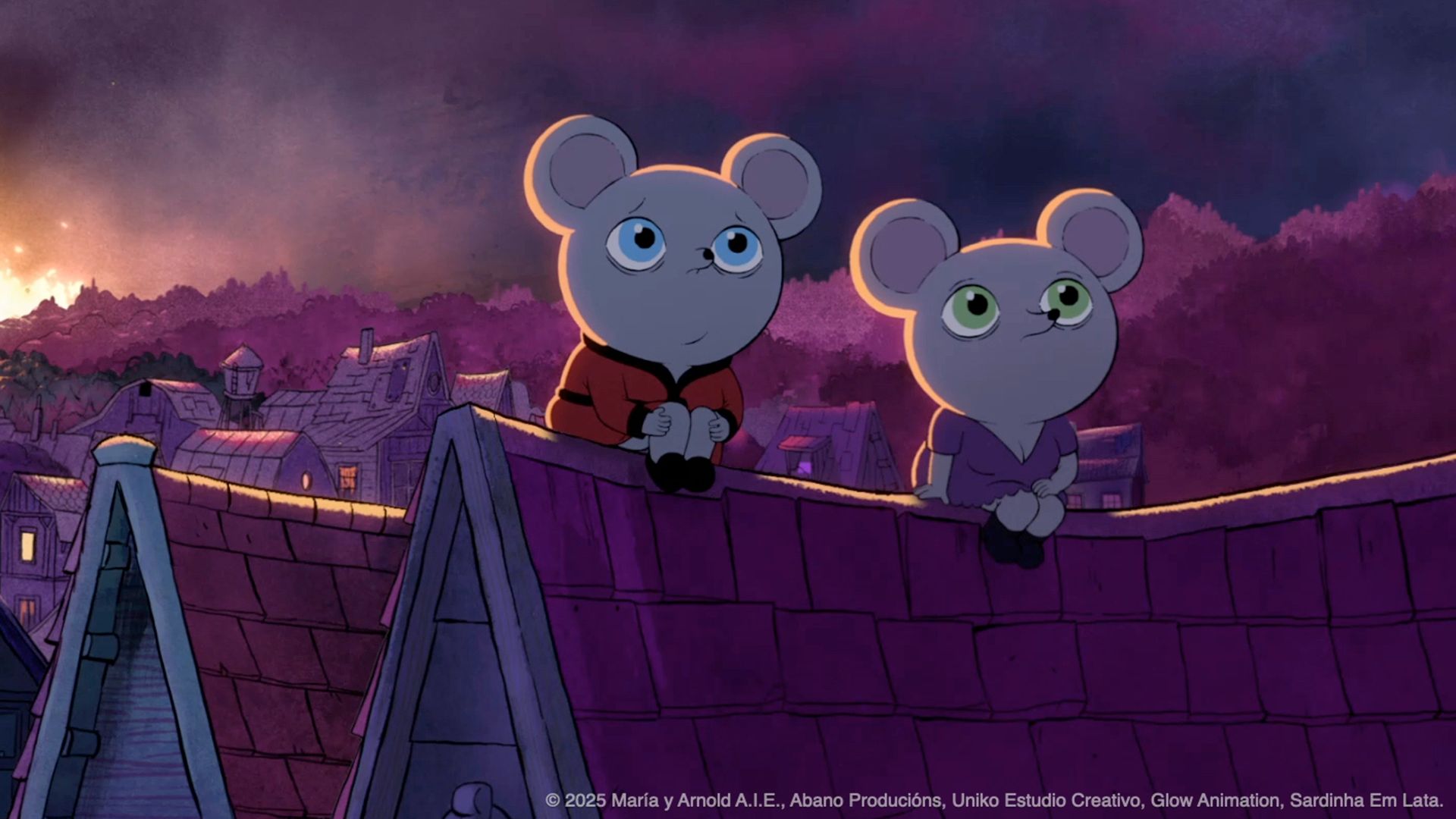
Alberto Vázquez‘s animated film, Decorado, tells the story of Arnold and María, a married couple who happen to be mice. They remind viewers of Mickey and Minnie Mouse, but are facing difficulties in their lives and careers. As their unhappiness grows, they begin to question the reality of their world – a theme reflected in the film’s title, as ‘decorado’ is a Spanish word for a theatrical set.
Vázquez often uses symbolism in his films, and he’s already won multiple Goya Awards for his animated shorts, including one from 2016. However, his latest work feels like a direct critique of capitalism. The powerful corporation at the story’s center, A.L.M.A., might feel unsettlingly familiar to some viewers.
In a ScreenRant interview, Vȧzquez explained how his film, Decorado, started as a short and grew into a full-length movie. He also discussed his choices for how the characters looked and what message he wanted to convey with his story, which he described as a blend of The Truman Show and Mickey’s Christmas Carol.
The Origins Of Decorado Revealed By Alberto Vázquez

ScreenRant asks: “Decorado” started as a short film ten years ago. What led you to turn it into a full-length movie, and what made this the right moment to do so?
I’ve been following Alberto Vázquez’s work for a while now, and it’s fascinating to learn how ‘Decorado’ came about. It wasn’t some grand, pre-planned project, actually! It started back around 2012 as a bunch of comics and short stories he was putting out. They were mostly funny, quick pieces – little one or two-page stories featuring animals dealing with, well, life’s big questions. Then, years later in 2017, he decided to go back to those ideas and turn them into a short film. It kept that same comedic feel and a really unique, non-linear structure. Visually, it’s stunning – black and white with backgrounds that look like old 19th-century prints, and just a really distinctive style.
I later connected with Xavi Manuel, who co-wrote the film with me, and we began developing an animated series for adults set in that same world. Although the series didn’t move forward, we created a lot of new story ideas, characters, and scenarios. We eventually decided that instead of trying to make the series, we could use all that material for a feature film. Having already directed two feature films – Birdboy: The Forgotten Children and Unicorn Wars – I felt confident we could pull it off.
This wasn’t a planned project from the beginning. It came together through a series of lucky events, helpful connections, and the contributions of key people – like Xavi, art director José Luis Ágreda, my long-time collaborator and animation director Pamela Poltronieri, and the producers, of course.
ScreenRant asks: What’s the reason for choosing a mouse as the main character? And do the characters share any similarities with the animals they represent?
Alberto Vázquez explains that his characters, the protagonists, are both mice – a deliberate nod to classic characters like Mickey and Minnie. While there’s a playful parody involved, these mice are older, middle-aged, and clearly show the effects of a hard life. They likely were quite attractive in their youth, but that’s no longer the case.
The connection between my characters and the animals they’re linked to isn’t always direct. Sometimes it’s quite obvious, and other times it’s more subtle. I often use familiar animal symbols – like cats, mice, police dogs, or owls – because these images are widely recognized. Animals are also powerful because they’re universally understood, transcending cultural and time barriers.
The work blends traditional symbolism with a strange, dreamlike mythology – think upside-down mermaids, ghosts, and even people made of mushrooms. These mushroom figures, for instance, are meant to represent the workers at the ALMA company – depicted as quiet, almost faceless individuals. So, while there’s a layer of familiar meaning, there’s also a more instinctive, illogical, and open-ended interpretation.
Breaking Down The Symbolism Of Decorado

In the movie, Arnold and Maria are going through a midlife crisis, and it’s clear they used to be much more passionate and driven people. Why did the filmmakers choose to show us flashbacks of their more vibrant past while also portraying their current struggles?
I wanted to show the origins of these characters and explain how they’ve changed. They weren’t always as they are now; they used to be much more rebellious, energetic, and lived life on the edge.
Everything changes when they lose their jobs, especially when Arnold has to care for his ailing father. This increasingly isolates him, leading to a state of emotional and social withdrawal.
I wanted to explore the characters’ histories to explain their current actions. Their struggles aren’t just about money; they also involve health, life’s big questions, and their feelings. Despite everything, they still care for each other, and a genuine friendship shines through. It was important to me to highlight that connection.
ScreenRant noted that, besides Arnold and Maria, many characters in the show resemble famous cartoon characters – for example, the Depression Fairy is a darker version of Tinkerbell, and Pato Roni is a warped take on Donald Duck. The interviewer asked which character the writer and their co-writer initially decided to include, and what motivated that choice.
Pato Roni was one of the first characters we envisioned, conceived as a warped take on Donald Duck. We were drawn to his surreal qualities – he’s a beggar, but also a former celebrity. The fact that he’s playing a beggar in a movie allowed us to explore multiple levels of reality and who he really is. The story also reveals his history, showing how he was once a popular toy created by ALMA, a powerful company that makes everything, controls everything, and ultimately discards what it creates.
We found the character’s decline fascinating, but also enjoyed how he could unexpectedly and humorously change – going from a beggar to a real estate agent, and eventually becoming a powerful figure who seemed to run things alongside others. This highlights a world where appearances are everything and people constantly play roles, creating a sense of artificiality.
We also found other characters compelling, such as the demon and the Depression Fairy, who comes across as a darker take on Tinkerbell – a sort of gothic fairy figure.
ScreenRant asked: The film has some really striking, funny, and dreamlike moments that emphasize the idea that everything is a constructed set. Were there any scenes you had to cut – either because the movie was too long or to improve the story’s pacing – that you still think were good and added something to the film?
Absolutely. It’s common to have to cut scenes during the filmmaking process – whether to improve the flow of the story, make things easier to understand, or simply to stay within budget. Every additional minute of animation adds to the cost of the film.
I think the final version missed some compelling details. Pato Roni’s backstory, in particular, was significantly shortened. We used to see much more of his difficult upbringing and the poverty he experienced. I specifically remember that his father was a manager who took advantage of him when he was young, which created a really dark and intriguing dynamic. I found that aspect especially compelling.
Ultimately, when creating a movie, you need to choose what elements truly enhance the story and what, even if well-made, distracts from it.
‘Decorado’ has already been shown at several film festivals before its general release. What reactions or discussions about the movie have resonated with you the most?
I’ve noticed a really wide range of reactions to the film, which I think is fascinating. Some people find it hilarious, almost like a comedy, while others are left feeling sad, down, or even scared. The ending also seems to affect people differently – some think it’s too ambiguous, while others feel it’s too conclusive. This variety is interesting to me because it shows that everyone brings their own perspective and experiences to the film.
Once a film is completed, I feel it truly belongs to the viewers, not me. It’s important to me that people can form their own opinions and understand the movie in their own way. I don’t try to dictate how they should react; I think it’s much more rewarding when everyone connects with the film personally. Ultimately, I’m pleased with how the movie turned out.
2026-05-18 17:52