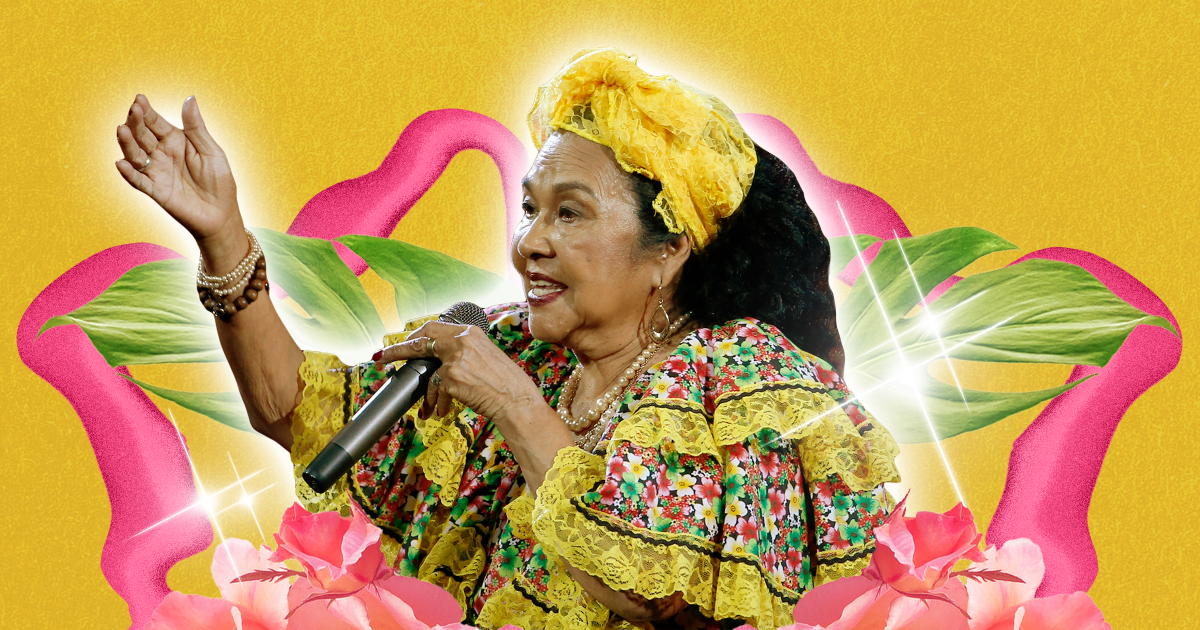
Colombian folk music icon Totó La Momposina, known as the “Queen of Cumbia,” has died. She was 85.
The Colombian Ministry of Culture announced the lauded vocalist’s death Tuesday morning.
The Ministry announced the passing of Totó (1940-2026), a beloved teacher and musician who shared the vibrant sounds of Colombia – cumbias, porros, mapalés, and bullerengues – with the world. A native of Mompos, he dedicated decades to preserving and celebrating the traditional music of the Caribbean, leaving a lasting legacy on Colombia’s cultural history.
In an Instagram post from the artist’s official account, her children provided a cause of death.
It is with deep sadness that we, Marco Vinicio, Angelica Maria, and Euridice Salome Oyaga Bazanta, share the news of our mother, Sonia Bazanta Vides – known to many as Totó la Momposina – passing away on Sunday, May 17th, in Celaya, Mexico. She was surrounded by her family when she died of a heart attack.
Pop & Hiss
This article was originally on a blog post platform and may be missing photos, graphics or links.
The children also touched on the enduring legacy that their mother left behind.
Totó was a remarkable woman who shared the rich culture and heritage of Colombia with audiences around the globe, primarily through her incredible voice and unwavering commitment. Her vibrant spirit, kindness, talent, and generosity touched the lives of so many. She beautifully expressed the music, traditions, and soul of Colombia’s Caribbean coast, and will be fondly remembered by all who knew and loved her.
Totó la Momposina, born Sonia Bazanta Vides in 1940 in Talaigua Nuevo, Colombia, comes from a family with both Afro-Colombian and Indigenous heritage. She became famous for music that blended the distinctive rhythms and instruments of her culture. She started performing publicly at just six years old, following in the footsteps of her musician parents.
Growing up, I was fascinated by how her music blended so many different influences. She really immersed herself in the traditional Colombian rhythms like mapalé, chalupa, porro, bullerengue, and cumbia. It wasn’t just about hearing the music, though – she’d actually go around to neighboring villages and learn directly from the musicians who kept those amazing Afro-Indigenous traditions alive. That’s what really shaped her unique sound.
Books
Gabriel Garcia Marquez’s novel, “Love in the Time of Cholera,” a story of a man who pursues a woman for over fifty years after her husband’s death, was awarded the fiction prize at the Los Angeles Times Book Prize competition. This was the ninth year of the awards.
In the 1960s, Totó la Momposina settled in Bogotá, Colombia, and became involved in the local music community, performing with a group. Later, in the 1980s, she moved to Paris to pursue music studies at the Sorbonne University.
In 1982, when Gabriel García Márquez, the Colombian author, won the Nobel Prize in Literature, she traveled with him to Stockholm and performed at the award ceremony alongside other Colombian artists.
After gaining some international attention, Totó la Momposina released her first solo album, “La Verdolaga,” in 1983. Her career reached a new level of global success when she began working with English musician Peter Gabriel. Through Gabriel’s Real World Records label, she released “La Candela Viva” in 1993, an album that was widely praised and became highly influential in the cumbia and bullerengue music styles.
As a huge fan, I was thrilled when she won Record of the Year at the Latin Grammys in 2011! It was for the amazing track “Latinoamérica,” a collaboration with Calle 13, Susana Baca, and Maria Rita. And it wasn’t just that single win – the Latin Grammys also honored her with a lifetime achievement award in 2013, which was so well-deserved. It’s wonderful to see such a talented artist get the recognition she deserves.
2026-05-20 03:31