Are viewers ready to return to Gilead?
Just under a year after the powerful and upsetting story of “The Handmaid’s Tale” ended, Margaret Atwood’s world continues on screen with “The Testaments.” This new series focuses on a growing rebellion, spearheaded by teenage girls played by Chase Infiniti and Lucy Halliday.
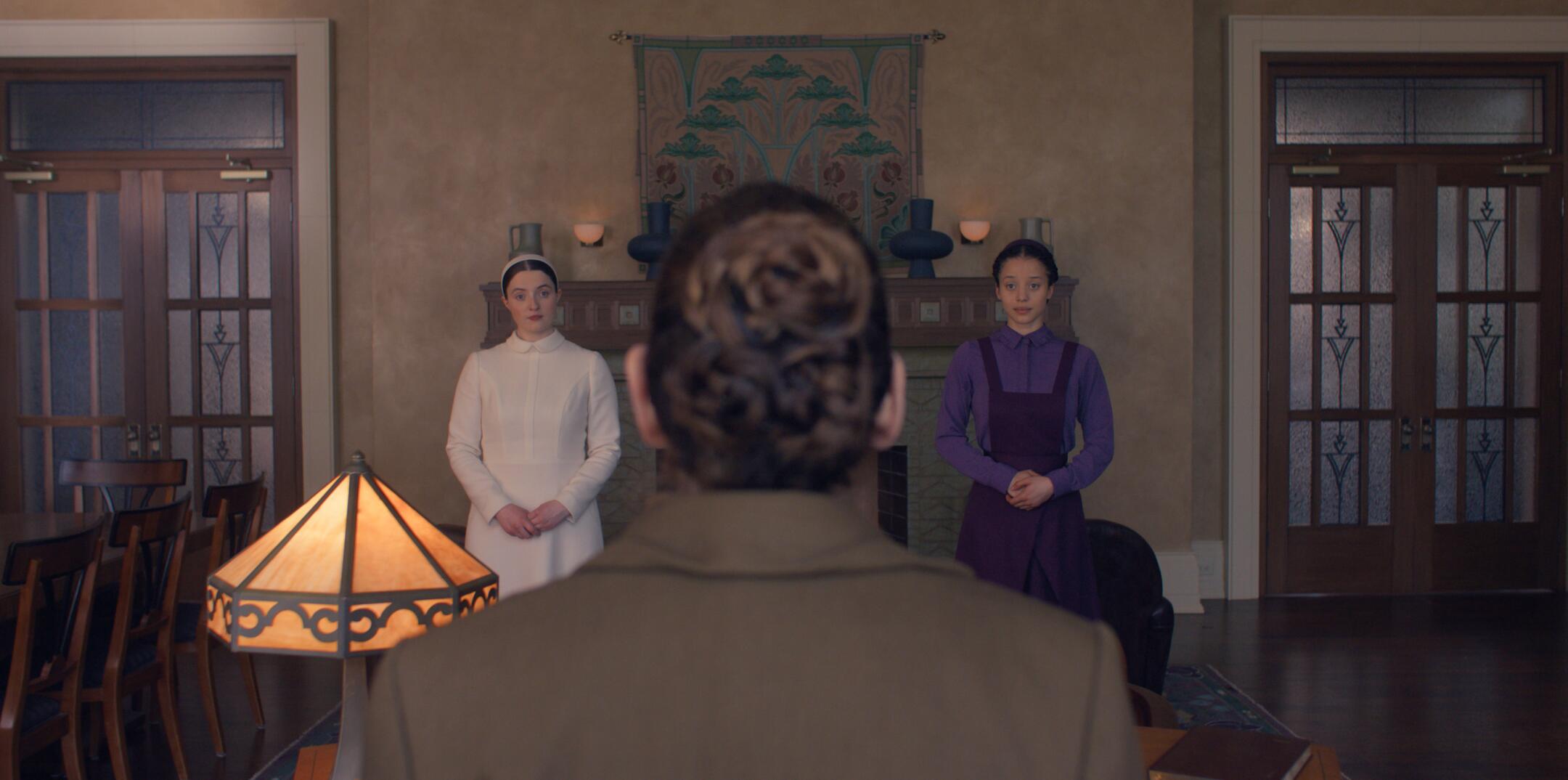
As a critic, I found the new series, based on Atwood’s 2019 novel, really intriguing. It picks up a few years after the events of ‘The Handmaid’s Tale’, showing us the very beginnings of Gilead’s downfall. The setting is particularly clever – an exclusive school designed to train the next generation of wives. It’s populated by the daughters of Commanders, many of whom are separated from their original families, and also by ‘Pearl Girls’ brought in from outside Gilead’s control. And the whole place is run by none other than Aunt Lydia, brilliantly portrayed by Ann Dowd – she remains one of the most fascinating and complicated characters on television.
As a huge fan of ‘The Handmaid’s Tale,’ I was really intrigued by the new characters introduced this season. We meet Agnes MacKenzie, played by Infiniti, who seems like a privileged Commander’s daughter, but it’s soon revealed she’s actually Hannah, June’s long-lost daughter! Then there’s Daisy, brought to life by Halliday, who joins the Pearl Girls, but is secretly working as a spy for Mayday, guided by June herself. Interestingly, the show deviates from the book here – Daisy isn’t Baby Nicole, which is a pretty big twist! It’s a lot to take in, but adds so much depth to the story.
As a huge fan of “The Handmaid’s Tale,” I was really excited to hear Bruce Miller, the guy who brought the first series to life, was adapting “The Testaments.” He’s talked about how, just like June found her strength to rebel, the new generation – Agnes, Daisy, and the others – have this raw determination that’s going to make the story feel hopeful, not just relentlessly bleak. It’s that fighting spirit that’s going to prevent it from feeling like endlessly scrolling through bad news, apparently.
Miller believes the show’s potential for a powerful conclusion is what will keep viewers engaged. Gilead created women who are capable of dismantling the oppressive regime itself, because they defied Gilead’s rules by forming friendships and developing their own sense of right and wrong. While June initially weakened Gilead, her daughter will be the one to finally destroy it.
The first three episodes of the show are now available on Hulu. Recently, The Times spoke with actors Infiniti and Halliday about joining the world of “The Handmaid’s Tale,” watching Elisabeth Moss perform, and the music they enjoyed while filming. Here’s a slightly edited version of that conversation.
Could you share what you know about the world Margaret Atwood has created in her books? Also, before working on this, had you read either of her novels, or seen the TV show “The Handmaid’s Tale?”
Infiniti: [Points to Halliday] You’ve got the Margaret Atwood No. 1 fan right here.
I’m a huge Margaret Atwood fan—I readily admit it. I had already read all of her books, including “The Handmaid’s Tale” and “The Testaments,” before starting this job, and of course, I was familiar with the TV show.
I first encountered the story through the TV show. I was in high school when “The Handmaid’s Tale” initially aired, and it quickly became a huge topic of conversation all over campus – everyone was watching and discussing it. I later read the books.
I first encountered “The Testaments” when a friend shared it with me during school. It feels really special to be discussing it now, like things have come full circle.
What types of conversations were you having about it?
Halliday notes the story feels relevant no matter when you experience it. What initially drew her in, and continues to with this production, is the fresh, youthful perspective within the world of Gilead. She found it particularly engaging as a teenager reading about another young woman’s experience, even though their lives were vastly different – she wasn’t living in Gilead, of course. The story resonated with her on a personal level.


I’m so excited to see what Chase Infiniti does next! After her amazing performance in the Oscar-winning film “One Battle After Another,” where she played the daughter of revolutionaries, she’s taking on another powerful role in “The Testaments.” She recently shared that playing someone so young who’s fighting for something important feels like a real responsibility, and I totally get that. I can’t wait to see her bring this new character to life!
Chase, could you share your perspective on Agnes and how her sense of self might change if she were to live as Hannah? And Lucy, how do you view the Daisy we see in flashbacks compared to the Daisy we encounter in Gilead?
I haven’t really considered what Agnes will be like once she has the same freedom as Hannah. I have some ideas, but I’m hesitant to develop them too much right now, as that might affect how I approach the character if we get a second season and beyond. However, you can definitely see Agnes grow and find her voice throughout the first season, and really come into her own.
Halliday points out an interesting contrast with the character Daisy. While she initially seems free and happy in Toronto, she’s surprisingly closed-minded, particularly when it comes to the people of Gilead. She prejudges them as primitive and avoids connection. However, when Daisy arrives in Gilead, she loses many of the freedoms she took for granted, facing oppression and restrictions. Through her interactions and friendships with the girls there, she begins to broaden her perspective and become more open to understanding those who are different from herself.

Television
As someone who’s been following Hulu’s ‘The Handmaid’s Tale’ closely, I recently heard from Eric Tuchman and Yahlin Chang, the showrunners, about how they approached the finale. They talked a lot about the story’s themes and how eerily relevant they feel to things happening in the real world. It was fascinating to get their insights into the show’s ending and the bigger picture they were trying to paint.
Let’s talk about Agnes and Daisy’s connection. At first, they didn’t trust each other very much. What did you find interesting about how they interacted?
Lucy’s description of Agnes and Daisy is spot-on, and I completely agree with her perspective.
I think of Agnes and Daisy as cautiously getting to know each other, like two cats sizing each other up. They immediately sense a connection, a shared understanding, which also makes them uneasy. Each sees the other as an outsider, someone they don’t necessarily want to be linked to, but they can’t ignore the fact that they’re fundamentally alike. It’s as if they speak the same language, just expressed in different ways. This dynamic plays out throughout the season, and they end up influencing each other, each having something valuable to offer the other.
One major difference between the book and the TV show is that Daisy isn’t revealed to be Baby Nicole, Agnes’s half-sister. Lucy, what were your thoughts on that alteration?
Infiniti: Wait a minute. I thought we were sisters this whole time. [laughs]
The revelation didn’t really change the core of the story because Agnes and Daisy have always been like sisters. Their connection remains strong, and June continues to be a vital person in both of their lives – she raises Daisy after her family is gone, meaning they share a common past. Despite not knowing it, they’ve led remarkably similar lives, and ultimately form a loving sisterly bond. Essentially, everything else about Margaret Atwood’s original characters, Daisy and Agnes, stays the same.

In this story, a girl’s first period is a significant event, representing both power and possibility for the teenage characters. The author revisited their own feelings about starting menstruation as a young person to portray this experience. Agnes feels constrained by societal expectations of girls, but she’s also eager to grow up, and getting her period is a crucial part of that journey.
My experience with getting my period was very different from Agnes’. She was thrilled and hopeful, seeing it as a positive step towards becoming a wife, if that was what God wanted for her. There’s a lot of mystery surrounding periods, and girls aren’t often taught what actually happens – they just learn about the changes that come after. I remember being really scared when I first got mine, and I cried because I didn’t know what to expect.
Were you home? I was at a sleepover and was mortified.
Okay, so watching ‘Infiniti,’ I immediately connected with the school setting – especially because I never excelled at math, which made the whole situation even more unsettling! I was genuinely impressed by Agnes’s reaction when she gets her period. She handled it with this quiet strength, refusing to let fear stop her, and I found that incredibly compelling. But honestly, it was also heartbreaking. These girls are so young and completely unprepared for what’s happening to them – they have no idea about periods, puberty, or any of the changes they’re about to experience. It’s a really powerful, and sometimes painful, portrayal of that moment.
Periods are generally a taboo subject that people don’t openly discuss. Interestingly, in the dystopian world of Gilead, they’re talked about much more freely. It’s thought-provoking that despite believing our society is more advanced, we often avoid conversations about menstruation in the same way they do talk about it there.

Television
Ann Dowd’s compelling performance as the original villain in ‘The Handmaid’s Tale’ has evolved the character into a symbol of change and a link to a new series.
Okay, so one scene that really stuck with me from Episode 2 was Agnes’s ceremony. It was incredibly raw and direct – she basically announced to everyone, and I mean everyone, that she’d started her period, framing it as a blessing from God. Seriously, she said it almost exactly like that! It was shocking, but it really highlighted how rare that event is in Gilead and how formalized the announcement of it has become. It really showed you how different things are in that world.
On the set, I recall director Mike Barker – who helmed the first three episodes – jokingly requesting a ‘menarche playlist.’ It was just a lighthearted moment.
Infiniti: Guess what one of the songs was?
Please tell me. I’m thinking Leona Lewis’ “Bleeding Love.”
Infiniti: One of them was totally “… Baby One More Time” by Britney Spears.
Halliday: But I just remember that we’re on set in 2025 and people would be like, “What’s menarche?”
One thing I really appreciate about the show is how openly the characters discuss menstruation and periods with each other. Your friends are often the first people you talk to about these things – they’re the ones who show you how to use pads or tampons and teach you about taking care of yourself. I love that the show highlights this, and how it creates a bond between the characters. Of course, it also adds to the drama, especially because fertility rates are so low in Gilead.


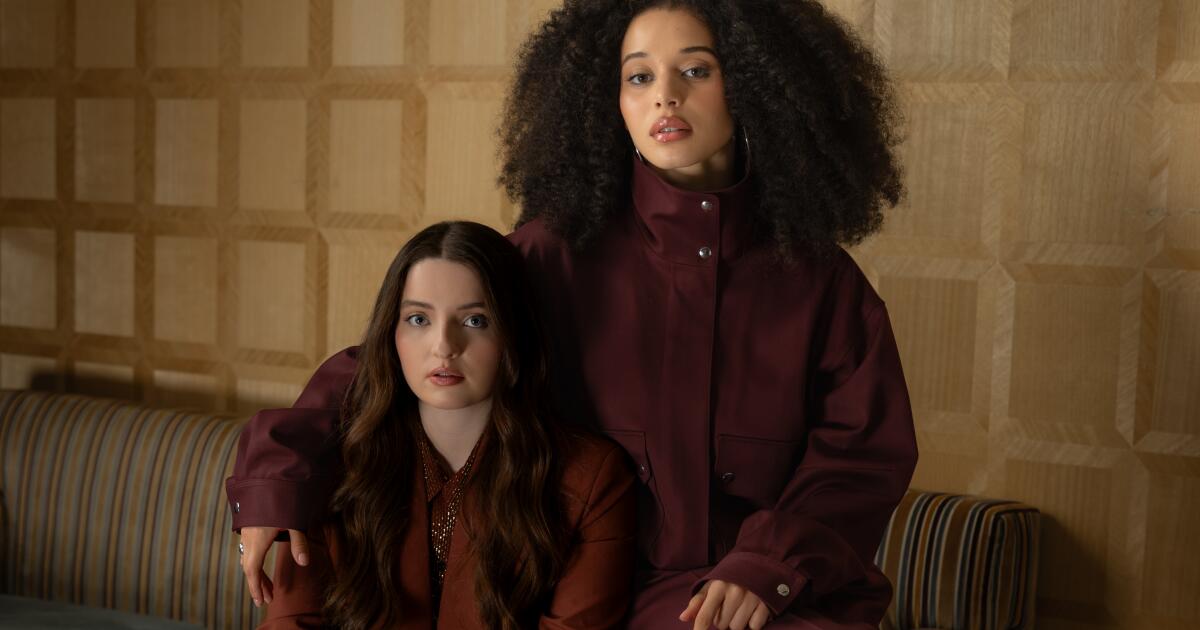
Lucy Halliday plays Daisy in “The Testaments,” a character who appears to be a young Pearl Girl but is secretly working as a spy for the Mayday organization. Halliday hopes the show will upset viewers and challenge them to confront difficult issues, stating, “We should never be comfortable.” (Jason Armond / Los Angeles Times)
We previously discussed the flashback episode and what it revealed about Daisy’s journey to Gilead. However, we didn’t fully explore Elisabeth Moss’s dual role – she’s both an executive producer and the actress playing June. We first see her backstory briefly, and then more extensively in Episode 3, learning how she agreed to let Daisy work as a spy within the school and assist Mayday’s efforts to overthrow Gilead. What was it like having Elisabeth Moss on set for these scenes?
I managed to get on set while she was filming with Lucy, but it was okay. She was incredibly kind and supportive to both of us, which meant the world. It felt fitting, because she truly embodies the spirit of ‘The Handmaid’s Tale’ – she is the handmaid in that story.
Watching Ann Dowd work was a real treat. She’s incredibly knowledgeable about the show, the world of Gilead, and her character, and I really wanted to learn from that. It reinforced how important preparation is as an actor, which is something both of us really focused on. Actually, my first day on set was a scene with her, and it was a little intimidating!
Actors frequently discuss how their clothing choices influence their performances. In “The Handmaid’s Tale,” the red robes became a powerful symbol of defiance in the real world. In this production, the plum and green outfits reflect very strict and limited expectations for how women should dress. How did these costumes impact your work as an actor?
Working on ‘The Handmaid’s Tale’ really made me aware of my posture. The costumes demand perfect uprightness, and initially, wearing them for 12 to 14 hours a day was physically painful. Despite being custom-fitted, the outfits are restrictive and immediately immerse you in the world of Gilead, forcing you to embody the character’s rigid physicality. It’s like you have to move and stand like a doll.
I really felt like a different person while filming in Toronto compared to Gilead. Being in those different locations helped me fully become the character, and it gave me a strong sense of what Daisy would be experiencing – feeling unable to be herself or act naturally in such a restrictive environment.
Infiniti: And you had your little pearl [in your ear].
I used to check the filming location for about a month after we wrapped up. I felt like I was acting like a Secret Service agent, constantly looking around.
Infiniti: I was like, “Is that how the Pearl Girls communicate with each other?”
Halliday: It was like the Starship Enterprise.


Lucy Halliday, right, and Chase Infiniti of “The Testaments.” (Jason Armond / Los Angeles Times)
A lot of viewers have commented on how relevant the show’s themes are. When you’re actually performing these roles, do you consider the political aspects of the story, or do those thoughts come to you later when you’re reflecting on the show or watching it as an audience member?
It’s impossible to create a story without some connection to real-world events, simply because we’re all influenced by the news and the world around us. However, it’s important to remember that this work wasn’t meant to be a factual account. Margaret Atwood drew inspiration from historical events, ensuring the story was grounded in reality, but it’s striking—and sadly, not surprising—to see those events mirrored or repeated in current affairs.
Your previous book, “One Battle After Another,” explored themes of political division and extremism. What was it like shifting from that subject matter to the topic of this new work?
I really connected with both projects because Willa and Agnes are both inspiring characters who fight for important causes. It feels like a big responsibility to portray someone so young who is dedicated to something larger than themselves. We felt lucky to be part of a story that speaks to the world and has the potential to make a difference. We were committed to honoring the story, the writing, and Margaret Atwood’s work by telling it as truthfully as possible through our characters. Ultimately, we hoped to create something that would resonate with audiences and maybe even inspire positive change in their own lives.
We want viewers to be entertained, but also to connect with the show’s themes of friendship and its compelling story. More importantly, we hope the show shocks people. We’re constantly bombarded with disturbing images and stories – in the news and in fiction – and there’s a danger of becoming numb to them. Our goal is for the show to reignite viewers’ outrage and discomfort. We shouldn’t become complacent or accepting of these issues; we need to maintain a strong emotional response.
Read More
- The Division Resurgence Best Weapon Guide: Tier List, Gear Breakdown, and Farming Guide
- GearPaw Defenders redeem codes and how to use them (April 2026)
- Last Furry: Survival redeem codes and how to use them (April 2026)
- Gold Rate Forecast
- Limbus Company 2026 Roadmap Revealed
- After THAT A Woman of Substance cliffhanger, here’s what will happen in a second season
- Wuthering Waves Hiyuki Build Guide: Why should you pull, pre-farm, best build, and more
- Genshin Impact Version 6.5 Leaks: List of Upcoming banners, Maps, Endgame updates and more
- The Division Resurgence Specializations Guide: Best Specialization for Beginners
- XO, Kitty season 3 soundtrack: The songs you may recognise from the Netflix show
2026-04-08 13:36