Reasoning with Agents: A New Logic for Smarter Systems
![A system employing differentiable trust dynamically adjusts agent weighting during communication, allowing reliable agents to maintain a consistent trust value of approximately [latex]0.94[/latex], while progressively down-weighting malfunctioning agents to around [latex]0.08[/latex], ultimately enabling the consensus mechanism-represented by a multilayer neural network-to closely track ground truth signal quality, a performance notably superior to that achieved through simple averaging biased by the faulty sensors.](https://arxiv.org/html/2602.12083v1/x8.png)
Researchers are blending the power of symbolic reasoning with neural networks to create multi-agent systems that can better understand, diagnose, and coordinate with each other.
Researchers are blending the power of symbolic reasoning with neural networks to create multi-agent systems that can better understand, diagnose, and coordinate with each other.
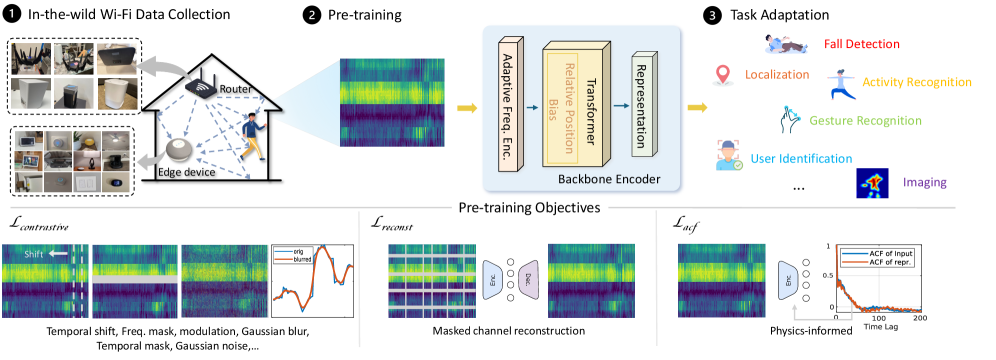
Researchers have developed a foundation model that leverages readily available WiFi signals to understand and interpret surrounding environments, paving the way for smarter, more responsive ambient systems.
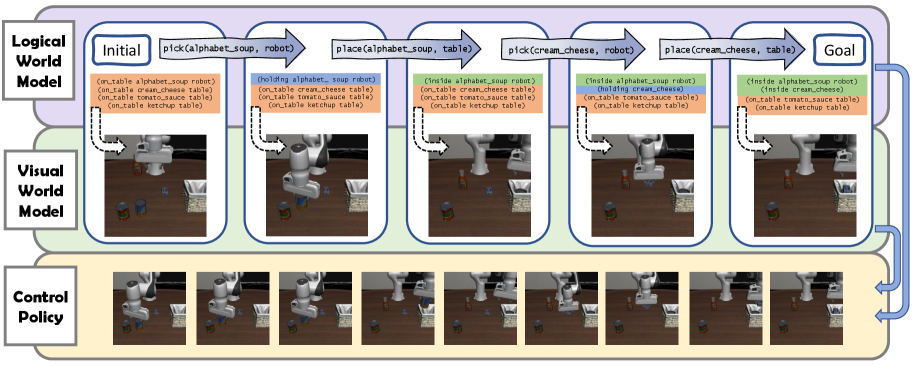
Researchers have developed a hierarchical system that allows robots to better understand and predict the outcomes of complex actions, significantly improving long-term task planning.
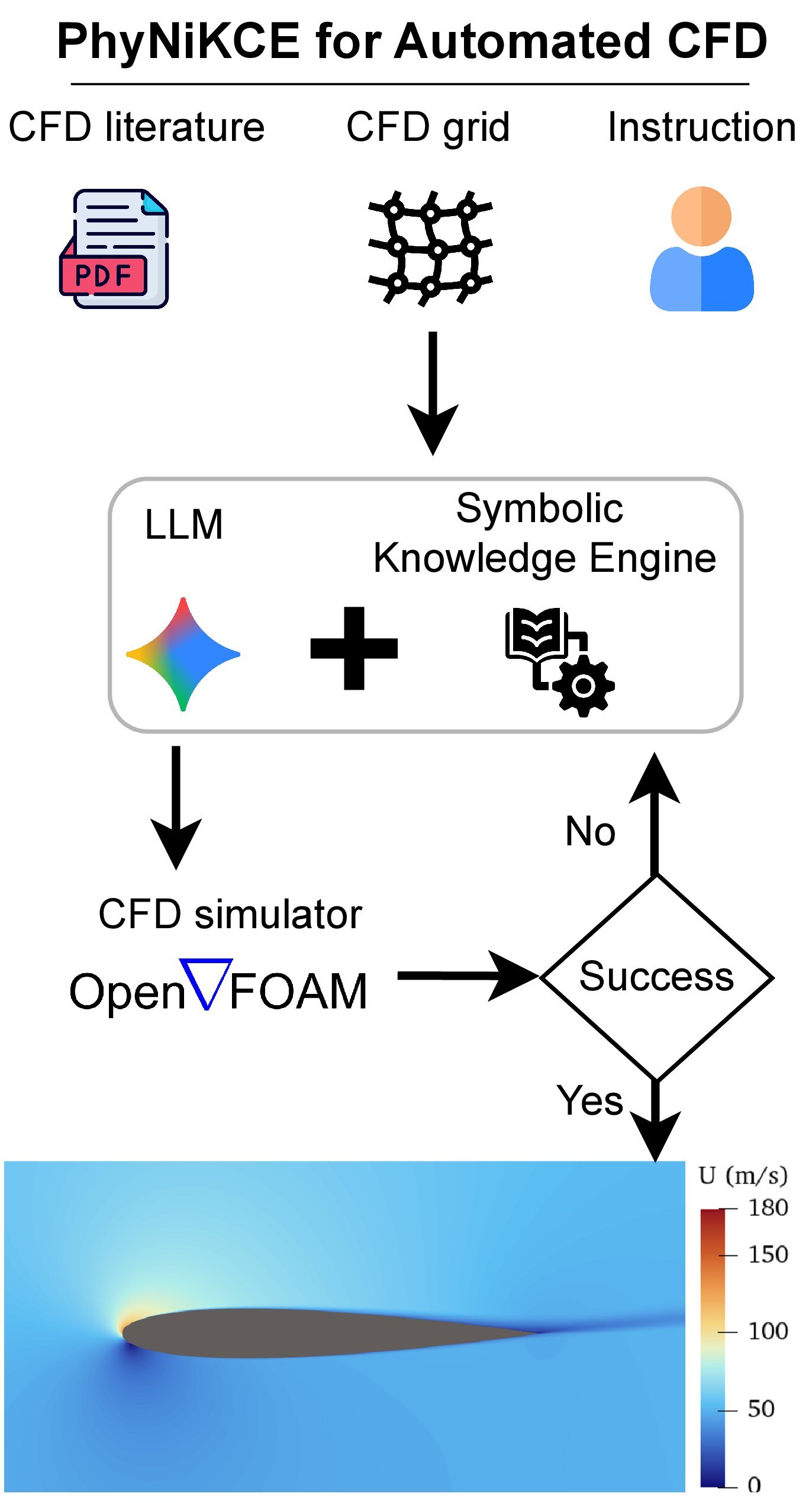
Researchers have developed a novel framework that combines neural reasoning with deterministic validation to create more accurate and reliable autonomous simulations of complex fluid flows.
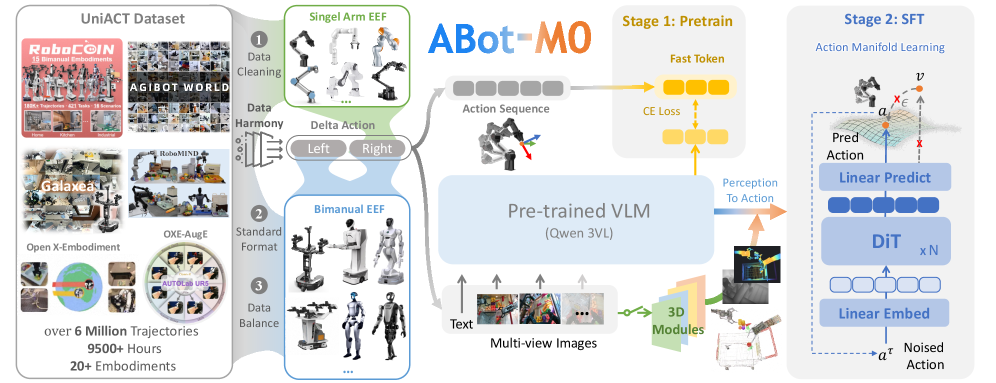
Researchers have unveiled ABot-M0, a framework that unifies diverse robotic datasets and employs a novel learning technique to enable more general and adaptable robotic manipulation skills.
A new generation of clinical decision support systems, powered by artificial intelligence, is showing promise in improving the accuracy and efficiency of diabetes care.
![This framework addresses distributional inconsistencies across a three-stage pipeline-expanding training coverage via heuristic DAgger and spatio-temporal augmentation in [latex]P_{\text{train}}[/latex], merging complementary policies in weight space with stage-aware advantage in [latex]Q_{\text{model}}[/latex], and ensuring execution accuracy with temporal chunk-wise smoothing and closed-loop refinement in [latex]P_{\text{test}}[/latex].](https://arxiv.org/html/2602.09021v1/x1.png)
A new framework tackles the challenges of transferring robot skills from simulation to the real world, boosting performance on complex tasks like garment manipulation.
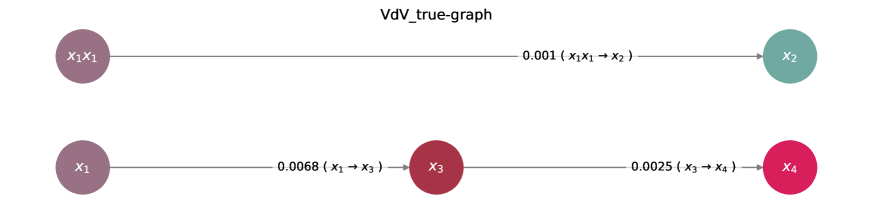
A new method efficiently reconstructs complex chemical reaction networks directly from experimental data, offering a powerful tool for systems biology.

New research demonstrates a framework for optimizing proactive agents to not only achieve goals but also minimize disruption and maximize user engagement.
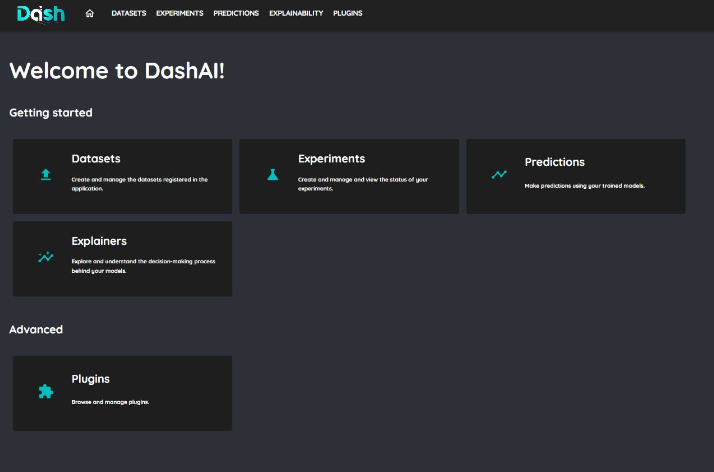
New research explores how to make the inner workings of machine learning models accessible to everyone, without requiring programming expertise.