Decoding the Digital Classroom: How Students Interact with AI Cybersecurity Tutors
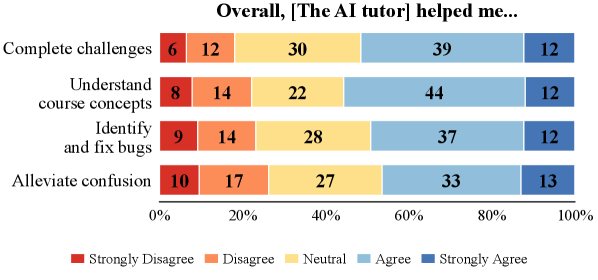
A new study examines real-world student interactions with AI-powered teaching assistants in a cybersecurity course, revealing key insights into learning patterns and tutor effectiveness.

![AgentConductor addresses complex code problems through a three-stage process: initial supervised fine-tuning [latex]SFT[/latex] on varied network topologies instills structural understanding in the base [latex]Qwen-2.5-Instruct-3B[/latex] language model, followed by reinforcement learning with [latex]GRPO[/latex] to create a task-specific orchestrator capable of adapting network difficulty, and culminating in dynamic, multi-turn topology generation for end-to-end problem solving.](https://arxiv.org/html/2602.17100v1/x3.png)
![The study demonstrates a consistent reduction in token usage-averaging 28,500 tokens per step-across ten agent iterations, initially achieving 95% savings which gradually decreased to 57% as contextual history accumulated, indicating a predictable relationship between information retention and computational cost represented by [latex] \Delta Tokens = f(History) [/latex].](https://arxiv.org/html/2602.17046v1/results/agent_loops_comprehensive.png)
![The analysis of an [latex]Al_{70}Co_{10}Fe_5Ni_{10}Cu_5[/latex] decagonal quasicrystalline alloy reveals a layer-dependent structure, where atomic composition, electronegativity, valence electron concentration, and coordination number vary systematically across six topologically defined layers, indicating a gradient in chemical and electronic properties throughout the nanoparticle.](https://arxiv.org/html/2602.17528v1/x1.png)