Testing the Limits of AI Scientists
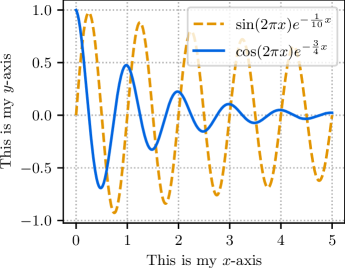
A new benchmark suite challenges artificial intelligence to perform core tasks within the scientific research process.
A new benchmark suite challenges artificial intelligence to perform core tasks within the scientific research process.
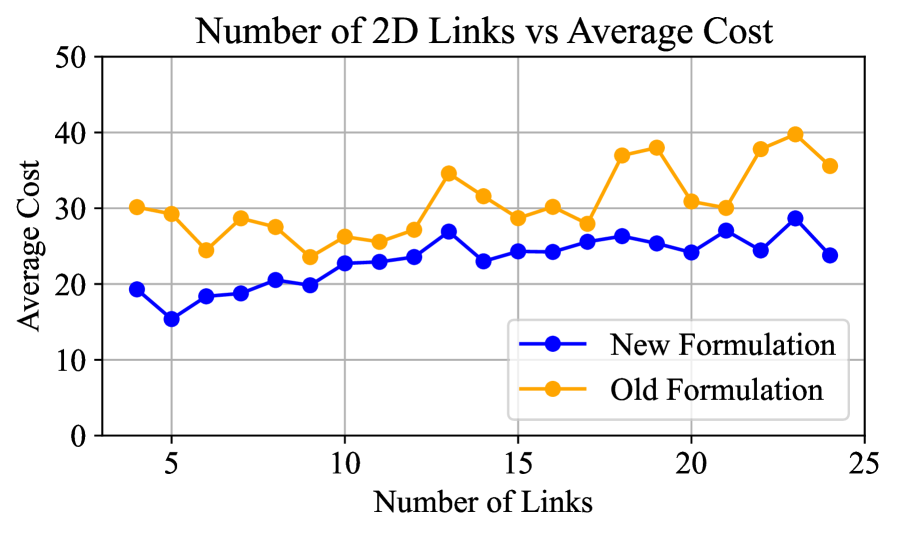
A new framework combines the strengths of both optimization-based and analytic inverse kinematics to achieve more efficient and robust robotic motion planning.
![The PVK-LLM framework advances scientific discovery through an iterative, closed-loop active learning process, leveraging a knowledge base constructed from scientific literature to refine a language model across three stages-domain knowledge acquisition ([latex]Stage \, I[/latex]), knowledge grounding with experimental data ([latex]Stage \, II[/latex]), and structured knowledge graph creation ([latex]Stage \, III[/latex])-thereby enabling autonomous design, verification, and optimization cycles within both simulated and laboratory environments, as demonstrated by a corpus of perovskite literature spanning from 2018 to 2025.](https://arxiv.org/html/2602.04914v1/x1.png)
A new approach combines the power of artificial intelligence with materials science to autonomously develop perovskite solar cell compositions, accelerating the pace of innovation in renewable energy.
![A particle navigating a non-smooth harmonic potential experiences a wave-memory force generated by its own motion, effectively creating a self-interaction alongside a drag force, where the wave’s spatial form is described by [latex]W(x)=\cos(x)[/latex] and decays exponentially over time.](https://arxiv.org/html/2602.05913v1/FIG1.png)
A new study reveals how walking droplets exhibit surprisingly rich and chaotic behavior when confined by textured surfaces and driven by internal wave effects.
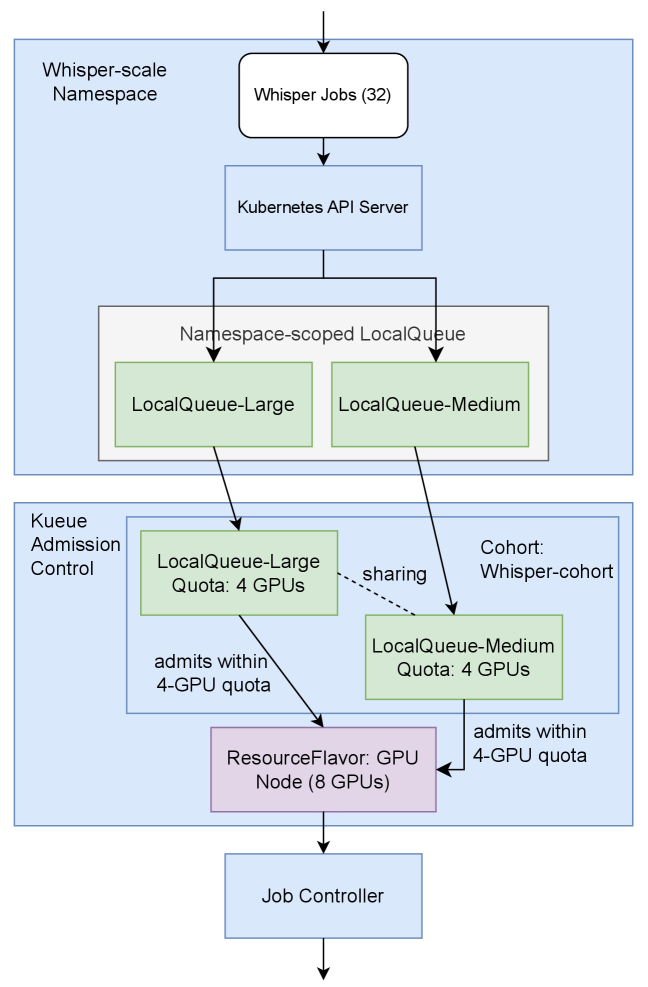
A new study details how Kubernetes, enhanced with open-source tools, can efficiently manage the demanding workloads of modern generative AI applications.
A new method allows AI agents to intelligently leverage past successes in novel situations by subtly adjusting their internal understanding of the world.
![A universal linear structure-property relationship (SPR) is established for predicting phonon-related properties of amorphous materials, where atomic configurations are encoded via a symmetry-invariant radial distribution function [latex]RDF_g(r)g(r)[/latex] and mapped to target observables-including phonon density of states, Raman, inelastic neutron scattering, and inelastic X-ray scattering spectra-through learnable weights and biases shared across diverse amorphous systems, encompassing monolayers, bulk glasses, and high-entropy alloys with varying degrees of structural disorder.](https://arxiv.org/html/2602.05313v1/x1.png)
New research reveals a surprisingly simple relationship between structure and vibrational properties in amorphous materials, challenging the need for complex modeling.
![The study establishes bounds for multi-robot dispersion, demonstrating that universal exploration sequences require memory [latex]M^*[/latex] dependent on the least inter-robot distance [latex]iiis[/latex], the number of nodes [latex]n~(k)[/latex], and maximum degree Δ, with performance varying based on prior knowledge of these parameters-or the lack thereof-and where computational complexity is expressed as time [latex]T[/latex] and memory [latex]M[/latex] with polylogarithmic factors suppressed by [latex]\tilde{O}[/latex].](https://arxiv.org/html/2602.05948v1/x9.png)
Researchers have formalized a more complex version of the classic ‘dispersion’ problem, requiring robots to navigate graphs and find nodes matching their assigned color, demonstrating increased difficulty over previous models.
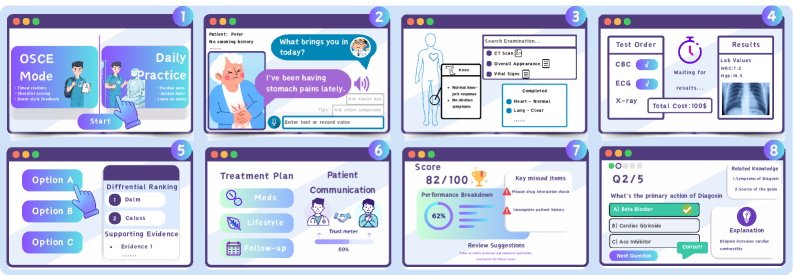
New research reveals that medical learners prioritize effective instruction and focused practice over realistic conversation when co-designing AI-powered standardized patients.
![The research visualizes common data corruptions inherent in multi-sensor perception systems, specifically demonstrating how noise affects both camera imagery and [latex] 360^\circ [/latex] LiDAR point clouds- modalities labeled as C and L respectively-as captured within the JRDB dataset.](https://arxiv.org/html/2602.05538v1/x7.png)
A new study rigorously compares how different sensor technologies – cameras, LiDAR, and their combinations – perform in detecting people across real-world indoor and outdoor environments.