
Bitcoin is navigating a unique and challenging economic landscape, different from anything it’s experienced in its 17-year history.
Bond returns, adjusted for inflation, are currently strong. The yield on 30-year Treasury Inflation-Protected Securities (TIPS) is nearing 3%, which is the highest it’s been in 17 years, as reported by TreasuryBonds.com.
According to the website, this is a rare chance to protect your money and potentially earn a solid return. Investors could receive almost 3% each year on top of the inflation rate for the next thirty years, with the U.S. government guaranteeing the investment.
Historically, bonds have been seen as reliable investments during uncertain times. When these ‘safe haven’ assets offer a good return—like 3% more than the rate of inflation—it makes holding things that don’t pay out or are riskier, such as gold and Bitcoin, less appealing. However, many people, particularly in the crypto world, believe Bitcoin is actually *better* at preserving value and acting as a safe haven because it’s decentralized and can’t be easily controlled. There’s definitely some logic to this idea; for example, houses seem much more affordable when priced in Bitcoin compared to US dollars.
It’s unclear if rising yields on Treasury Inflation-Protected Securities (TIPS) will negatively impact Bitcoin. So far, it hasn’t – new Bitcoin ETFs have attracted almost $1 billion in just seven days, indicating renewed institutional investment. However, if changes in the bond market cause investors to shift away from tech stocks, that volatility could spread to the crypto market.
Another important event today is BitMEX shutting down its business. This move by one of the first cryptocurrency exchanges to offer perpetual futures suggests that the market for crypto derivatives is becoming more concentrated, with pioneering companies finding it harder to compete against bigger and more established platforms.
The trend also shows a growing focus on following regulations and becoming more established businesses. Older cryptocurrency exchanges will either need to grow significantly or risk being forced out of the market, because perpetual futures trading is quickly turning into a high-volume, standardized business dominated by just a few major players.
Stay alert!
Today’s signal
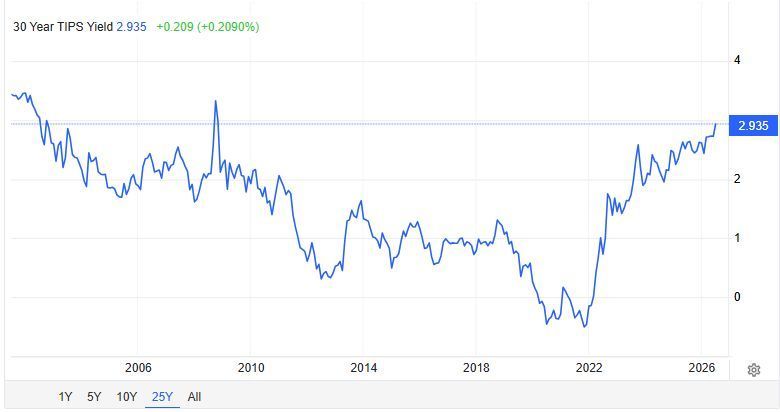
This graph displays the returns on U.S. Treasury Inflation-Protected Securities (TIPS) with a 30-year term, starting from 2005.
The rate has climbed to almost 3%, the highest it’s been in 17 years. This means investors can buy these bonds and earn a return of 3% *above* the rate of inflation.
This elevated real yield is often seen as a headwind for risk assets.
2026-07-23 14:50