The digital asset space has shuffled its chairs in 2026. The wild west of memecoin mayhem is trading up for a boardroom, expensive coffee, and real grown-up infrastructure.
We’re watching a migration so obvious you could trip over it: crypto’s innovations are skulking from hype headlines into the backrooms of the world’s biggest asset managers, banks, and payment networks.
As the border between TradFi and crypto effectively vanishes, the market requires something more effective than a “popularity contest” to identify its true leaders. It requires a data-backed standard of excellence.
Enter the BeInCrypto Institutional 100 Awards.
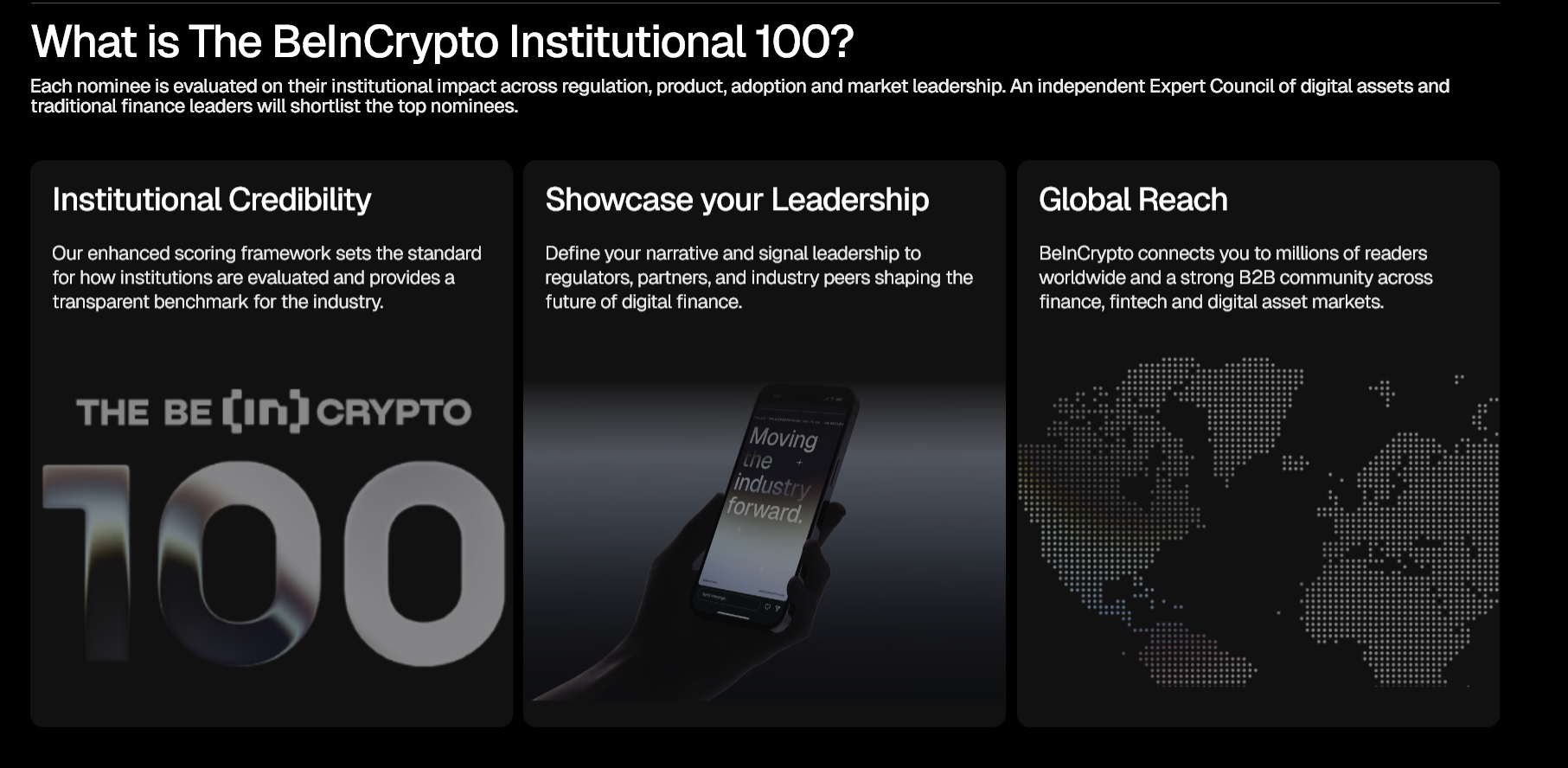
We’re frankly thrilled to unleash the BeInCrypto 100 Institutional Awards. The awards spotlight the companies at the intersection between digital assets and TradFi.
Nominees will be evaluated by a panel of judges drawn from BeInCrypto’s council of industry experts.
Start…
– BeInCrypto (@beincrypto) March 23, 2026
Unlike traditional industry awards that often rely on subjective “vibes” or paid placements, BeInCrypto has unveiled a data-backed framework designed to measure excellence across the entire institutional value chain.
Whether the category is high-speed trading infrastructure, the tokenization of real-world assets, or large-scale enterprise rollouts, the 2026 evaluation process is anchored by one “gold standard” rule: Show us the receipts.
In crypto, we know that marketing often outpaces reality. So, how do you solve this? Every point a nominee earns must be backed by an auditable data source. If you can’t trace it to a specific metric, a regulatory filing, or a verified on-chain event, it doesn’t count.
BeInCrypto has built a “firewall” around its rankings. No entity can purchase, negotiate, or lobby for a spot on this list. Unlike traditional awards, where a small committee might pick winners based on personal connections or brand recognition, our process is entirely transparent and traceable.
To ensure total fairness, we use a two-stage evaluation designed to eliminate “anchoring bias,” that common human tendency to automatically favour “big names” over better-performing newcomers. Here is how the process works:
- Stage 1: The Data Filter
We start by looking at the numbers. This stage is purely mathematical, using hard metrics to filter dozens of candidates down to the top contenders. If the data doesn’t back up the hype, the nominee doesn’t move forward.
- Stage 2: The Expert Council
The top candidates are then reviewed by a panel of industry veterans. Their job isn’t to pick favorites, but to interpret the data profiles through the lens of real-world experience, strategic execution, and leadership.
- The Result
This creates a ranking where a disruptive, high-growth “underdog” can actually unseat a legacy giant, provided the data proves they are doing a better job.

A Methodology Built for Reality
Institutional finance is built on privacy and proprietary strategy. Many firms treat their specific user numbers and revenue splits as confidential, which often leaves researchers with a “data gap.”
BeInCrypto uses a specialized toolkit of Derived Estimation Methods to ensure these firms are still measured accurately.
Reverse-Engineering Impact
If a firm doesn’t disclose specific user counts, our analysts work backward. Using Revenue-Ratio Inference, we take reported segment earnings and apply industry benchmarks to find a realistic activity level.
The “Reciprocity” Test
We verify partnership claims by checking the other side of the deal. Through Partnership Reciprocity Testing, we search the communications of a nominee’s partners. A partnership that is actively acknowledged by both parties carries significantly more weight than a one-sided claim.
Regional Modeling
By combining a company’s total footprint with local crypto adoption data from sources like Chainalysis, we build an accurate map of their actual influence in specific global markets.
The Three-Track Architecture
You wouldn’t use a ruler to measure the temperature, and you shouldn’t use the same criteria to measure a Bitcoin ETF as you would a New York Law Firm. To keep things fair, the 2026 methodology splits all 25 award categories into three specialized “tracks” based on what kind of data is available.
Track A: The Data-First Track
- Best for: High-transparency products like ETFs, On-Chain Protocols, and Asset Managers.
- How it works: In this track, the numbers do 50% of the talking. Because we can see exactly how much money is moving on the blockchain or in a fund, the data carries equal weight with our experts.
- Example: When evaluating “Best Digital Asset Product,” we look at $AUM$ (Assets Under Management) and daily inflows. If a new Bitcoin ETF is growing at 300% month-over-month, the data automatically pushes it to the top of the pile.
Track B: The Hybrid Track
- Best for: Consumer-facing companies like Neobanks, Crypto Brokers, and Onramps.
- How it works: These companies often have “hidden” data, like how many monthly active users they actually have. This track rewards transparency. We give a 20% “bonus” weight to firms that voluntarily share their internal metrics with our researchers.
- Example: If two Digital Banks have similar public reputations, but Bank A provides verified data on their institutional client growth while Bank B stays silent, Bank A earns a higher “Transparency Score,” giving them the competitive edge.
Track C: The Expert-Led Track
- Best for: Complex areas like Governance, Regulatory Compliance, and Policy Leadership.
- How it works: You can’t measure “good leadership” with a spreadsheet alone. In this track, our Expert Council, veterans from traditional finance and legal sectors, provides 80% of the score. However, we still include a 20% “sanity check” based on measurable signals.
- Example: For “Best Compliance Program,” the Council looks at the quality of a firm’s legal framework. But we anchor that opinion with data, such as: How many licenses do they actually hold? or What is the ratio of compliance staff to total employees? This ensures even “expert opinions” are rooted in reality.
Negative Signals
Innovation shouldn’t come at the cost of integrity. Every nominee faces a mandatory Negative Signal Scan.
This isn’t just a Google search. Our team scours SEC and VARA enforcement databases, Immunefi bug bounty records, and the DefiLlama Hacks database.
An unresolved security breach or a major regulatory fine isn’t just a “red flag,” it’s often a disqualifier. By baking risk assessment into the core score, BeInCrypto ensures that the “Institutional 100” represents the most stable and reliable actors in the space.
Looking Ahead to June 2026
The BeInCrypto Institutional 100 is about setting a real-world benchmark for an industry that has finally found its footing.
By opening up our playbook and publishing this methodology in full, we’re doing more than just handing out awards; we’re inviting the entire market to hold us and the winners to a much higher standard.
When the winners are revealed this June, you’ll know exactly how they got there. In a market still crowded with noise, we’re placing our bets on the data.
Read More
- ‘Project Hail Mary’s Unexpected Post-Credits Scene Is Worth Sticking Around
- Beyond Accuracy: Gauging Trust in Human-AI Teams
- How Martin Clunes has been supported by TV power player wife Philippa Braithwaite and their anti-nepo baby daughter after escaping a ‘rotten marriage’
- Clash Royale Balance Changes March 2026 — All Buffs, Nerfs & Reworks
- Gold Rate Forecast
- CookieRun: OvenSmash coupon codes and how to use them (March 2026)
- The most surprising Hannah Montana cameos: From John Cena to Dwayne Johnson and even a Coronation Street soap star as show celebrates its 20th anniversary
- eFootball 2026 is bringing the v5.3.1 update: What to expect and what’s coming
- Total Football free codes and how to redeem them (March 2026)
- Genshin Impact Version 6.5 Leaks: List of Upcoming banners, Maps, Endgame updates and more
2026-04-01 19:42