Author: Denis Avetisyan
Researchers have developed a new AI system that combines spectroscopic data with scientific literature to answer complex questions about battery materials.
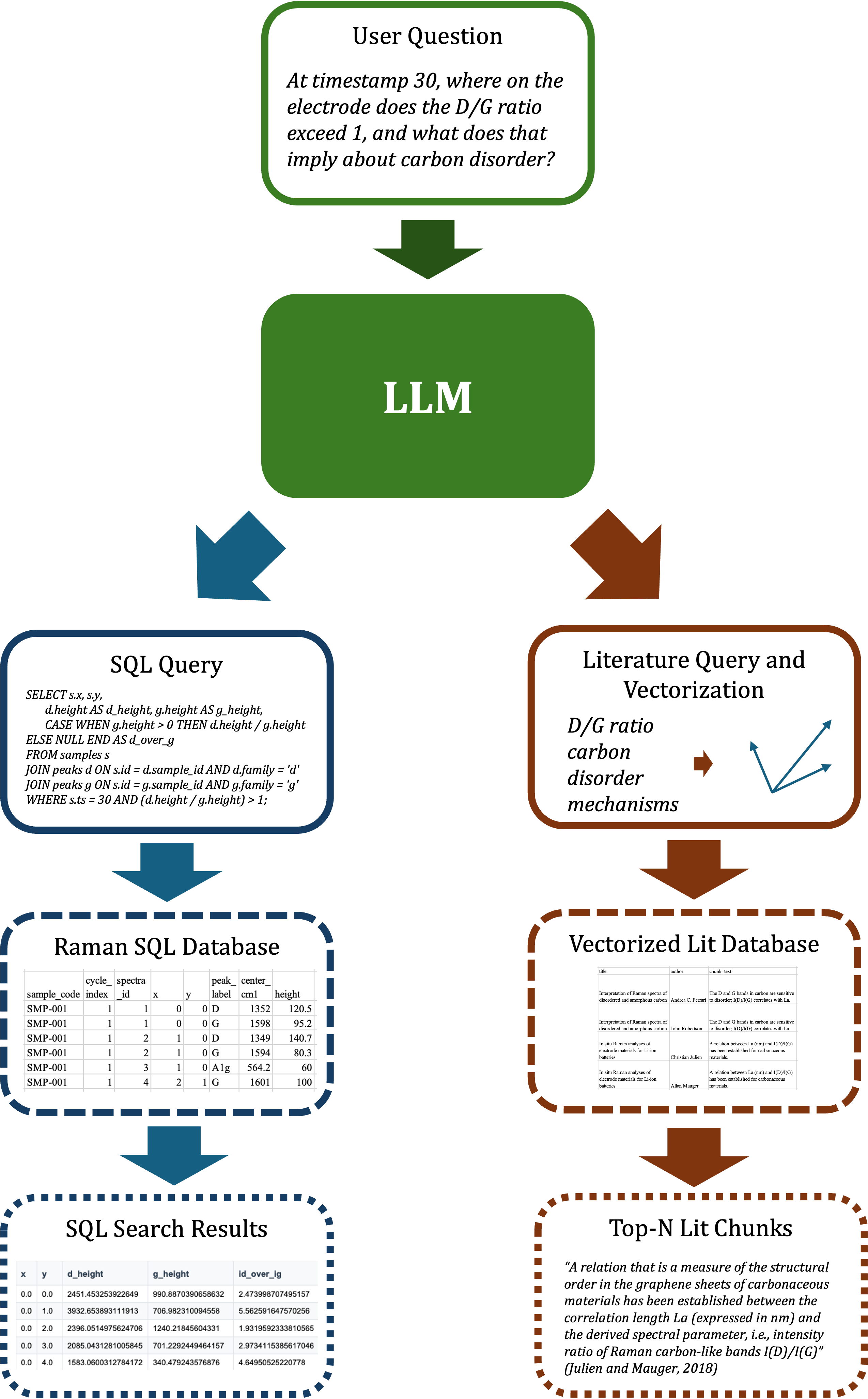
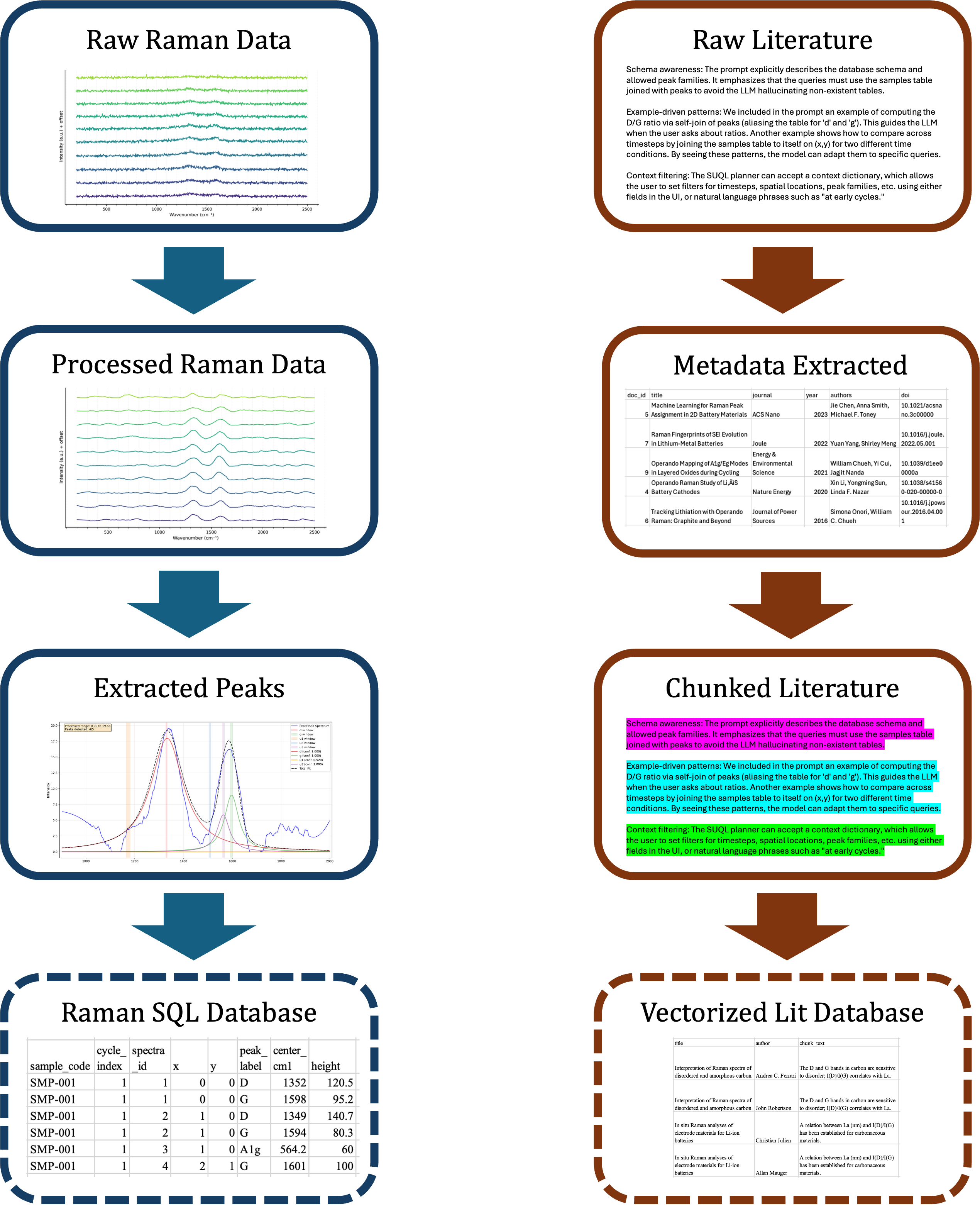
SpectraQuery leverages hybrid retrieval-augmented generation to integrate structured Raman spectroscopy data with unstructured text, creating a powerful conversational assistant for battery science.
Linking experimental data with supporting literature is crucial for scientific reasoning, yet current large language models struggle to integrate these distinct modalities. To address this, we introduce SpectraQuery: A Hybrid Retrieval-Augmented Conversational Assistant for Battery Science, a framework that combines a relational Raman spectroscopy database with a vector-indexed corpus of scientific literature. This hybrid approach-utilizing semantic parsing and retrieval-augmented generation-enables SpectraQuery to translate open-ended questions into coordinated data and literature queries, producing cited answers grounded in both numerical evidence and mechanistic explanation. Could such hybrid architectures redefine scientific workflows by seamlessly bridging data and discourse for complex experimental datasets?
The Challenge of Unveiling Battery Dynamics
Optimizing battery performance hinges on a thorough understanding of the materials within, yet conventional characterization techniques often present significant limitations. Traditional methods, such as post-mortem analysis and lengthy electrochemical testing, are frequently destructive, providing only snapshots of a battery’s state and failing to capture the dynamic processes occurring during operation. This creates a bottleneck in materials discovery and optimization, as researchers struggle to correlate material properties with real-time battery behavior. The inability to observe changes in situ – while the battery is charging and discharging – hinders efforts to pinpoint degradation mechanisms and improve longevity. Consequently, advancements in battery technology are increasingly reliant on developing faster, non-destructive characterization methods capable of providing continuous, insightful data streams.
Modern battery characterization, particularly through techniques like Raman Spectroscopy, generates data at an astonishing rate – often exceeding terabytes per experiment. While this wealth of information holds the key to unlocking improved battery performance and longevity, simply having the data isn’t enough. The sheer volume presents a significant analytical hurdle; identifying subtle spectral shifts indicative of chemical changes, degradation processes, or material interactions requires sophisticated algorithms and substantial computational resources. Extracting meaningful insights from this ‘data deluge’ necessitates not only advanced signal processing but also innovative approaches to data visualization and machine learning, enabling researchers to pinpoint critical patterns and correlations that would otherwise remain hidden within the noise.
Effective battery design hinges on comprehending the complex interactions between its constituent parts, particularly the cathode material and the electrolyte-a relationship that extends beyond simple material properties. Researchers are increasingly focused on integrating experimental datasets with the wealth of knowledge contained within scientific literature to achieve this understanding. By computationally linking spectroscopic data, for example, to published studies on material degradation pathways or electrochemical reactions, it becomes possible to identify correlations and mechanisms that would otherwise remain hidden. This approach allows for a more nuanced interpretation of experimental results, enabling the prediction of battery performance under various conditions and ultimately accelerating the development of more efficient and durable energy storage solutions. The ability to synthesize information from diverse sources is proving vital in moving beyond empirical observation toward a predictive, knowledge-driven paradigm in battery research.
SpectraQuery: An Intelligent Lens for Battery Data
SpectraQuery employs a hybrid approach to information access, integrating data retrieval techniques with the capabilities of generative language models to facilitate querying within the domain of battery science. This architecture allows the system to not only generate human-readable responses, but also to ground those responses in factual data. Specifically, SpectraQuery retrieves relevant data points from its knowledge base and then utilizes a generative model to formulate a comprehensive answer, combining the strengths of both approaches to overcome the limitations of relying solely on either data retrieval or generative models independently. This hybrid design is crucial for addressing the complex and nuanced questions common in materials science research.
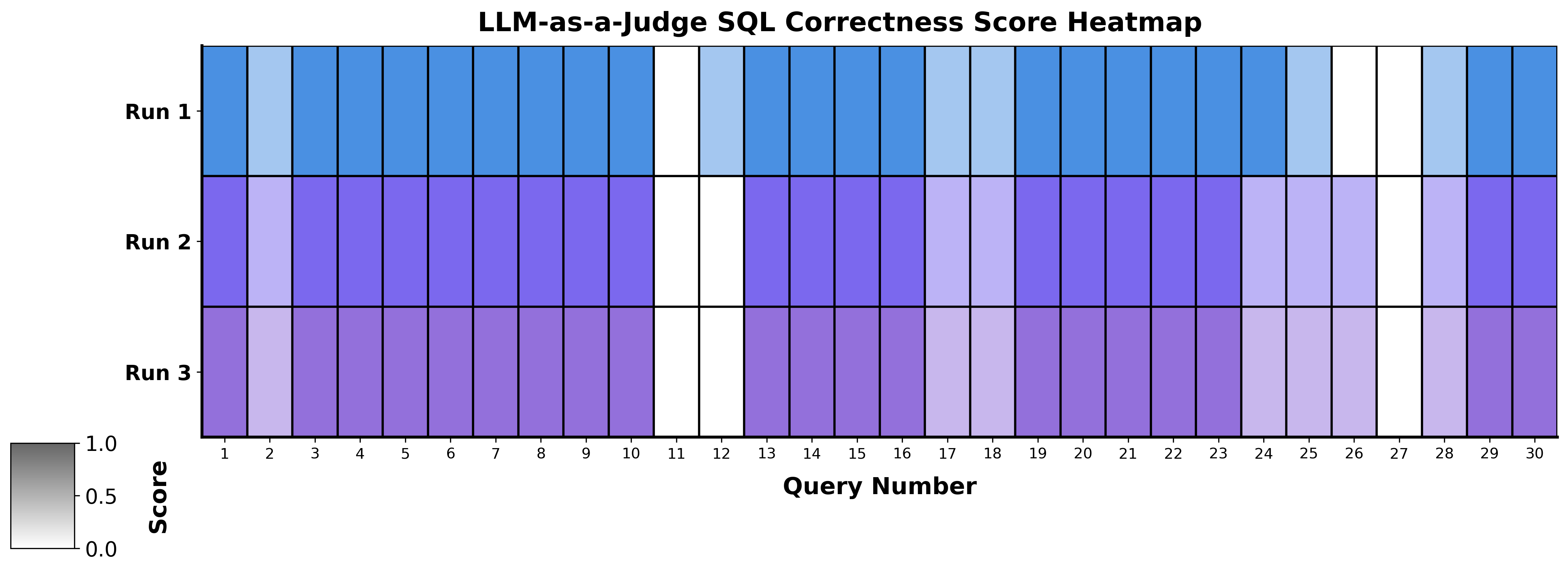
SpectraQuery’s core functionality relies on Retrieval Augmented Generation (RAG) to enhance response accuracy and contextual relevance. This approach combines information retrieval with a generative language model, allowing the system to ground its responses in a specific knowledge base. Evaluation, conducted using an LLM-as-a-judge methodology, demonstrates an 80% correctness rate for SQL queries generated by the system. This metric indicates the system’s ability to accurately translate natural language queries into structured database requests, facilitating precise data retrieval from the underlying Raman spectra database.
SpectraQuery employs the SUQL Planner to convert user-submitted natural language questions into executable Structured Query Language (SQL) statements. This translation process facilitates data retrieval from a dedicated database containing Raman spectra and associated metadata. The SUQL Planner is designed to interpret the semantic intent of the query and map it to the specific schema of the database, enabling precise and targeted searches for spectral information. The resulting SQL queries are then executed against the database, and the retrieved data informs the system’s response generation.
Validating Insights with Automated Assessment
SpectraQuery utilizes an ‘LLM-as-a-Judge’ component to automate the evaluation of generated responses, assessing both correctness and coherence without requiring human intervention. This automated assessment process involves prompting a large language model (LLM) to analyze the generated answer in relation to the original query and the supporting evidence retrieved from the knowledge source. The LLM then assigns scores or labels indicating the quality of the response, providing a quantitative measure of its accuracy and logical flow. This allows for continuous monitoring and improvement of the system’s response generation capabilities, facilitating iterative refinement based on the LLM’s evaluations.
The LLM-as-a-Judge component within SpectraQuery operates as an iterative refinement mechanism. By evaluating generated responses, the system identifies areas where query interpretation or information synthesis requires improvement. This evaluation isn’t merely a pass/fail assessment; it provides granular feedback that is then used to adjust the model’s parameters and retrieval strategies. Consequently, subsequent responses to similar complex queries demonstrate increased accuracy and coherence, evidenced by improvements in groundedness scores – rising from 60% with top-5 passages to 93.3% utilizing the top-10 – and consistently high expert evaluations averaging 4.0+ on a 5-point scale for both scientific validity and practical usefulness.
Evaluation of the SpectraQuery system demonstrates a groundedness score of 93.3% when responses are generated utilizing the top-10 retrieved passages as context. This represents a substantial improvement over performance achieved with only the top-5 retrieved passages, which yielded a groundedness score of 60%. Further validation through expert review resulted in average ratings exceeding 4.0 on a 5-point Likert scale, assessing both the scientific accuracy and overall usefulness of the generated responses.
Decoding Battery Behavior: A New Era of Observation
Researchers are gaining unprecedented insight into the dynamic processes within batteries by integrating SpectraQuery with operando Raman spectroscopy. This powerful combination enables real-time observation of material changes as the battery charges and discharges, moving beyond static post-mortem analysis. By tracking the vibrational signatures of battery components, scientists can now pinpoint the onset of degradation, identify evolving chemical species, and understand the complex interplay of materials at the nanoscale during operation. This capability is crucial for accelerating the development of more stable, efficient, and long-lasting battery technologies, offering a pathway to optimize performance and extend lifespan through informed material design and operational strategies.
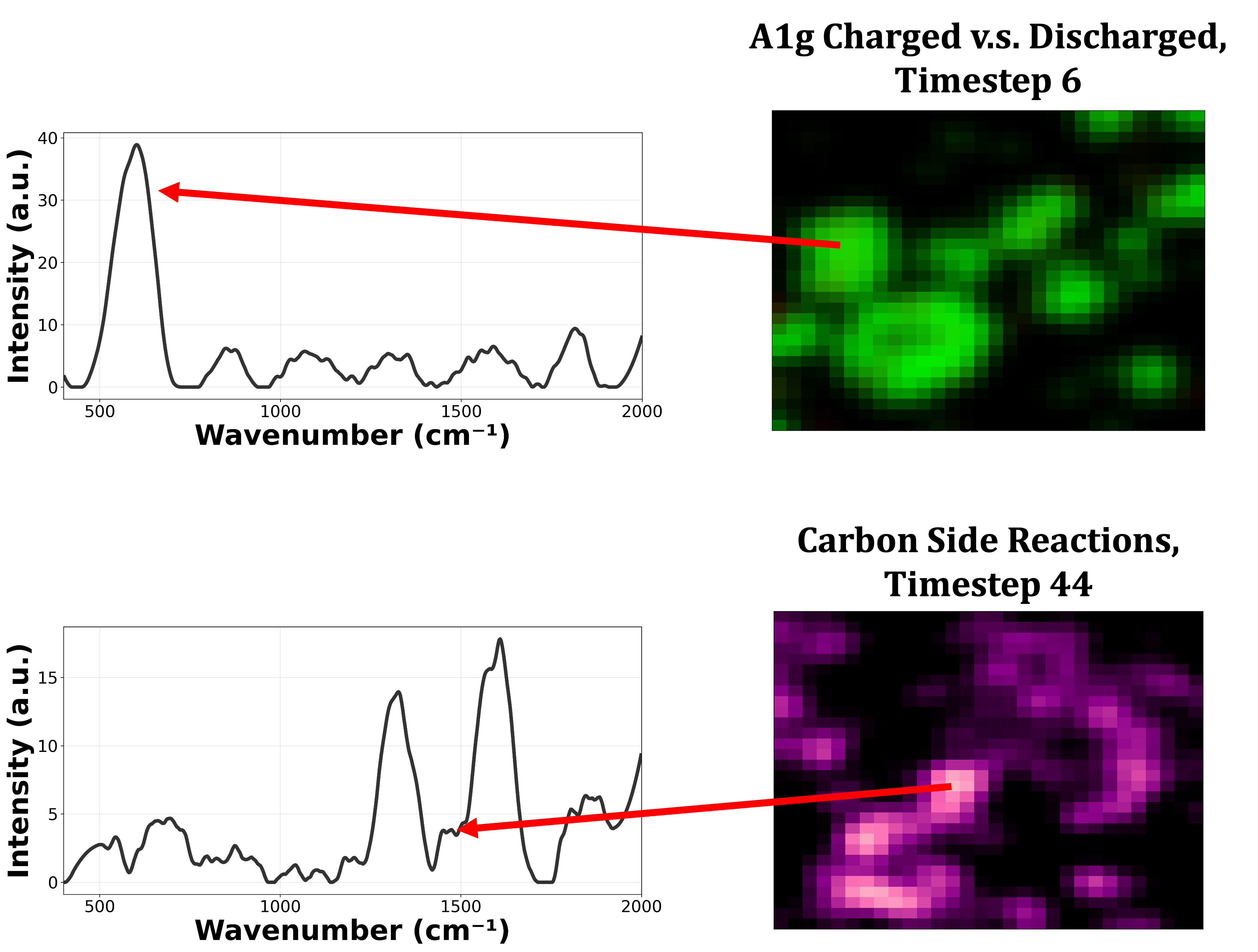
Operando Raman spectroscopy allows researchers to pinpoint subtle shifts in battery materials as they charge and discharge, and analyzing specific Raman spectral features is key to understanding what is happening at a molecular level. The intensity and position of the A1g mode, for example, reveals information about the layer stacking and overall structure of battery components like graphite, while the ratio of the D band to the G band – often denoted as the D/G ratio – acts as a sensitive indicator of defects and disorder within the material. An increasing D/G ratio typically signifies growing structural damage, such as the formation of defects or the breakdown of the material’s crystalline structure, directly correlating to performance degradation. By tracking these features in real-time, scientists can not only observe the progression of these changes but also link them to specific operating conditions, ultimately paving the way for the design of more durable and efficient batteries.
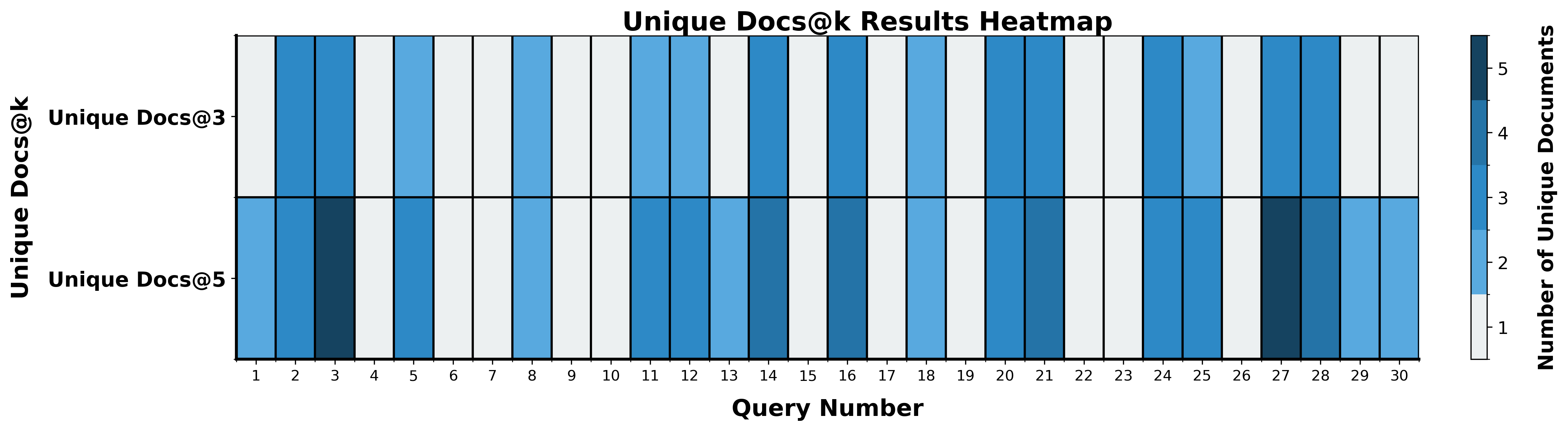
Evaluations reveal the system achieves a Precision@k score of 0.56 to 0.58 when tested against established benchmark queries, indicating a robust ability to retrieve relevant information regarding battery behavior. However, a UniqueDocs@k value of 1.8 suggests that the retrieved documents, while pertinent, exhibit limited diversity; the system tends to favor a relatively narrow range of sources. This highlights the need for further refinement, potentially through strategies that encourage exploration of a wider spectrum of research and data to provide a more comprehensive understanding of the complex processes occurring within operating batteries.
SpectraQuery embodies a principle of elegant reduction, mirroring the pursuit of clarity over complexity. The system deftly navigates both structured Raman spectroscopy data and unstructured scientific literature, a feat achieved not through sheer volume, but through focused retrieval and generation. As Brian Kernighan aptly stated, “Debugging is twice as hard as writing the code in the first place. Therefore, if you write the code as cleverly as possible, you are, by definition, not smart enough to debug it.” This resonates with SpectraQuery’s design; the system prioritizes a functional, insightful response-a lossless compression of information-over elaborate architectural flourishes. The hybrid approach allows for efficient knowledge distillation, effectively ‘hiding deletions’ of irrelevant data to present a concise and actionable response for battery researchers.
What Remains?
The current iteration of SpectraQuery addresses a demonstrable need: the efficient intersection of structured spectroscopic data with the diffuse landscape of scientific literature. However, to suggest this constitutes a solution is premature. The system, while functional, remains tethered to the quality of its ingested data. Noise in the spectra, ambiguities in the literature – these are not errors to be corrected, but fundamental properties of the systems under investigation. Future work must grapple not with eliminating uncertainty, but with representing and propagating it.
A pertinent limitation lies in the inherent constraints of language models. They excel at pattern recognition, but lack true causal understanding. SpectraQuery can associate spectroscopic features with battery performance metrics, but it cannot explain the underlying electrochemical processes. The pursuit of “explainable AI” in this context risks merely substituting one form of opacity for another. A more fruitful avenue lies in accepting the limits of explanation and focusing on predictive accuracy, rigorously quantified and validated against experimental results.
Ultimately, the true test of such a system will not be its ability to answer existing questions, but to formulate better questions. The unnecessary is violence against attention; therefore, future development should prioritize the system’s capacity for autonomous hypothesis generation, guided not by pre-defined knowledge, but by the inherent structure of the data itself. Density of meaning is the new minimalism, and the path forward lies in relentless reduction to essential, testable predictions.
Original article: https://arxiv.org/pdf/2601.09036.pdf
Contact the author: https://www.linkedin.com/in/avetisyan/
See also:
- Clash Royale Best Boss Bandit Champion decks
- Vampire’s Fall 2 redeem codes and how to use them (June 2025)
- World Eternal Online promo codes and how to use them (September 2025)
- How to find the Roaming Oak Tree in Heartopia
- Mobile Legends January 2026 Leaks: Upcoming new skins, heroes, events and more
- Best Arena 9 Decks in Clast Royale
- ATHENA: Blood Twins Hero Tier List
- Brawl Stars December 2025 Brawl Talk: Two New Brawlers, Buffie, Vault, New Skins, Game Modes, and more
- Clash Royale Furnace Evolution best decks guide
- What If Spider-Man Was a Pirate?
2026-01-16 04:16